
The Reason This “Traditional” Level Instrument Has Not Been Replaced
In modern process industries, radar level transmitters are often considered one of the most advanced technologies for liquid level measurement. With advantages such as non-contact measurement, high accuracy, and low maintenance requirements, radar technology has become widely used in industries including oil & gas, chemical processing, power generation, and water treatment.
However, one question is often asked:
If radar level transmitters are so advanced, why are magnetic level gauges still widely installed in industrial plants around the world?
The answer is simple:
A magnetic level gauge is not outdated technology. Instead, it provides a unique combination of mechanical reliability, direct visual indication, and safety advantages that electronic instruments cannot completely replace.
In many critical applications, radar and magnetic level gauges are not competitors. They work together as complementary measurement solutions.
1. The Unmatched Advantage of Direct Local Level Indication
Radar level transmitters rely on electronic measurement technology. They require power supply, signal processing, and communication systems to provide measurement data.
Under normal operating conditions, radar instruments provide excellent performance. However, industrial plants must also consider abnormal situations:
- Power failure
- Communication interruption
- Electronic system malfunction
- Signal instability caused by harsh process conditions
In these situations, operators may temporarily lose access to electronic level information.
A magnetic level gauge works differently.
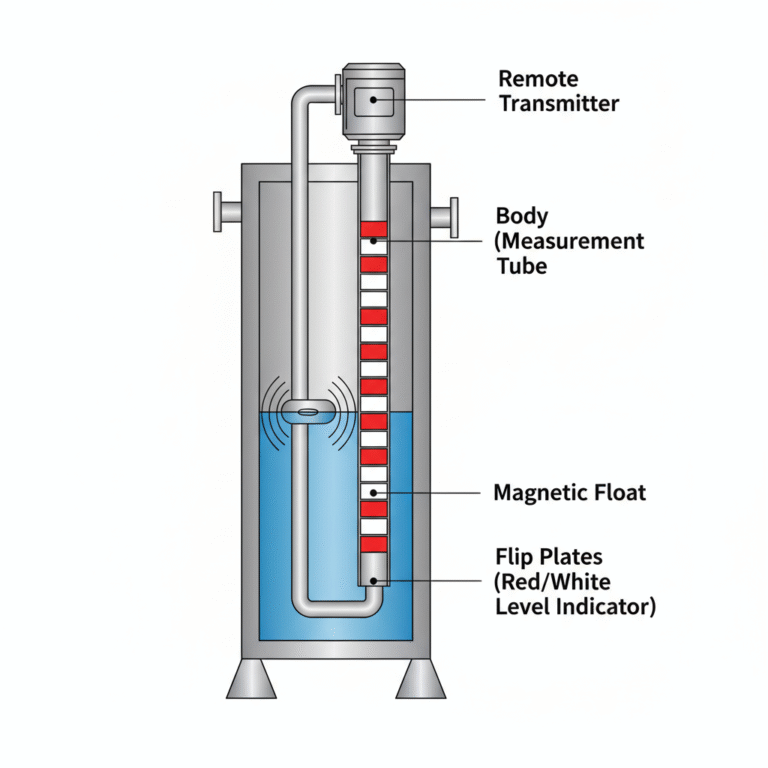
Based on the principle of buoyancy and magnetic coupling, a float inside the measuring chamber follows the liquid level movement. The magnetic system drives external indicator flags, allowing operators to directly observe the liquid level.
No external power supply is required.
No electronic signal processing is needed.
The level indication remains visible even during power outages or system failures.
This “always available” mechanical indication makes magnetic level gauges especially valuable for:
- Chemical storage tanks
- Oil and gas facilities
- Hazardous media applications
- Safety-critical vessels
For many operators, the red and white indicator on a magnetic level gauge provides an immediate and reliable confirmation of actual liquid level.
2. Remote Transmission: Turning Magnetic Level Gauges into Smart Instruments
A common misunderstanding is that magnetic level gauges are only suitable for local indication and cannot achieve modern automation requirements.
This is not correct.
With different remote transmission technologies, magnetic level gauges can be integrated into modern control systems such as DCS and PLC platforms.
Common remote options include:
2.1 Reed Switch Level Transmitter – Simple and Reliable Point Detection
A reed switch system uses magnetic switches installed along the measuring chamber.
When the float reaches a specific position, the corresponding switch is activated.
Features:
- Simple structure
- No external power required for switching output
- High reliability
- Suitable for high and low level alarms
Typical applications:
- Pump protection
- Overflow alarms
- Process interlocks
2.2 Differential Pressure Transmitter – Traditional Continuous Measurement
A differential pressure transmitter can also be used for level measurement by measuring the hydrostatic pressure generated by the liquid column.
Advantages:
- Mature technology
- Good accuracy under stable conditions
- Widely used in industrial processes
However, measurement accuracy depends on liquid density.
Changes in:
- Temperature
- Composition
- Fluid characteristics
may affect measurement results.
2.3 Magnetostrictive Level Transmitter – High Accuracy Continuous Measurement
Magnetostrictive technology is one of the most advanced solutions for magnetic level gauges.
It determines float position by measuring the propagation time of a pulse along a sensing wire.
Advantages include:
- High measurement accuracy
- Continuous 4–20 mA output
- HART communication option
- Excellent repeatability
With a magnetostrictive transmitter, a magnetic level gauge can provide measurement performance comparable to many electronic level instruments while maintaining its mechanical reliability.

3. Reliability and Cost Advantages in Harsh Applications
Radar level transmitters are powerful instruments, but certain process conditions can create measurement challenges.
Examples include:
Foam and Vapor
Heavy foam or strong vapor generation may reduce radar signal quality in some applications.
Low Dielectric Media
Liquids with low dielectric constants may produce weaker radar reflections.
Internal Tank Structures
Agitators, nozzles, and obstacles inside tanks may influence radar signal paths.
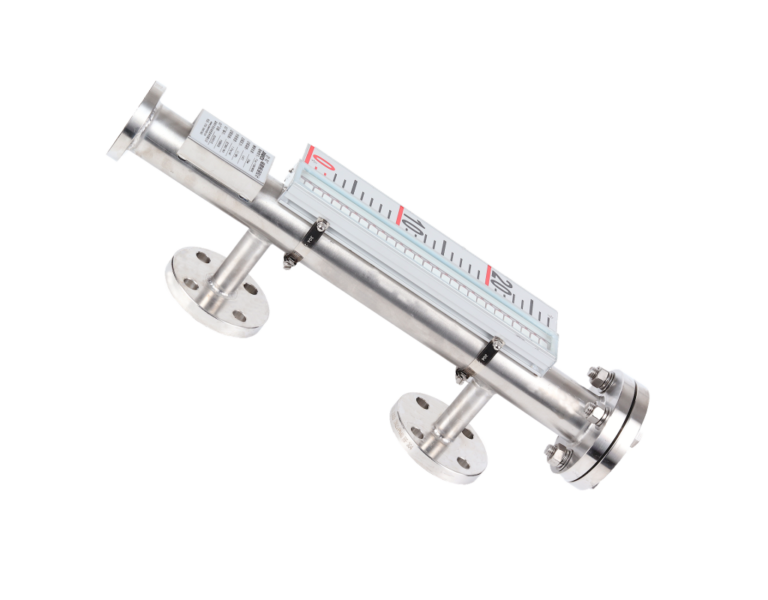
A magnetic level gauge uses a bypass chamber design. The float moves inside a controlled measuring tube and is less affected by:
- Turbulence
- Foam
- Vapor
- Internal tank movement
For high-temperature and high-pressure applications, magnetic level gauges remain a reliable choice.
Another important factor is cost.
For many storage tanks and process vessels, a magnetic level gauge can provide a cost-effective solution while still meeting industrial reliability requirements.
4. The Future Is Not Replacement — It Is Combination
The reason magnetic level gauges have survived the development of radar technology is that they solve a different problem.
Radar level transmitters provide:
- Smart measurement
- Remote monitoring
- Digital communication
- Continuous process control
Magnetic level gauges provide:
- Direct visual confirmation
- Mechanical reliability
- Independent backup indication
- Excellent safety performance
In many modern plants, the ideal configuration is:
Radar Level Transmitter + Magnetic Level Gauge
The radar transmitter provides continuous measurement to the DCS system.
The magnetic level gauge provides local visual verification and an independent backup source.
This combination creates a higher level of operational safety.
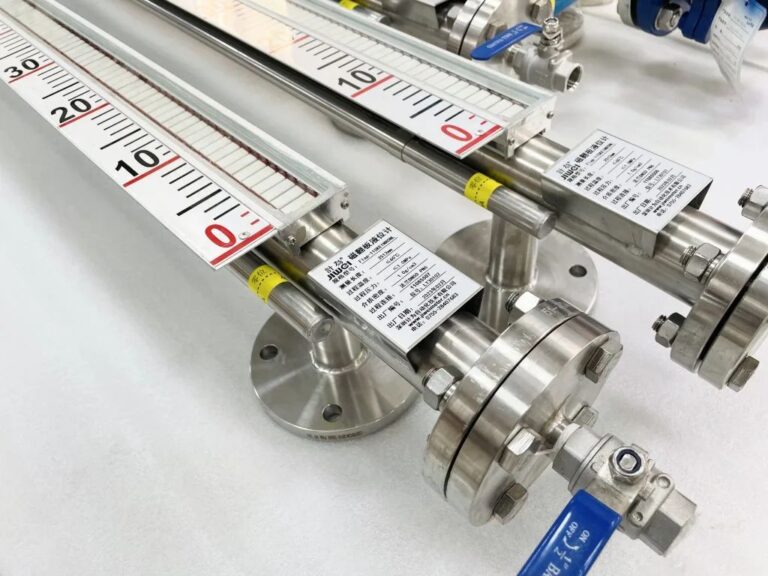
When electronic measurement becomes uncertain, operators can immediately check the actual liquid level through the magnetic indicator.
Conclusion: Traditional Design, Modern Value
Magnetic level gauges have not disappeared because they continue to provide advantages that electronic instruments cannot fully replace.
Their strength comes from:
- Simple mechanical design
- No-power visual indication
- Excellent reliability
- Flexible remote transmission options
Radar level transmitters are the “smart eyes” of modern plants.
Magnetic level gauges are the “reliable backup” that operators can always trust.
In industrial level measurement, the best solution is often not choosing one technology over another — but combining both technologies to achieve accuracy, safety, and reliability.