
Introduction
Many engineers know that a Venturi flow meter works by measuring the differential pressure generated between the inlet section and the throat section. However, when it comes to special applications — such as high-pressure oxygen, dirty gas, slurry, black water, or systems with limited installation space — one important design question often appears:
Should the Venturi tube use a pressure averaging ring?
The answer depends on the application conditions.
A pressure averaging ring is not required for every Venturi flow meter, but in certain demanding applications, it can significantly improve measurement stability, reduce plugging risks, and extend the operating life of the flow measurement system.
This article explains what a pressure averaging ring is, how it works, and when it should be selected.
1. How Does a Venturi Flow Meter Work?
A Venturi flow meter is a differential pressure (DP) flow measurement device based on the principles of:
- Continuity equation (mass conservation)
- Bernoulli’s equation (energy conservation)
When fluid flows through the converging section of the Venturi tube, the flow velocity increases at the throat, causing the static pressure to decrease.
The pressure difference between the upstream section and throat section is proportional to the flow velocity:
Higher flow rate → Higher velocity → Larger differential pressure
A differential pressure transmitter measures this pressure difference and converts it into a flow signal.
Venturi tubes are widely used for measuring:
- Liquid flow
- Gas flow
- Steam flow
Standard Venturi meters are commonly designed according to:
- ISO 5167
- GB/T 2624
Compared with other differential pressure devices, Venturi tubes have:
- Lower permanent pressure loss
- Better long-term stability
- Lower maintenance requirements
- Shorter straight pipe requirements
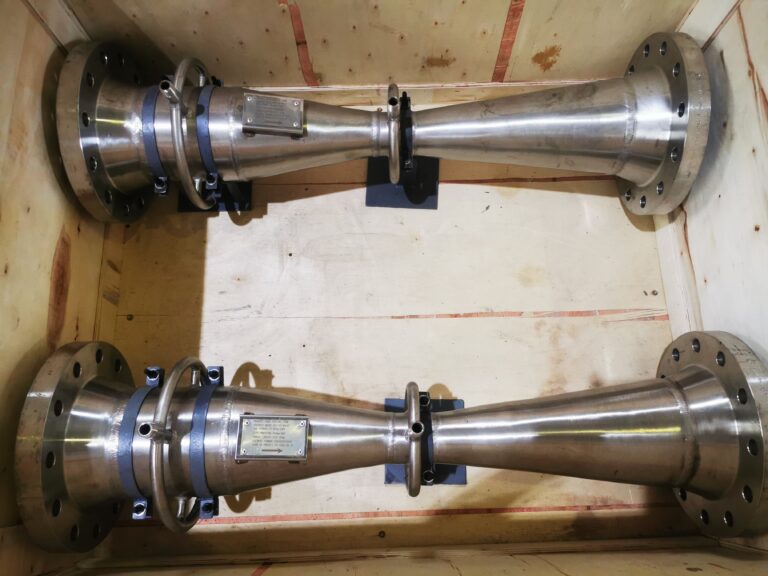
2. What Is a Pressure Averaging Ring?
A pressure averaging ring (also called a piezometer ring) is a pressure tapping device that connects multiple pressure sensing holes located on the same cross-section of the pipe.
Instead of measuring pressure from only one point, several tapping points collect pressure signals and combine them inside a pressure balancing chamber.
The result is a more representative average pressure value of the entire cross-section.
A typical Venturi flow meter with a pressure averaging ring includes:
- Multiple pressure tapping holes
- Positive pressure averaging ring
- Negative pressure averaging ring
- Pressure guide tubes
- Differential pressure transmitter connection

3. Main Functions of a Pressure Averaging Ring
3.1 Providing a More Accurate Pressure Signal
The main purpose of the averaging ring is to obtain a stable pressure signal.
In real industrial piping systems, the velocity profile may not always be ideal.
For example:
- Nearby elbows
- Valves
- Reducers
- Pumps
- Pipe disturbances
can cause uneven velocity distribution.
A single pressure tapping point may not represent the actual average pressure of the flow section.
The averaging ring collects pressure from multiple points and provides a more reliable differential pressure signal.
3.2 Reducing the Influence of Flow Disturbance
One advantage of the Venturi tube is its ability to operate under difficult installation conditions.
The pressure averaging ring helps reduce measurement errors caused by:
- Swirling flow
- Asymmetric velocity profiles
- Upstream disturbances
This is especially useful in retrofit projects where the required straight pipe length is difficult to achieve.
3.3 Reducing the Risk of Pressure Tap Blockage
For dirty or viscous media, single pressure taps may suffer from:
- Solid particle accumulation
- Sludge deposition
- Condensation blockage
A pressure averaging ring uses multiple pressure holes.
Even if one tapping point becomes partially blocked, other pressure points can continue providing pressure information.
Typical applications include:
- Coal gas
- Slurry
- Wastewater
- Black water
- Heavy oil
For extremely dirty applications, a drain connection can also be installed below the averaging ring for regular cleaning.
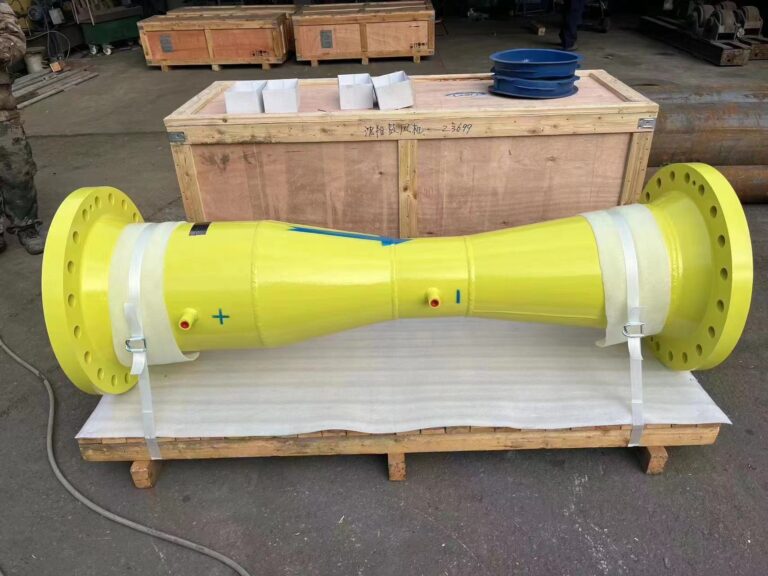
4. When Should You Use a Venturi Meter with a Pressure Averaging Ring?
4.1 High-Pressure Oxygen Applications
High-pressure oxygen measurement is one of the typical applications.
Examples:
- Coal gasification plants
- Oxygen supply systems
In oxygen service, flow velocity and pressure loss are important safety considerations.
A Venturi tube with averaging ring can provide:
- Stable pressure measurement
- Lower permanent pressure loss
- Better pressure distribution
This makes it suitable for demanding oxygen flow measurement applications.
4.2 Applications Requiring Very Low Permanent Pressure Loss
One of the biggest advantages of a Venturi meter is its extremely low permanent pressure loss.
Compared with many other DP flow devices:
- Orifice plates create higher energy loss
- Some restriction devices create larger pressure recovery losses
A Venturi meter usually has a permanent pressure loss of approximately:
10–20% of the measured differential pressure
Therefore, it is preferred in systems where pumping or compression energy costs are important.
Examples:
- Large air pipelines
- CO₂ systems
- Large water transportation systems
4.3 Dirty, Viscous, or Particle-Containing Fluids
Many engineers compare Venturi meters with wedge flow meters for these applications.
Both can be used for difficult fluids, but their advantages are different.
Venturi Meter vs Wedge Flow Meter
| Feature | Venturi Flow Meter | Wedge Flow Meter |
|---|---|---|
| Flow passage | Smooth streamlined design | Restriction wedge design |
| Permanent pressure loss | Very low | Higher |
| Particle resistance | Good | Very good |
| Self-cleaning ability | Medium | Excellent |
| Wear resistance | Good with proper coating | Depends on wedge design |
| Low Reynolds number performance | Limited | Better |
For highly abrasive fluids containing hard particles such as:
- SiO₂
- Al₂O₃
a wedge meter may experience faster wear because of the sharp restriction edge.
A Venturi tube has a smoother flow path and fewer sharp edges, which can provide longer service life in some applications.
For severe abrasion conditions, special materials or coatings such as tungsten carbide coating may be considered.
4.4 Limited Installation Space
Traditional differential pressure flow meters often require sufficient upstream and downstream straight pipe length.
In some compact plants or retrofit projects:
- Equipment layout is crowded
- Pipe routing is complicated
- Required straight length cannot be achieved
A Venturi tube with optimized pressure tapping design may provide a practical solution.
However, the actual straight pipe requirement should always be confirmed according to:
- ISO 5167
- Pipe configuration
- Reynolds number
- Upstream disturbance conditions

5. When Is a Pressure Averaging Ring Not Necessary?
For normal clean fluid applications, a standard Venturi meter without an averaging ring is usually sufficient.
Examples:
- Clean water
- Clean air
- Stable process gas
- Low contamination liquid
The additional complexity and cost of an averaging ring may not provide significant benefits in these applications.
6. Quick Selection Guide
| Application Condition | Recommended Solution |
|---|---|
| Clean water or clean gas | Standard Venturi meter |
| High-pressure oxygen | Venturi with pressure averaging ring |
| Dirty gas | Venturi with pressure averaging ring |
| Slurry or black water | Evaluate Venturi and wedge meter based on abrasion |
| Very low pressure loss requirement | Venturi meter |
| Limited installation space | Optimized Venturi design |
7. Conclusion
A pressure averaging ring is not a standard requirement for every Venturi flow meter.
However, it becomes highly valuable when the application involves:
- High-pressure oxygen
- Dirty or viscous fluids
- Particle-containing media
- Strict pressure loss requirements
- Difficult installation conditions
For clean and stable fluids, a standard Venturi tube is usually sufficient.
For challenging industrial applications, selecting the correct pressure tapping method is critical for achieving reliable and long-term flow measurement performance.
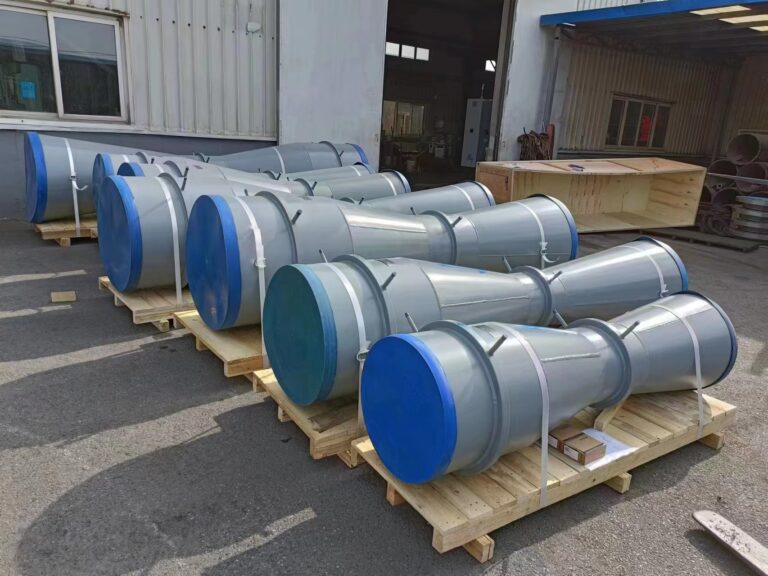
Zero Instrument provides customized Venturi flow meters designed according to ISO 5167 standards, including pressure averaging ring designs for demanding applications such as oxygen systems, gasification processes, slurry measurement, and large industrial pipelines.