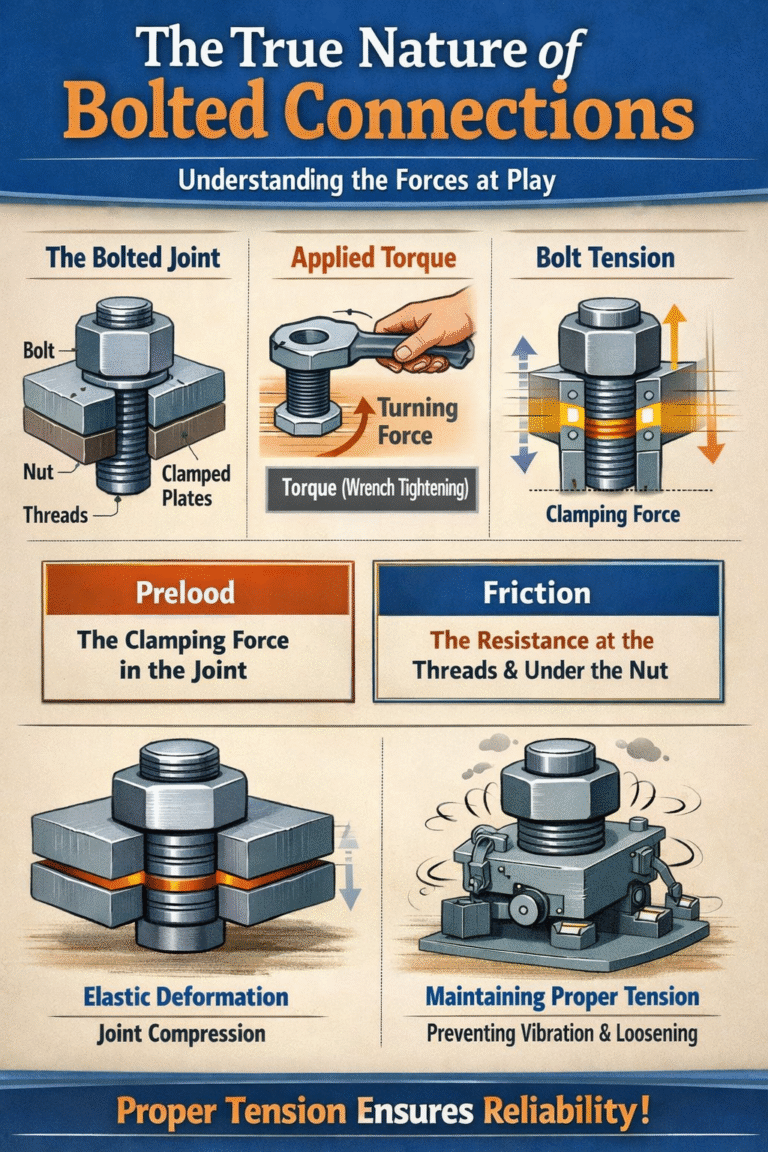
The Engineering Principles Behind Industrial Fasteners (Complete Guide) / Instrumentation The Engineering Principles That Determine Equipment ReliabilityIn industrial systems, most failures are not caused by major components—but by something much smaller:👉 FastenersBolts, nuts, and screws may seem simple, but they directly determine whether a system remains stable—or fails.And here is the key reality:👉 Most fastening failures are NOT caused by insufficient strengthThey are caused by:Improper preloadIncorrect installationPoor understanding of engineering standardsTo truly understand fasteners, we must move beyond individual components and adopt a system-level engineering perspective. 1. The True Nature of Bolted ConnectionsFrom an engineering standpoint, a bolted joint does not rely on the bolt itself to carry shear loads.Instead, it works by:👉 Generating preload force → Creating friction → Transmitting loadKey principle:External loads are mainly carried by friction between contact surfacesThe bolt primarily experiences tensile stress, not shearThis is the fundamental assumption behind most engineering standards, including:GB/T standardsISO standards (ISO 898, ISO 4014, ISO 4032)👉 If this assumption is violated, the connection becomes unstable. 2. Preload: The Most Critical Factor ⭐ MUST DOPreload is not a random parameter—it must be carefully controlled.A properly designed preload must ensure:No slip under maximum loadBolt remains within elastic rangeAdequate fatigue life⚠️ HIGH RISK:Too low preload → joint loosening + fatigue failureToo high preload → yielding or thread damage💡 PRO TIP:Fastener reliability is not about “tightening harder”—it is about achieving and maintaining the correct preload. 3. Strength Grades: Not Always “Higher is Better”Common bolt strength classes:8.8 → General applications10.9 → Higher load conditions12.9 → High-strength applicationsWhile higher grades allow higher stress:👉 They also reduce ductility and fatigue toleranceKey insight:High strength ≠ high reliabilityWrong selection can accelerate failure 4. Fatigue Failure: The Real EnemyAccording to ISO, DIN, and high-reliability industries:👉 Most fastener failures are fatigue failures—not overloadFailure process:Preload lossMicro-slip between surfacesAlternating stress on boltCrack initiation at thread rootCrack propagation → fracture👉 This is why:Reuse of critical bolts is restrictedTightening procedures are strictly controlled 5. Material Selection: Match the EnvironmentFastener materials must match operating conditions:Carbon steel / alloy steel:High strengthGood fatigue performanceSuitable for general environmentsStainless steel:Excellent corrosion resistanceLower strength compared to alloy steel👉 Choosing the wrong material can:❗ Reduce reliability under load❗ Cause premature failure 6. Surface Treatment: More Than Corrosion ProtectionSurface treatment affects not only corrosion resistance—but also:👉 Friction coefficientAnd friction directly affects:👉 Preload accuracyExample:Dacromet coatingStable friction coefficientBetter preload controlWidely used in high-strength applications 7. Anti-Loosening DesignThe goal of anti-loosening is not just preventing rotation—but maintaining preload stability over time.Traditional methods (like spring washers) are no longer sufficient.Modern solutions include:Structural anti-rotation designFriction stabilizationControlled tightening processes👉 Anti-loosening is a system design issue, not just a component issue. 8. Full Lifecycle ManagementIn industries such as:Wind powerRail transportationAerospaceNuclear energyFasteners are treated as critical engineering elements.Lifecycle control includes:Design stage → load & fatigue calculationManufacturing stage → material & heat treatmentAssembly stage → controlled tighteningOperation stage → inspection & monitoringMaintenance stage → replacement & traceability👉 Fasteners are not consumables—they are lifecycle-managed components 🔚 Final TakeawayThe upper limit of equipment performance depends on design.But the lower limit of reliability depends on:👉 the quality of its connectionsFasteners may look simple, but they represent one of the most fundamental—and critical—engineering challenges.👉 Respecting fasteners means respecting engineering principles. Share This Story, Choose Your Platform! Contact Us Please prove you are human by selecting the cup. Request a Quote