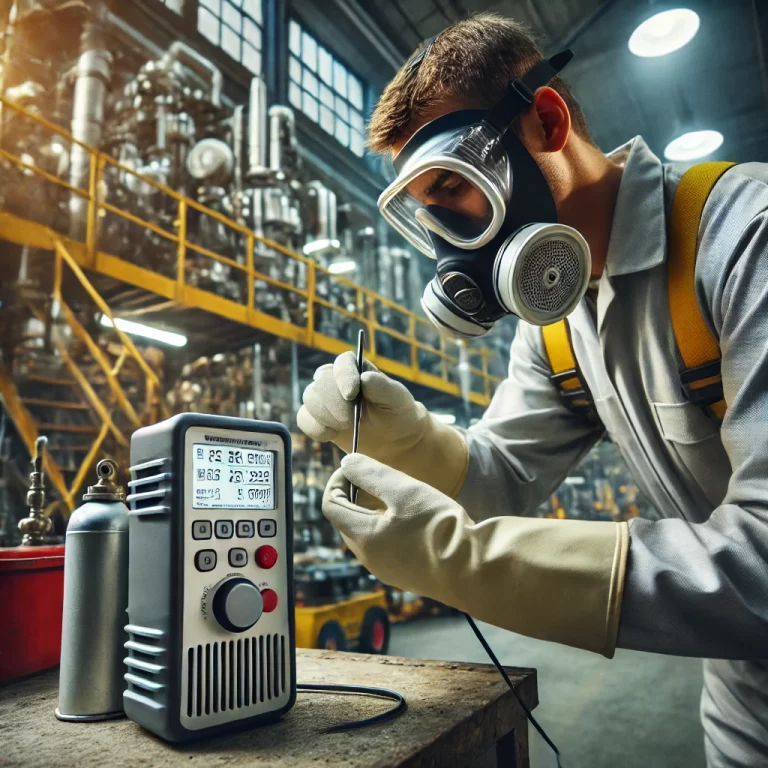
In industries such as petrochemical, oil & gas, and pharmaceuticals, combustible gas leaks are one of the leading causes of safety accidents.
Statistics show that over 70% of fire and explosion incidents are related to combustible gas leaks.
An incorrect alarm setting is not just a technical issue—it can be the difference between early warning and catastrophic failure.
Combustible gas detectors serve as the first line of defense. Only with scientifically set alarm values can they provide timely and reliable warnings to ensure personnel safety and stable plant operation.
2. Common Misconception: “25% / 50% LEL Is Always Correct”
Many users assume that alarm settings are straightforward:
Low alarm: 25% LEL
High alarm: 50% LEL
While this complies with general standards, blindly applying these values can be risky.
The real issue is that alarm settings are often made without considering actual application conditions, such as:
Type of gas being measured
Calibration gas mismatch
Environmental influences
Lack of periodic calibration and adjustment
👉 Alarm setting is not about fixed numbers—it’s about proper adaptation.
3. Standards and Real-World Cases
Relevant Standards
According to:
GB/T 50493-2019
Low alarm ≤ 25% LEL
High alarm ≤ 50% LEL
SY/T 6503-2022
Low alarm ≤ 20% LEL (recommended 10%)
High alarm ≤ 40% LEL
Although values differ slightly, the core principle is:
👉 Alarm values must be based on the Lower Explosive Limit (LEL).
Typical Problems in Practice
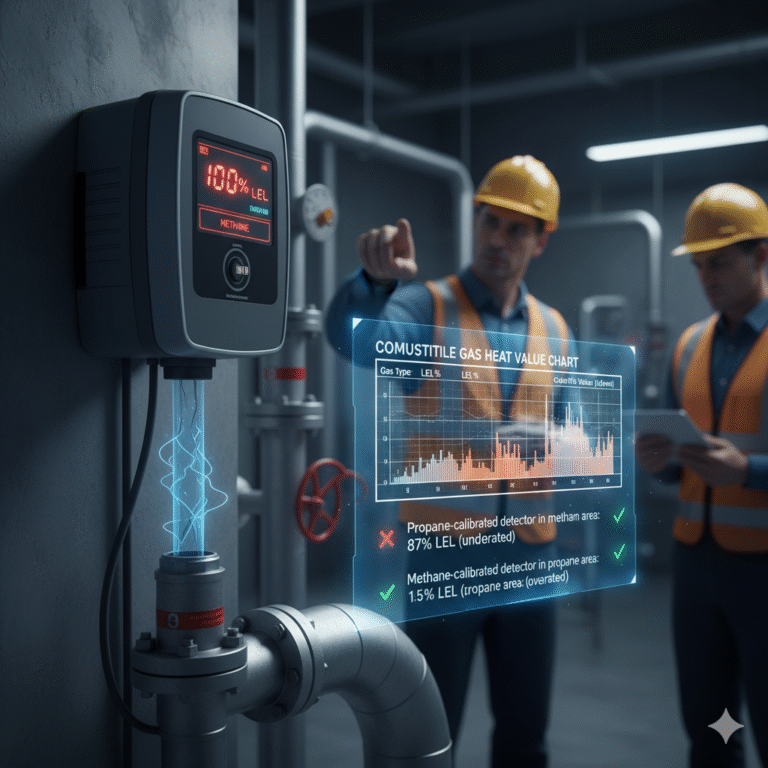
Case 1 A detector labeled for methane is used to measure methanol. → Result: Inaccurate readings and unreliable alarms
Case 2 Multiple gases (hydrogen, LPG, propane, etc.) are monitored using detectors all calibrated with methane gas. → Result: Measurement deviation → potential missed alarms
👉 Key takeaway: Incorrect gas type or calibration can lead to:
False alarms (affecting production)
Missed alarms (serious safety risks)
4. Working Principle Determines Accuracy
Most industrial combustible gas detectors use catalytic combustion sensors.
They do NOT directly measure gas concentration. Instead, they measure:
👉 Heat generated during catalytic oxidation of gas
How it works:
Gas diffuses into the sensor
Catalytic oxidation occurs (similar to flameless combustion)
Heat increases sensor temperature
Electrical signal changes accordingly
👉 The higher the gas concentration → the greater the heat → the stronger the signal
Why This Matters
Different gases produce different combustion heat:
Hydrogen → high heat
Methane → medium
Methanol → lower
👉 The detector cannot distinguish gas types 👉 This leads to measurement deviation if mismatched
Correction Factor Is Critical
If one detector is used for multiple gases:
Use manufacturer-provided correction factors
Or calibrate with the correct standard gas
Otherwise:
Methane calibration → readings may be lower than actual
Pentane calibration → readings may be higher
👉 Best practice:
Use matching calibration gas
Or use propane / isobutane when exact gas is unavailable
5. Environmental Factors Cannot Be Ignored
Alarm settings are also influenced by operating conditions:
Factor
Impact
High temperature
Reduced sensitivity, slower response
High humidity
Corrosion, signal instability
Electromagnetic interference
Signal fluctuation
Dust
Blocks gas diffusion
Sulfur compounds
Catalyst poisoning
👉 In addition:
Sensor performance degrades over time
Regular calibration is essential
Alarm settings should be dynamically optimized based on historical data
6. Best Practices for Alarm Setting
To ensure reliable operation:
✔ Select correct gas type for detection ✔ Use appropriate calibration gas ✔ Apply correction factors when necessary ✔ Consider environmental conditions during installation ✔ Perform regular calibration and maintenance ✔ Analyze alarm history and continuously optimize settings
7. Final Conclusion
Proper alarm setting of combustible gas detectors is not a fixed value, but a result of comprehensive evaluation.
Incorrect settings may lead to:
❌ Frequent false alarms → production interruption
❌ Missed alarms → severe safety incidents
👉 Gas detection is not just about instruments—it is about safety management.
Need Technical Support?
If you are unsure about:
Alarm setting
Gas selection
Calibration methods
👉 Feel free to contact us. We provide professional technical support and customized solutions for your applications.