
Introduction
In the world of industrial flow measurement, many advanced technologies have emerged in recent decades, including electromagnetic flow meters, ultrasonic flow meters, vortex flow meters, and Coriolis mass flow meters.
However, the orifice plate flow meter, one of the oldest differential pressure flow measurement technologies, is still widely used in industries such as chemical processing, power generation, oil & gas, steam systems, and industrial utilities.
Why has this traditional technology remained popular for so many years?
The answer lies in its simple structure, proven measurement principle, excellent durability, and strong adaptability to harsh operating conditions.
This article explains why orifice plate flow meters are considered one of the most reliable flow measurement solutions and where they are most suitable.
1. Why Orifice Plate Flow Meters Are Known for Long-Term Stability
1. Simple Mechanical Structure with Few Failure Points
One of the biggest advantages of an orifice plate flow meter is its extremely simple design.
A typical orifice flow measurement system consists of:
- Orifice plate
- Flange assembly or orifice carrier
- Differential pressure transmitter
- Impulse piping and valves
Unlike electromagnetic flow meters, which rely on electrodes and excitation coils, or ultrasonic flow meters, which require sensitive ultrasonic sensors, an orifice plate itself contains no electronic sensing components and no moving parts.
Because the primary measuring element is only a precision-machined metal plate with a calibrated opening, it can maintain stable geometry for many years under suitable conditions.
This means:
- Minimal mechanical wear
- Low maintenance requirements
- Excellent long-term repeatability

2. Mature Measurement Principle and International Standards
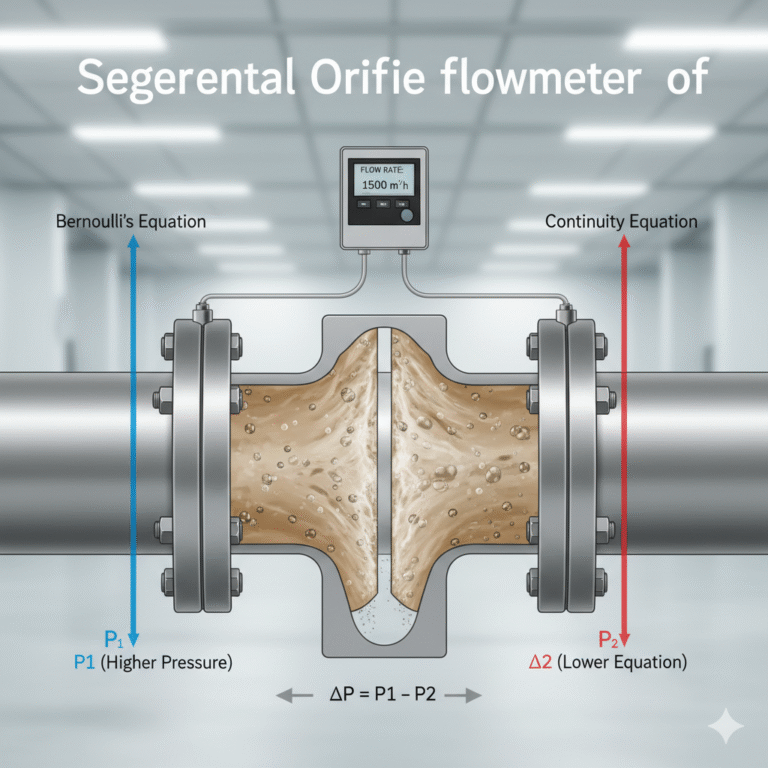
The orifice plate flow meter works based on the differential pressure principle derived from the Bernoulli equation.
When fluid passes through the restriction created by the orifice plate, a pressure difference is generated between the upstream and downstream sides.
The flow rate can then be calculated according to the relationship between:
- Differential pressure
- Fluid density
- Orifice diameter
- Pipe size
- Operating conditions
The design and calculation of standardized orifice plates are governed by international standards such as:
- ISO 5167
- GB/T 2624
These standards define:
- Orifice geometry
- Calculation methods
- Installation requirements
- Accuracy considerations
Because of this standardization, orifice measurement systems can maintain reliable and traceable performance over long service periods.
3. Excellent Performance Under High Temperature and High Pressure Conditions
One of the most important advantages of orifice plate flow meters is their ability to operate in demanding industrial environments.
Metallic orifice plates can be designed for:
- High temperature steam
- High pressure gas
- Industrial process applications
- Extreme operating conditions
For example:
- Steam measurement in power plants
- High-pressure gas measurement in chemical plants
- Utility energy monitoring systems
Compared with some other flow measurement technologies:
- Electromagnetic flow meters cannot measure gases or steam
- Ultrasonic flow meters may experience signal attenuation under extreme temperature conditions
Orifice plate flow meters remain a reliable choice because the primary sensing element is a robust mechanical component.
With pressure and temperature compensation, measurement accuracy can be further improved for gas and steam applications.

4. Strong Resistance to Electromagnetic Interference
Industrial environments often contain:
- Variable frequency drives (VFDs)
- Large motors
- High-voltage equipment
- Complex electrical systems
These conditions may affect some electronic measuring devices.
An orifice plate itself has no electrical sensing mechanism. The measurement is based on mechanical pressure differential generation.
Therefore, the primary measuring element is not affected by electromagnetic interference.
When combined with a properly installed differential pressure transmitter, the system can provide stable measurement even in electrically noisy environments.
5. Simple Maintenance and Low Operating Cost
The maintenance requirements of an orifice plate system are relatively simple.
Routine maintenance usually includes:
- Checking impulse lines
- Cleaning possible blockage
- Calibrating the differential pressure transmitter
- Inspecting valves and connections
The orifice plate itself normally requires little maintenance if:
- The fluid is clean
- The material is properly selected
- Severe erosion does not occur
For many industrial plants, this long service life and low maintenance requirement are major reasons why orifice flow measurement remains widely used.

Typical Applications of Orifice Plate Flow Meters
1. Steam Flow Measurement
Steam measurement is one of the most common applications.
Typical applications include:
- Boiler steam monitoring
- District heating systems
- Chemical plant steam distribution
- Energy management systems
Because steam involves:
- High temperature
- High pressure
- Gas-phase measurement
Orifice plate flow meters are widely selected for reliable long-term operation.
2. High Pressure Gas Measurement
Orifice flow meters are commonly used for:
- Natural gas
- Compressed air
- Nitrogen
- Hydrogen
- Process gases
With pressure and temperature compensation, the system can accurately calculate gas flow under changing operating conditions.
Typical applications:
- Gas stations
- Compressor stations
- Chemical plants
- Industrial utility systems
3. Clean Liquid Measurement
Although electromagnetic flow meters are often preferred for many liquid applications, orifice flow meters can also be used for clean liquids such as:
- Water
- Oil
- Methanol
- Ethanol
- Process chemicals
They are suitable when:
- The liquid contains few particles
- Long-term stability is more important than minimum pressure loss
4. High Temperature and High Pressure Process Lines
In industries such as:
- Refining
- Petrochemical
- Chemical processing
process conditions can be extremely demanding.
A properly selected orifice plate material can handle:
- High pressure
- High temperature
- Continuous operation
This makes it suitable for harsh industrial process measurement.
When Should You Avoid Using an Orifice Plate Flow Meter?
Although orifice plate flow meters are highly reliable, they are not suitable for every application.
1. Slurry, Wastewater, or Fluid Containing Large Particles
Avoid using orifice plates for:
- Slurry
- Mud
- Wastewater with solids
- Fiber-containing fluids
Particles may cause:
- Erosion of the orifice edge
- Measurement errors
- Blockage of impulse lines
For these applications, electromagnetic flow meters are often a better choice.
2. High Viscosity or Crystallizing Fluids
Fluids with high viscosity or crystallization tendency may cause:
- Plugging of impulse lines
- Unstable differential pressure signals
Alternative technologies should be considered.
3. Low Pressure Loss Applications
An orifice plate creates permanent pressure loss.
Therefore, it may not be ideal for:
- Low-pressure large flow systems
- Energy-sensitive applications
- Large water transmission pipelines

Orifice Plate Flow Meter System Configuration
A complete industrial orifice flow measurement system usually includes:
- Orifice plate
- Differential pressure transmitter
- Three-valve manifold
- Pressure transmitter (optional)
- Temperature transmitter (optional)
- Flow computer or totalizer (optional)
For steam and gas measurement, temperature and pressure compensation are often recommended to improve accuracy.
Conclusion
The reason why orifice plate flow meters remain widely used after decades is not because they are the newest technology, but because they provide a combination of:
- Simple structure
- Proven measurement principle
- Excellent durability
- High temperature and pressure capability
- Low maintenance requirements
- Long-term measurement stability
For applications involving:
- Steam
- High-pressure gases
- Clean industrial liquids
- Harsh process conditions
an orifice plate flow meter remains one of the most reliable and cost-effective solutions.
However, for slurry, wastewater, highly viscous fluids, or large low-pressure water systems, alternative technologies such as electromagnetic or ultrasonic flow meters may provide better performance.
Choosing the right flow measurement technology always depends on the actual process conditions.