
In many engineers’ minds, digital signals are often considered more advanced, more accurate, and more stable than analog signals.
At first glance, this seems absolutely correct.
However, in real industrial environments with strong electromagnetic interference (EMI), low signal-to-noise ratio (SNR), or insufficient error correction mechanisms, analog signals may sometimes appear more stable than digital communication.
This does not mean analog technology is inherently superior.
Rather, it reflects the different ways these two signal systems respond to interference.
1. Continuous Systems vs Decision-Based Systems
The fundamental difference lies in how information is represented.
Analog Signals
Analog signals are continuous in both amplitude and time.
The information is directly embedded in the waveform itself.
Typical examples include:
- 4–20 mA current signals
- 0–10 V voltage signals
- analog audio transmission
Even when noise is added, the waveform still retains part of its original trend.
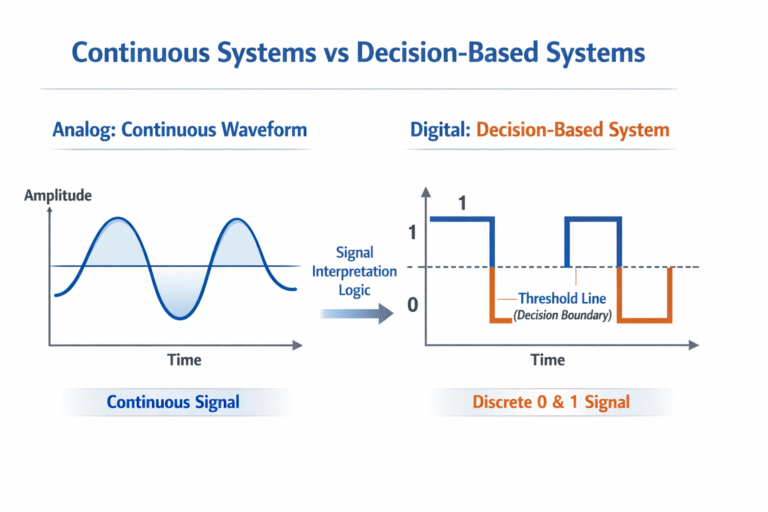
2. Digital Signals Depend on Threshold Decisions
Digital signals are different.
They rely on discrete level decisions.
For example:
- logic 0 / logic 1
- binary data packets
- Modbus RS485 communication
- pulse outputs
The receiver must decide whether the signal level belongs to “0” or “1”.
Once interference pushes the signal beyond the decision threshold, the system may immediately generate bit errors.
This is why digital systems may sometimes show:
- sudden communication failure
- intermittent data loss
- CRC errors
- burst transmission errors
instead of gradual degradation.
3. Why Analog Signals Often Show Better Stability Under Strong EMI
The key reason is graceful degradation.
Analog signals usually degrade progressively.
For example:
- signal noise gradually increases
- waveform becomes distorted
- reading fluctuations become larger
But the signal often remains usable.
This is especially common in industrial instrumentation.
For example, a 4–20 mA flow transmitter may still continue to provide a readable signal even when motors, inverters, or high-voltage cabinets generate strong interference nearby.
The reading may fluctuate slightly, but the control system can still work.
4. Why Digital Signals May Fail Suddenly
Digital communication behaves differently.
When noise approaches the decision threshold, performance often drops nonlinearly.
This means the system may appear stable for a long time, then suddenly fail.
Typical examples include:
- Modbus timeout
- RS485 frame loss
- communication interruption
- invalid checksum alarms
This is why engineers sometimes experience situations where:
analog output remains normal
but RS485 communication becomes unstable
under the same field conditions.

5. Practical Industrial Example: 4–20 mA vs RS485
This is one of the most common examples in industrial automation.
Analog Output
- 4–20 mA
- strong anti-noise capability
- suitable for long cable runs
- highly stable in harsh environments
Digital Output
- RS485 Modbus
- rich data communication
- supports multiple parameters
- higher integration flexibility
However, RS485 requires:
- proper grounding
- shielded cable
- terminal resistance
- correct communication parameters
Otherwise, EMI can easily cause communication instability.
This is why many industrial flow meters and level transmitters still keep 4–20 mA as the standard output.
6. Does This Mean Analog Is Better Than Digital?
Not necessarily.
Modern digital systems have major advantages.
For example:
- FEC error correction
- CRC verification
- data retransmission
- lossless storage
- advanced DSP processing
When properly designed, digital communication can achieve reliability far beyond analog systems.
Therefore, the real conclusion is:
Analog signals degrade gradually
Digital signals may fail abruptly near threshold conditions
Neither is absolutely better.
The best choice depends on:
- installation environment
- interference level
- transmission distance
- system design requirements

Conclusion
In harsh industrial environments, analog signals often appear more stable because they degrade progressively instead of failing suddenly.
This is why 4–20 mA analog output is still widely used in industrial instrumentation, even in today’s digital era.
For critical industrial applications, many engineers still prefer analog signals for their robustness and predictability.