
When an industrial instrument stops working, does the entire device need to be replaced?
Not necessarily.
In many cases, the issue may be caused by a single functional component rather than the sensing element itself. Communication settings may be incorrect, a power module may be affected by electrical interference, a display board may fail, or field wiring and grounding conditions may have changed.
In other words, an instrument being “out of service” does not automatically mean that the sensor has failed—or that the entire device must be replaced.
This is exactly where modular design comes into play.
Traditionally, many industrial instruments were designed with a highly integrated architecture, where sensing, signal processing, communication, display, and power functions were all combined into a single unit. While compact, such designs often make troubleshooting and maintenance more difficult, as a minor failure can require extensive inspection or even complete replacement of the instrument.
Modular design takes a different approach. Components that are likely to vary between applications, require frequent maintenance, or need future upgrades are separated into independent modules, while the core measurement chain remains stable and consistent.
The purpose of modularity is not simply to make a device easier to disassemble. Its real value lies in simplifying troubleshooting, reducing maintenance costs, and extending the service life of the instrument.
How Does an Instrument Generate Measurement Data?
Take a level switch as an example.
The measurement value displayed by the instrument is not produced directly by the sensor.
First, the sensing element detects changes in the process medium and converts them into a weak electrical signal. This raw signal then passes through amplification, filtering, temperature compensation, and linearization circuits before being converted into digital information through an ADC (Analog-to-Digital Converter).
The microcontroller (MCU) processes the data using calibration parameters, span settings, and compensation algorithms. Finally, the result is transmitted to a PLC, DCS, or SCADA system through outputs such as 4–20 mA, HART, RS485, Modbus, or Industrial Ethernet.
A modern intelligent instrument typically contains several functional layers:
- Sensor module for data acquisition
- Signal conditioning circuit for processing raw signals
- Main controller (MCU) for calculations
- Communication module for data transmission
- Power supply module for isolation and protection
- Display and operation module for local monitoring and configuration
Understanding these functional layers helps explain why some parts are more suitable for modular design than others.

Which Parts Are Suitable for Modular Design?
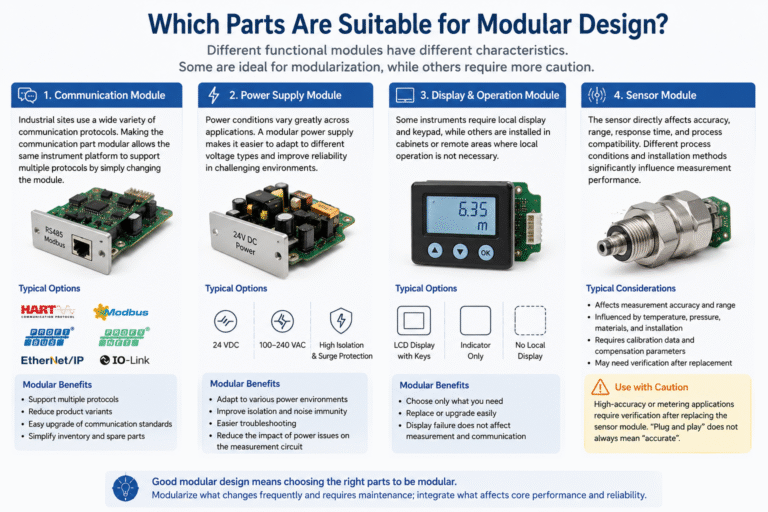
Communication Modules
Communication interfaces are among the most common candidates for modularization.
Industrial facilities use a wide variety of communication standards. Some systems still rely on 4–20 mA signals, while others require HART, Modbus RTU, Profibus, Profinet, EtherNet/IP, IO-Link, or other industrial protocols.
In traditional designs, communication circuitry is permanently integrated into the main board. Every additional protocol may require a new product variant, increasing development complexity and inventory costs.
A modular communication design allows the same instrument platform to support multiple protocols simply by changing the communication module. This reduces the number of product variants while making future upgrades and spare-parts management much easier.
Power Supply Modules
Power modules are also ideal candidates for modularization.
Besides powering the instrument, they must minimize electrical noise and protect the measurement circuitry from disturbances.
Field power conditions vary significantly:
- 24 VDC systems
- AC-powered installations
- Sites with unstable voltage
- Areas exposed to lightning surges and electromagnetic interference
Many measurement instability issues are actually caused by power quality, grounding problems, or electrical noise rather than sensor failures.
Separating the power module simplifies troubleshooting and allows the most appropriate power solution to be selected for each application.
Display and Operation Modules
Display modules are another area where modularity provides flexibility.
Some instruments require local displays and keypad access for operators, while others are installed in cabinets or remote locations where local operation is unnecessary.
By making the display module optional, users can select only the features they need. Even if the display module requires maintenance, measurement and communication functions can continue operating without affecting the control system.
Sensor Modules Require More Caution
Sensor modules directly affect measurement performance, including:
- Accuracy
- Measuring range
- Response time
- Process compatibility
Temperature, pressure, materials of construction, and installation conditions all influence measurement results.
A mature modular design stores calibration data, compensation coefficients, range settings, and serial numbers within the sensor module itself. When connected to the host electronics, these parameters can be automatically recognized and applied.
However, in custody transfer, metering, or high-accuracy applications, replacing a sensor module still requires verification and validation. Simply plugging in a new sensor does not guarantee measurement accuracy.
The Real Challenge of Modularity: Interfaces
Many people assume modular design simply means “plug-and-play.”
In reality, successful modular instrumentation depends on well-designed interfaces.
Mechanical Interfaces
Industrial environments often involve vibration, temperature cycling, moisture, dust, and corrosive media.
Poor sealing or weak mechanical connections can significantly increase failure rates.
Electrical Interfaces
Signal definitions, isolation requirements, reverse polarity protection, short-circuit protection, and surge immunity must all be carefully engineered.
Data Interfaces
The host system must be able to:
- Identify module types
- Manage version compatibility
- Read and store parameters
- Handle communication errors correctly
Without reliable data interfaces, modular systems become difficult to maintain.
Maintenance Interfaces
Maintenance personnel should be able to quickly identify problems.
After replacing a module, the system should clearly display:
- Module status
- Firmware version
- Diagnostic information
- Fault codes
These features directly impact maintenance efficiency.
More Modules Do Not Always Mean Better Design
The value of modularization lies in improving flexibility and maintainability.
However, every additional connector, contact point, sealing surface, or plug-in structure introduces a potential failure point.
Industrial environments are rarely ideal. Long-term exposure to vibration, humidity, dust, temperature fluctuations, and electromagnetic interference places a premium on reliability.
For this reason, the best modular designs are often conservative rather than excessive.
Functions that frequently change—such as communication, power supply, and display—are good candidates for modularization.
Functions that directly influence measurement accuracy, sealing integrity, certifications, or metrological performance require much greater caution.
Good engineering is not about making everything modular. It is about determining what should remain integrated and what should be independent.
How Does Modular Design Help Maintenance?
Modular architecture makes troubleshooting much more systematic.
For example:
- No display? Check the display module and power supply first.
- Communication failure? Verify the communication module, address settings, baud rate, wiring, and protocol configuration.
- Measurement drift? Focus on the sensor, signal processing circuitry, compensation algorithms, installation conditions, and process environment.
- Complete device failure? Inspect the power input, protection circuits, and internal connections.
This approach is far more efficient than immediately disassembling the entire instrument.
Modular design simplifies fault isolation, reduces spare-parts inventory complexity, and provides greater flexibility for future upgrades.
A single instrument platform can support multiple communication protocols, adapt to changing site requirements, and continue operating even when certain auxiliary modules require replacement.

Conclusion
The primary purpose of modular design in industrial instrumentation is to support long-term operation and easier maintenance.
It is not intended to make instruments more complicated. Instead, it creates clear functional boundaries:
- Sensors collect data
- Controllers process information
- Communication modules transmit data
- Power modules provide energy and protection
- Display modules support local operation
A well-designed modular architecture helps maintenance personnel locate faults more quickly, simplifies spare-parts management, and allows instruments to remain useful even as systems evolve.
The true value of an industrial instrument is not measured only by its accuracy or features on the datasheet. It is also measured by its ability to remain maintainable, upgradeable, and adaptable throughout years of operation.
That is the real advantage of modular design.