1. Why Sludge Interface Measurement Is Important in Wastewater Treatment
In wastewater treatment plants, sedimentation tanks are used to separate suspended solids from treated water. During operation, sludge gradually accumulates at the bottom of the tank.
The sludge blanket level directly affects:
Treatment efficiency
Sludge removal frequency
Clarified water quality
Operation cost
If sludge accumulates too much, it may cause:
Sludge carryover
Reduced treatment capacity
Poor effluent quality
Therefore, reliable sludge interface detection is essential for automatic sludge discharge control.
2. What Is Sludge Interface Level Measurement?
Different from normal liquid level measurement, sludge interface measurement detects the boundary between:
Upper clear water layer
Lower sludge sediment layer
The purpose is not to measure the total liquid height, but to identify:
Where the sludge layer starts inside the sedimentation tank.
Typical applications include:
Primary clarifiers
Secondary sedimentation tanks
Sludge thickening tanks
Industrial wastewater treatment systems
3. Challenges of Measuring Sludge Level
Sludge measurement is more difficult than normal liquid level measurement because the medium contains:
Suspended solids
Floc particles
Floating materials
Gas bubbles
Variable density
Traditional technologies may face problems:
Ultrasonic Level Measurement
Ultrasonic instruments can be affected by:
Foam
Surface turbulence
Poor reflection from sludge interface
Radar Level Measurement
Radar is excellent for liquid surface measurement, but identifying the sludge-water interface can be challenging in some applications.
Float Type Devices
Mechanical floats may suffer from:
Sludge adhesion
Mechanical blockage
Frequent maintenance
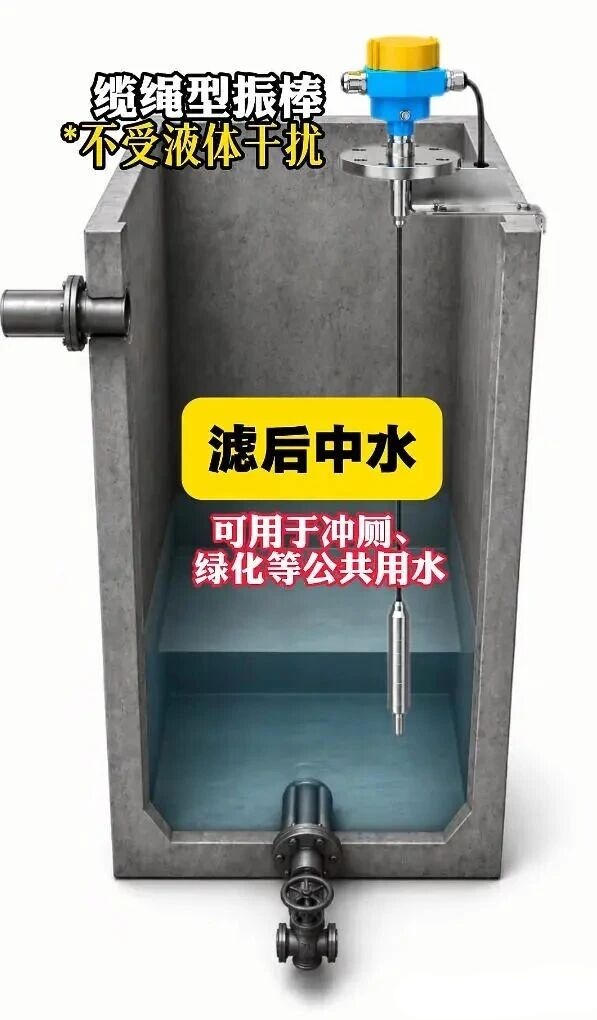
4. Working Principle of Rope Type Vibrating Probe Sludge Level Switch
A rope type vibrating probe level switch works based on vibration damping technology.
The sensor probe continuously vibrates in clean water.
When the probe enters sludge:
Sludge creates resistance
Vibration amplitude decreases
Electronic circuit detects the change
A switching signal is generated
The output signal can be used for:
Sludge pump control
Automatic drainage valves
Alarm systems
5. Advantages of Rope Type Vibrating Probe Technology
Long Installation Length
With flexible cable construction, the probe length can reach up to 20 meters.
Suitable for:
Deep sedimentation tanks
Large wastewater facilities
Not Affected by Liquid Properties
Compared with capacitive sensors, vibrating probes are less affected by:
Conductivity changes
Color changes
Turbidity
Suitable for Low Density Sludge
Advanced vibrating probe technology can detect sludge with density as low as:
0.02 g/cm³
This makes it suitable for:
Flocculated sludge
Biological sludge
Activated sludge
Simple Installation and Maintenance
Features:
No calibration required
Compact design
Relay output available
Easy integration with PLC systems
6. Typical Application Example
Automatic Sludge Discharge Control
The system works as follows:
Sensor detects sludge reaching preset level
Level switch sends signal to PLC
PLC starts sludge discharge pump
When sludge level decreases, discharge stops
This improves:
Automation level
Energy efficiency
Treatment stability
7. Vibrating Probe vs Other Sludge Level Measurement Technologies
Technology
Application Suitability
Ultrasonic sludge level meter
Medium
Radar level meter
Medium
Float switch
Low
Pressure transmitter
Low
Vibrating probe sludge detector
High
8. Conclusion
For sedimentation tanks where sludge interface detection is required, rope type vibrating probe level switches provide a simple and reliable solution.
With long cable installation, resistance to dirty water conditions, and stable switching performance, this technology is widely suitable for wastewater treatment and industrial clarification processes.