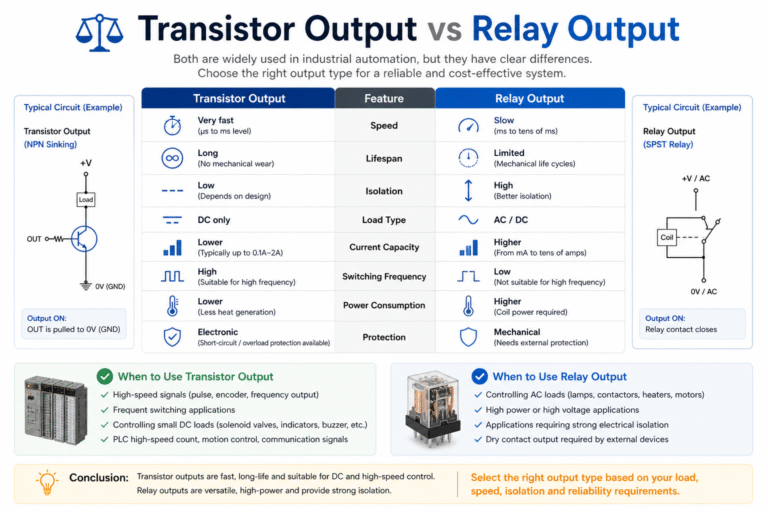
What Is Transistor Output? A Practical Guide to NPN vs PNP (With Real Wiring Cases) / Instrumentation 🔍 Introduction: When a “Simple Output” Burns Your PLCIn industrial automation, one of the most common but overlooked issues is transistor output wiring.It may look simple — just NPN or PNP — but in real projects:The load doesn’t workPLC input shows no signalOutput module gets damagedControl system fails unexpectedly👉 In many cases, the root cause is wrong understanding of transistor outputsThis guide will help you understand, select, and avoid costly mistakes. ⚙️ What Is Transistor Output?A transistor output uses a transistor as a switching device to control current or voltage.👉 In simple terms:A small control signal drives a larger loadTypical applications:PLC output modulesSensors (proximity, photoelectric)Solenoid valvesRelaysIndicator lightsMotor drivers ⚡ How Does It Work?A transistor has three terminals:Base (B) – controlCollector (C) – output pathEmitter (E) – referenceWhen the base is triggered → transistor turns ON → current flowsWhen no signal → transistor turns OFF👉 That’s why it behaves like a switch 🔄 NPN vs PNP: The Most Critical DifferenceThis is where most mistakes happen. 🔵 NPN Output (Sinking)Output pulls signal to 0V (Ground)Load is connected to positive power (+V)👉 Current flow:+V → Load → Transistor → 0V✔ Also called:Sinking outputOpen collectorLow-side switching 🔴 PNP Output (Sourcing)Output provides positive voltage (+V)Load is connected to 0V👉 Current flow:Output → Load → 0V✔ Also called:Sourcing outputHigh-side switching 🧠 Quick Selection Guide (Very Important)SituationRecommended OutputPLC input is SinkingUse PNPPLC input is SourcingUse NPNEuropean systemsUsually PNPJapanese systemsUsually NPNLong cable / noisy environmentPrefer PNP👉 Always confirm PLC input type before wiring ⚠️ Real Case: Wrong Wiring Caused System FailureProject: Wastewater treatment plantDevice: Proximity sensor (NPN output)Issue: PLC showed no input signalWhat happened?The engineer assumed it was PNP and wired it incorrectly.Result:No signal receivedSystem could not startTroubleshooting took 2 daysRoot cause:👉 NPN sensor connected to PNP input logic ⚡ Transistor Output vs Relay OutputFeatureTransistor OutputRelay OutputSpeedVery fastSlowLifetimeLongLimited (mechanical)Load typeDC onlyAC/DCCurrent capacityLowerHigherIsolationLowHigh👉 When to use transistor output:High-speed signals (pulse, encoder)Frequent switchingSmall DC loads👉 When to use relay:AC loadsHigh power devicesDry contact requirement ⚠️ Top 5 Common Mistakes (Avoid These!)1. Wrong NPN / PNP selection👉 Most common failure cause2. No flyback diode for inductive load👉 Can destroy transistor instantly3. Ignoring leakage current👉 Causes false triggering4. Overloading output👉 Leads to overheating or failure5. Incorrect COM wiring👉 PLC input won’t detect signal 🏭 Typical Industrial ApplicationsTransistor outputs are widely used in:PLC control systemsFlow meter pulse outputsProximity sensorsPhotoelectric sensorsSolenoid valvesServo / stepper control signals👉 Especially important in high-speed pulse output applications 🔧 Selection Checklist (For Engineers)Before choosing a device, confirm:Output type (NPN or PNP)Supply voltageMax output currentLoad type (resistive / inductive)Switching frequencyPLC input compatibilityProtection (short circuit / overload) 🚀 Final ThoughtTransistor output may seem like a basic concept —but in real industrial environments:👉 Wrong selection = system failure👉 Correct understanding = stable operationMany field issues are not caused by product quality,but by misunderstanding of interfaces 📩 Need Help Selecting the Right Output Type?If you’re unsure about:NPN or PNP selectionPLC compatibilityTransistor vs relay outputSensor or flow meter integration👉 Send us your application detailsWe will help you confirm the correct solution within 24 hours. Share This Story, Choose Your Platform! Contact Us Please prove you are human by selecting the star. Request a Quote