
In chemical plants, instrumentation is often called the “eyes and ears” of the process.
Flow meters, pressure transmitters, radar level sensors, temperature instruments, and control valves continuously provide critical data that operators rely on for safe and stable production.
However, many instrument failures are not caused by the instruments themselves.
In actual industrial sites, problems are often related to poor maintenance practices:
- Loose wiring terminals
- Moisture ingress inside junction boxes
- Corrosion buildup on electrodes
- Improper grounding
- Incorrect calibration
- Lack of preventive inspection
At first, these issues may seem minor. But over time, they can lead to unstable signals, false alarms, inaccurate measurements, batch dosing errors, process interruptions, or even unexpected shutdowns.
Below are some of the most common maintenance mistakes found in chemical plants — and how to avoid them.
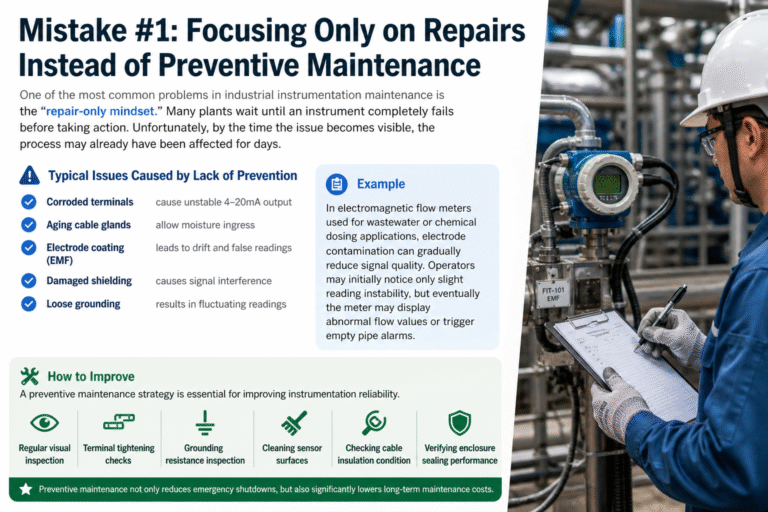
Mistake #1: Focusing Only on Repairs Instead of Preventive Maintenance
One of the most common problems in industrial instrumentation maintenance is the “repair-only mindset.”
Many plants wait until an instrument completely fails before taking action. Unfortunately, by the time the issue becomes visible, the process may already have been affected for days.
Typical examples include:
- Corroded terminals causing unstable 4–20mA output
- Aging cable glands allowing moisture ingress
- Electrode coating inside electromagnetic flow meters
- Damaged shielding causing signal interference
- Loose grounding leading to fluctuating readings
For example, in electromagnetic flow meters used for wastewater or chemical dosing applications, electrode contamination can gradually reduce signal quality. Operators may initially notice only slight reading instability, but eventually the meter may display abnormal flow values or trigger empty pipe alarms.
How to Improve
A preventive maintenance strategy is essential for improving instrumentation reliability.
Recommended actions include:
- Regular visual inspection
- Terminal tightening checks
- Grounding resistance inspection
- Cleaning sensor surfaces
- Checking cable insulation condition
- Verifying enclosure sealing performance
Preventive maintenance not only reduces emergency shutdowns, but also significantly lowers long-term maintenance costs.
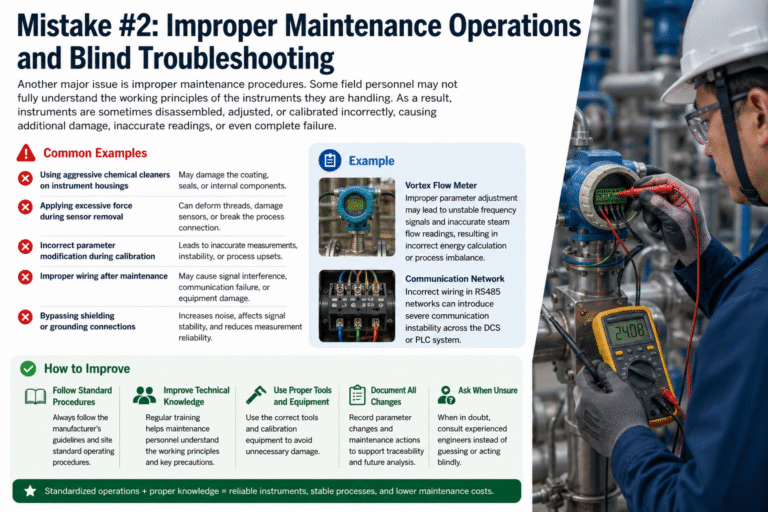
Mistake #2: Improper Maintenance Operations and Blind Troubleshooting
Another major issue is improper maintenance procedures.
Some field personnel may not fully understand the working principles of the instruments they are handling. As a result, instruments are sometimes disassembled, adjusted, or calibrated incorrectly, causing additional damage.
Common examples include:
- Using aggressive chemical cleaners on instrument housings
- Applying excessive force during sensor removal
- Incorrect parameter modification during calibration
- Improper wiring after maintenance
- Bypassing shielding or grounding connections
For instance, improper parameter adjustment in a vortex flow meter may lead to unstable frequency signals and inaccurate steam flow readings.
Similarly, incorrect wiring in RS485 communication networks may introduce severe communication instability across the control system.
How to Improve
Maintenance work should follow standardized procedures.
It is important to:
- Train maintenance personnel regularly
- Follow manufacturer guidelines
- Use proper calibration equipment
- Document parameter changes
- Avoid unnecessary disassembly
Simple maintenance manuals and troubleshooting procedures can also help reduce operational mistakes in the field
Mistake #3: Ignoring Environmental Impact on Instruments
Chemical plants are harsh environments for instrumentation.
High temperature, humidity, vibration, corrosive gases, and dust are common challenges that directly affect instrument lifespan and stability.
Unfortunately, some installations focus only on “getting the instrument running” without considering long-term environmental protection.
This often leads to:
- Corrosion inside junction boxes
- Condensation on circuit boards
- Radar antenna contamination
- Accelerated cable aging
- Sensor vibration damage
- Premature transmitter failure
For example:
- In corrosive acid environments, standard stainless steel components may fail rapidly without proper material selection.
- In high-humidity outdoor areas, poor sealing may allow rainwater to enter transmitters.
- In vibrating pipelines, unsupported cable connections may loosen over time.
How to Improve
Protection measures should always match the actual site conditions.
Recommended practices include:
- Using anti-corrosion materials
- Installing sunshields or cooling devices
- Adding vibration dampers
- Applying waterproof cable glands
- Selecting proper IP protection ratings
- Performing regular anti-corrosion inspections
Correct environmental protection can dramatically extend instrument service life and improve measurement stability.
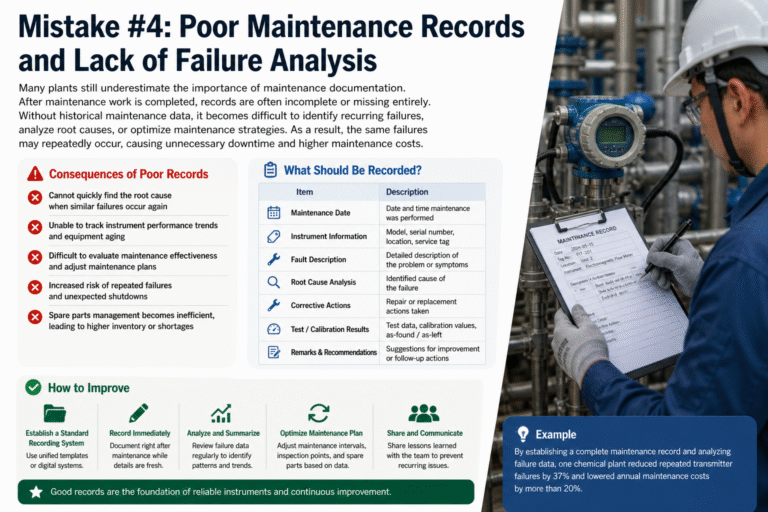
Mistake #4: Poor Maintenance Records and Lack of Failure Analysis
Many plants still underestimate the importance of maintenance documentation.
After maintenance work is completed, records are often incomplete or missing entirely.
Without historical maintenance data, it becomes difficult to:
- Identify recurring failures
- Analyze root causes
- Track instrument performance trends
- Optimize maintenance intervals
- Improve spare parts management
As a result, the same failures may repeatedly occur without permanent solutions.
How to Improve
A complete maintenance record system should include:
- Inspection dates
- Instrument model information
- Fault descriptions
- Calibration results
- Parameter changes
- Corrective actions taken
Over time, these records help maintenance teams identify common failure patterns and improve overall plant reliability.
Why Proper Instrument Maintenance Matters
In chemical plants, instrumentation is not just about displaying numbers on a screen.
Reliable instruments directly affect:
- Process safety
- Product quality
- Energy efficiency
- Production stability
- Environmental compliance
- Maintenance cost
A poorly maintained flow meter, pressure transmitter, or level sensor can eventually cause inaccurate control decisions, unnecessary downtime, or serious process risks.
In many cases, the cost of preventive maintenance is far lower than the cost of emergency shutdowns and production losses.
Final Thoughts
Good instrumentation maintenance is not simply about fixing problems after they happen.
The real goal is to prevent failures before they affect production.
By improving preventive maintenance practices, standardizing maintenance procedures, strengthening environmental protection, and keeping proper maintenance records, chemical plants can significantly improve instrument reliability and operational stability.
For industrial instrumentation, long-term reliability always starts with proper maintenance.
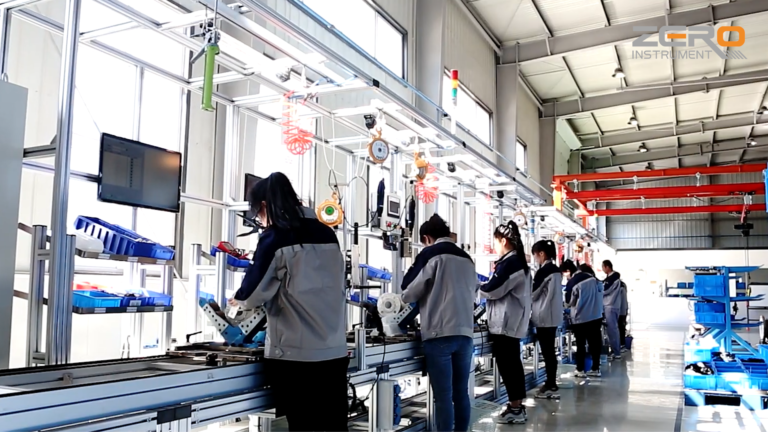
Need Help With Industrial Instrumentation?
We supply a wide range of industrial instruments for chemical, water treatment, oil & gas, and process automation applications, including:
- Electromagnetic Flow Meters
- Vortex Flow Meters
- Radar Level Transmitters
- Pressure Transmitters
- Ultrasonic Flow Meters
- Temperature Instruments
If you need technical support, model selection assistance, or maintenance recommendations, feel free to contact us.