
In industries such as petrochemical, natural gas, pharmaceuticals, and dust processing, the classification and management of explosive hazard zones are not only technical concerns but also safety regulations and mandatory standards. The depth of understanding directly influences the effectiveness of the explosion-proof system in any enterprise. This article provides a comprehensive professional interpretation of explosive hazard zones, based on standard definitions, zoning principles, key technologies, and legal provisions.
1. Professional Definition of Explosive Hazard Zones
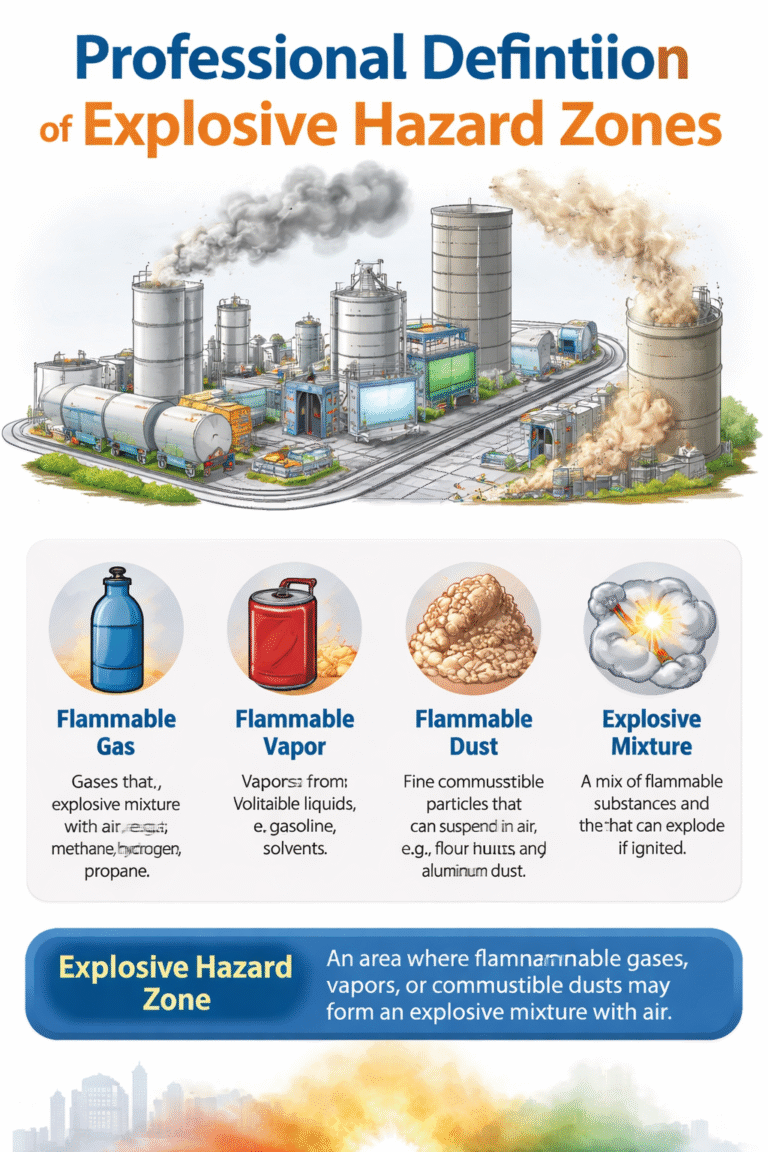
An explosive hazard zone is defined as an area where combustible gases, vapors, or combustible dusts, in normal or abnormal conditions, mix with air to form an explosive mixture that may persist or intermittently exist.
According to the current standard system GB/T 3836.1-2021 Explosion-Proof Environment Part 1: Equipment General Requirements, an explosive environment refers to a mixture formed by combustible substances in the form of gases, vapors, mists, or dusts, which, once ignited, can spread the flame through the entire unburned mixture.
Several key terms are involved:
- Combustible gases: Gases that can form explosive mixtures with air within a certain concentration range, such as methane, hydrogen, propane, etc.
- Combustible vapors: Gaseous substances formed by the evaporation of flammable liquids, such as gasoline vapors and solvent vapors.
- Combustible dusts: Solid particles that are sufficiently fine and can be suspended in the air to participate in combustion, such as flour dust, aluminum powder, and coal dust.
- Explosive mixture: A mixture of combustible materials and air in a certain proportion, which can result in rapid combustion or even explosion when exposed to an ignition source.
2. Zoning Principles and Standards for Explosive Hazard Zones
The classification of explosive hazard zones is based on international standards (such as IEC) and national standards (e.g., GB 50058, GB/T 3836 series). The core criterion for zoning is the frequency and duration of the explosive environment’s presence.
Gas/Vapor Environment Zoning:
Based on GB 50058 Electrical Equipment Design for Explosive Hazardous Environments:
- Zone 0: Areas where explosive gas environments are present continuously, for extended periods, or frequently. Common examples include the interiors of storage tanks or closed containers. Only the highest level of explosion-proof equipment (e.g., intrinsic safety type ia) is allowed.
- Zone 1: Areas where explosive gas environments are likely to occur under normal operating conditions, such as around valves, flanges, or pump bodies. Explosion-proof equipment such as flameproof (Ex d) and increased safety (Ex e) types are required.
- Zone 2: Areas where explosive gas environments are unlikely to occur during normal operations but may exist briefly in abnormal conditions, such as the outer regions of equipment or well-ventilated areas. Simplified explosion-proof designs can be used, though safety regulations must still be met.
Dust Environment Zoning:
- Zone 20: Areas where explosive dust clouds are continuously or for extended periods present, such as inside powder handling equipment.
- Zone 21: Areas where dust clouds may form during normal operations, such as near feeding or conveying points.
- Zone 22: Areas where dust clouds may form only occasionally under abnormal conditions and for short durations, such as dust deposition areas.
3. Explosion Formation Mechanism and Key Parameters
An explosion is essentially a rapid combustion reaction occurring within a confined space. It depends on the following three basic conditions (the “three elements of explosion”):
- Combustible concentration within the explosive limits:
- Lower Explosion Limit (LEL): The minimum concentration of combustible gas needed to cause an explosion.
- Upper Explosion Limit (UEL): The maximum concentration of combustible gas that can sustain an explosion.
When the concentration is either below the LEL or above the UEL, an explosion is unlikely to occur.
- Sufficient oxygen concentration (typically 21% in air).
- Presence of an effective ignition source:
Ignition sources may include electrical sparks (switching, motor faults), electrostatic discharge, hot surfaces (above the self-ignition temperature), mechanical friction, or impact sparks.
4. Explosion-Proof Technical Systems and Key Measures
Safety control for explosive hazard zones relies on a systematic explosion-proof technical framework, primarily consisting of the following aspects:
Explosion-Proof Equipment Selection:
According to GB 50058, the selection of electrical equipment for explosive environments should be based on the zone level, type of explosive gas or dust, and temperature classification.- Intrinsic safety (Ex i): Limits circuit energy to ensure that explosions cannot be triggered under any circumstances.
- Flameproof (Ex d): Uses a robust enclosure to contain explosions and prevent the flame from spreading.
- Increased safety (Ex e): Provides higher safety margins to prevent sparks and high temperatures.
Temperature and gas classifications are also critical:
- Temperature classes (T1–T6): Specifies the maximum permissible surface temperature of the equipment.
- Gas groups (IIA, IIB, IIC): Classifies gases based on their explosive hazards.
- Ignition Source Control:
- Static grounding and bonding: Prevents charge accumulation that could lead to electrostatic discharge.
- Measures to prevent potential ignition sources from generating sparks or high temperatures.
- Strict approval systems for hot work activities.
- Ventilation and Concentration Control:
According to GB/T 50493, combustible gas detection and alarm systems should be set up.- First-level alarm: Should not exceed 25% of the LEL.
- Second-level alarm: Should not exceed 50% of the LEL.
- Dilution ventilation: Reduces the concentration of combustible gases below the explosive limit.
- Closed system design: Minimizes leakage sources.
- Zoning and Engineering Design:
According to GB/T 3836.14-2014, hazardous areas should be classified based on leak source levels, ventilation conditions, release frequency, and duration.- Areas should be divided based on leakage source levels (continuous, primary, secondary).
- Clear physical boundaries should be established for hazardous zones, and overlapping hazardous areas should be minimized.
- Management and Personnel Factors:
- Establish explosion-proof safety management systems.
- Regularly conduct hazard identification and risk assessments (e.g., HAZOP analysis).
- Enhance personnel awareness of explosion-proof measures and emergency training.

5. Common Misunderstandings and Risk Alerts
- Misunderstanding 1: Relying on the sense of smell to detect risks.
Many combustible gases (e.g., methane, hydrogen) are colorless and odorless, making sensory detection unreliable. - Misunderstanding 2: Assuming “low concentration is always safe.”
Risks increase rapidly once the concentration enters the explosive range. - Misunderstanding 3: Underestimating the risk of dust explosions.
Dust explosions are often more destructive and easily underestimated.
6. Conclusion
The essence of managing explosive hazard zones is controlling or eliminating at least one of the three elements of explosion through engineering technology and management measures. This is not only a regulatory requirement but also the core of modern industrial safety systems. In high-risk industries, explosion-proofing is not a single measure but a comprehensive system. Only by controlling all aspects—from design and selection to operation and management—can inherent safety be achieved.