
Particle Size Distribution (PSD) is a critical parameter for characterizing the properties of particulate materials. It describes the proportion of particles of different sizes within a sample. In industries such as pharmaceuticals, powder processing, and multiphase systems, PSD directly influences material performance, process efficiency, and product quality. Therefore, accurately understanding and controlling PSD—particularly parameters like D10, D50, and D90—is essential for optimizing industrial processes and ensuring high-quality outputs.
1. The Importance of Particle Size Distribution
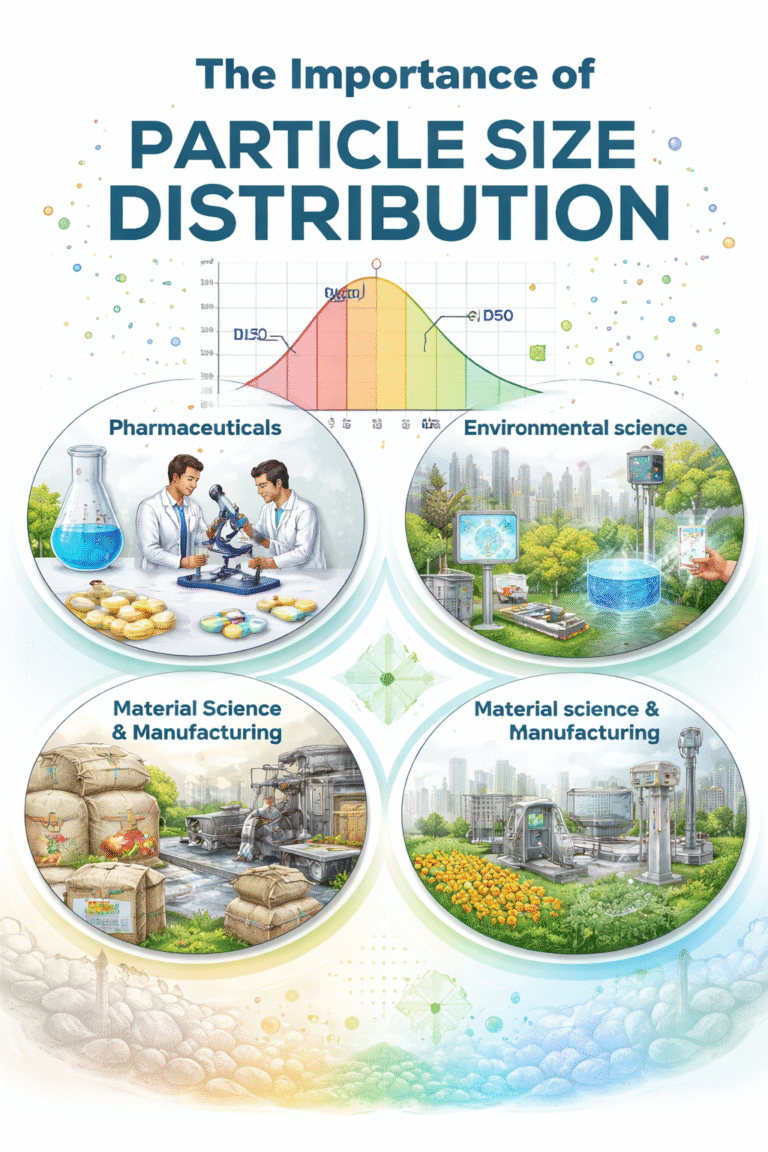
PSD is a mathematical model used to describe the size range and distribution of particles in a material. Its significance spans multiple industries:
- Pharmaceutical Industry: Particle size affects the drug dissolution rate, absorption, and bioavailability. Smaller particles dissolve faster, improving bioavailability.
- Environmental Science: PSD is used to monitor air pollutants, control particulate emissions, and assess water quality.
- Materials Science and Manufacturing: Particle size influences the flowability, compressibility, and processing characteristics of raw materials such as cement and fertilizers.
Understanding PSD allows industries to enhance process efficiency and improve product performance.
2. Understanding D10, D50, and D90
D10, D50, and D90 are the most commonly used parameters to describe PSD. These values are derived from cumulative distribution data and represent specific particle size thresholds:
- D10: This is the particle size below which 10% of the particles are smaller, reflecting the fine fraction of the sample.
- D50: Also known as the median particle size, this is the size at which 50% of the particles are smaller and 50% are larger. It serves as an important indicator of the average particle size.
- D90: This is the particle size below which 90% of the particles are smaller, representing the coarser fraction of the material.
These parameters provide a comprehensive overview of the particle size distribution, allowing precise control over product quality and process efficiency.
For example, in the pharmaceutical industry, controlling D10 can optimize drug dissolution rates, while D90 helps in minimizing coarse particles that may affect product performance.
3. Particle Size Measurement Instruments and Techniques
Accurate measurement of PSD is essential for quality control and process optimization. Advanced technologies and instruments, such as Laser Diffraction Analyzers, enable precise particle size measurements:
- Laser Diffraction Analyzers:
- Principle: Laser light is scattered by particles. Smaller particles scatter light at larger angles, while larger particles scatter light at smaller angles.
- Advantages: High precision, fast analysis, and suitability for fine particles.
- Applications: Widely used in pharmaceutical quality control, food processing, and mineral production.
- Other Methods:
- Sieving: Measures larger particles through a series of mesh screens.
- Sedimentation: Determines particle size by observing the settling speed of particles in a fluid.
4. Applications of PSD in Industrial Processes
PSD plays a crucial role in various industries:
- Pharmaceutical Industry: Particle size directly impacts drug dissolution, absorption, and bioavailability. Controlling PSD can enhance drug efficacy and reduce side effects.
- Mineral Processing: Monitoring and optimizing grinding and crushing processes to achieve the desired particle size.
- Cement and Fertilizer Production: Uniform PSD ensures consistent product performance, such as cement strength and fertilizer nutrient release.
- Coatings and Spraying: In industries like automotive or electronics, stable PSD ensures uniform coatings and reduces defects.
5. The Role of PSD in Process Control
PSD affects not only material quality but also process efficiency. A narrower particle size distribution often improves process performance, making reactions more uniform, enhancing flowability, and making operations more predictable.
Real-time monitoring of PSD using advanced instruments can enable automated quality control and process adjustments.
For instance, in spraying processes, PSD monitoring ensures even deposition of particles, resulting in consistent coating thickness and quality. In wastewater treatment, understanding PSD optimizes sedimentation and filtration processes.

Conclusion
D10, D50, and D90 are essential parameters for characterizing and optimizing particulate materials. These parameters are widely used across various industries. By utilizing advanced measurement technologies and PSD analysis, businesses can improve product quality, optimize processes, and enhance efficiency.
As technology continues to evolve, the role of PSD in industrial innovation and quality control will only continue to grow, driving advancements across multiple sectors.