
In a boiler feedwater system, engineers often find a pump installed before the main feedwater pump:
Deaerator → Feedwater Booster Pump → Main Feedwater Pump → High-Pressure Heater → Boiler
A common question for new engineers is:
“The main feedwater pump already has the ability to increase pressure. Why do we need another pump in front of it?”
The reason is related to the operating characteristics of high-pressure feedwater pumps.
The main feedwater pump is designed to provide very high discharge pressure, but it also has strict requirements for suction pressure and inlet flow conditions. If the pump inlet pressure is insufficient, problems such as cavitation, unstable flow, and reduced efficiency may occur.
The function of the feedwater booster pump is not to replace the main feedwater pump. Instead, it improves the suction conditions of the main pump by increasing the inlet pressure and ensuring a stable water supply.
1. What Is a Feedwater Booster Pump?
A feedwater booster pump (also called a boiler feed pump booster pump) is installed upstream of the main feedwater pump in a boiler feedwater system.
Its main function is:
- Draw water from the deaerator or feedwater tank
- Increase the pressure of the feedwater
- Deliver stable flow to the suction side of the main feedwater pump
The booster pump usually provides relatively low head but high flow capacity.
In large power plants, horizontal centrifugal pumps with a single-stage double-suction design are commonly used.
The double-suction structure allows water to enter the impeller from both sides, which provides several advantages:
- Lower inlet velocity
- Better suction performance
- Reduced axial hydraulic force
- Improved operating stability
The working relationship between the two pumps can be summarized as:
Feedwater Booster Pump: Improve inlet conditions
Main Feedwater Pump: Provide high-pressure delivery to the boiler
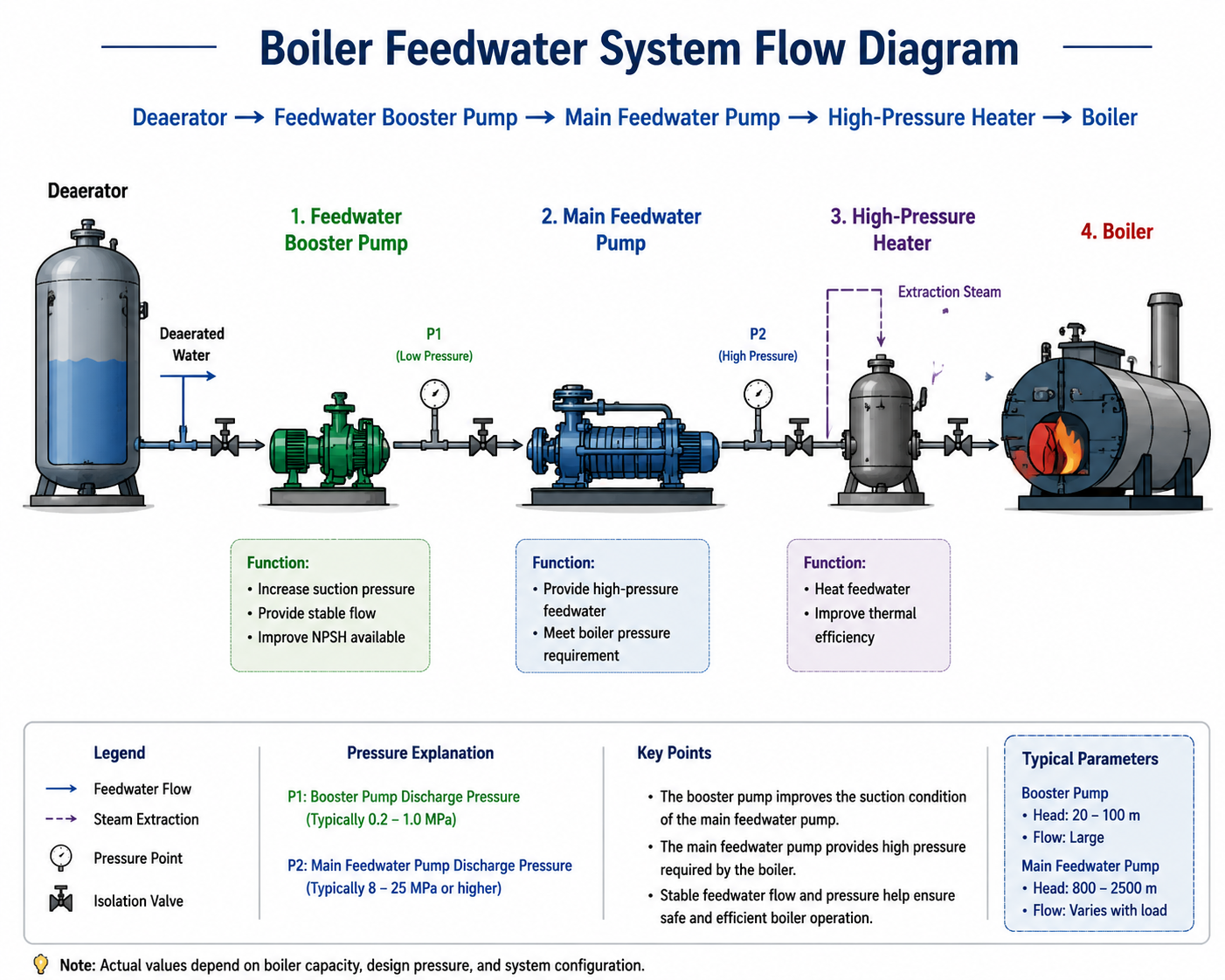
2. Why Is a Feedwater Booster Pump Installed?
2.1 Increasing the Suction Pressure of the Main Feedwater Pump
During operation, the pressure at the suction side of a centrifugal pump decreases as water enters the impeller.
If the inlet pressure is too low, the liquid may partially vaporize inside the pump.
The booster pump increases the pressure before the water enters the main feedwater pump, ensuring better suction conditions.
This allows the main feedwater pump to operate closer to its designed operating point.
2.2 Reducing Cavitation Risk
Cavitation is one of the most serious problems affecting centrifugal pumps.
In boiler feedwater systems, water temperature is usually high. When the local pressure inside the pump drops below the vapor pressure of the water, vapor bubbles can form.
These bubbles collapse when they move into higher-pressure areas, creating shock waves that impact the impeller surface.
Long-term cavitation may cause:
- Pitting and honeycomb damage on impeller surfaces
- Increased vibration
- Unstable discharge pressure and flow
- Reduced pump efficiency
- Shortened equipment service life
By increasing the suction pressure, the booster pump improves the NPSH available (Net Positive Suction Head) and reduces the possibility of cavitation in the main feedwater pump.
2.3 Stabilizing the Operating Conditions of the Main Pump
The inlet conditions of the main feedwater pump can change due to:
- Deaerator water level variation
- Unit load changes
- Pipeline resistance changes
- Valve operating conditions
A booster pump acts as a buffer between the deaerator and the main pump.
It provides:
- More stable suction pressure
- More uniform flow
- Reduced impact from upstream system fluctuations
This helps the main feedwater pump operate more reliably.
2.4 Allowing Each Pump to Perform Its Own Task
Without a booster pump, the main feedwater pump would need to handle two difficult tasks:
- Achieve excellent suction performance
- Generate extremely high discharge pressure
This would increase equipment complexity and operating requirements.
With a booster pump:
| Equipment | Main Function | Typical Design |
|---|---|---|
| Feedwater Booster Pump | Improve suction conditions | Low head, high flow |
| Main Feedwater Pump | Supply boiler high-pressure water | High head, multi-stage |
The two pumps work together to achieve a more stable and efficient feedwater process.
3. Structure and Working Principle of a Feedwater Booster Pump
A typical booster pump consists of:
- Pump casing
- Impeller
- Shaft
- Bearings
- Mechanical seal
- Coupling
3.1 Pump Casing
The pump casing provides the internal flow passage and withstands the operating pressure.
Large booster pumps often use a horizontal split casing design.
During maintenance, the upper casing can be removed to inspect internal components without disconnecting the main piping system.
3.2 Impeller
The impeller transfers mechanical energy from the motor to the water.
In a double-suction impeller design:
- Water enters from both sides
- Flow velocity at the suction area is reduced
- Hydraulic balance is improved
This makes the pump suitable for large flow applications.
3.3 Shaft and Coupling
The motor or small steam turbine drives the pump shaft through the coupling.
The shaft rotates the impeller and transfers mechanical energy to the water.
Problems such as:
- Shaft misalignment
- Coupling installation errors
- Shaft deformation
may cause:
- Excessive vibration
- Bearing overheating
- Seal damage
3.4 Bearings
Bearings support the rotating shaft and impeller assembly.
They carry:
- Radial forces
- Axial forces
Bearing lubrication, cooling, and installation quality directly affect pump vibration and operating temperature.
3.5 Mechanical Seal
The mechanical seal prevents water leakage where the shaft passes through the pump casing.
Seal performance depends on:
- Shaft vibration
- Cooling water condition
- Flushing system
- Installation quality

4. How Does a Feedwater Booster Pump Work?
During operation:
- The motor drives the pump shaft.
- The shaft rotates the impeller.
- Feedwater enters the impeller eye.
- The impeller increases the velocity of the water.
- The pump casing converts part of the velocity energy into pressure energy.
- Pressurized water flows to the suction inlet of the main feedwater pump.
The booster pump only provides initial pressure increase.
The final high-pressure delivery required by the boiler is still provided by the main feedwater pump.
5. Feedwater Booster Pump vs Main Feedwater Pump
| Comparison | Feedwater Booster Pump | Main Feedwater Pump |
|---|---|---|
| Installation Position | Before main pump | After booster pump |
| Main Function | Improve suction conditions | Supply high-pressure feedwater |
| Pressure Increase | Lower head | Very high head |
| Flow Requirement | Large and stable flow | Changes with unit load |
| Typical Structure | Single-stage double suction pump | Multi-stage centrifugal pump |
| Operating Requirement | Excellent suction performance | Requires stable inlet pressure |
Both pumps are essential components of the boiler feedwater system.
If either pump fails to operate properly, the entire feedwater process may be affected.
6. Common Causes of Feedwater Booster Pump Cavitation and Solutions
6.1 Maintain Stable Deaerator Level and Pressure
The booster pump suction pressure depends strongly on deaerator conditions.
A low water level or reduced deaerator pressure may reduce the available suction head and increase cavitation risk.
6.2 Keep the Suction Pipeline Clean
Restrictions in the suction line can reduce inlet pressure.
Common causes include:
- Blocked filters
- Incorrect valve position
- Foreign materials inside pipelines
- Welding debris after maintenance
The suction system should always be inspected before startup.
6.3 Remove Air From the Pump and Pipeline
Air trapped inside the pump can prevent normal operation.
Before startup:
- Complete pump filling
- Open the vent valve
- Confirm continuous water flow without air bubbles
6.4 Avoid Long-Term Low-Flow Operation
Operating below the minimum flow range may cause:
- Internal recirculation
- Temperature increase
- Increased cavitation risk
The minimum flow bypass system should be checked regularly to ensure proper operation.

Conclusion
A feedwater booster pump is not installed to replace the main feedwater pump.
Its purpose is to:
- Increase the suction pressure of the main feedwater pump
- Improve NPSH conditions and reduce cavitation risk
- Stabilize feedwater flow and pressure
The booster pump handles the first stage of pressure increase, while the main feedwater pump provides the high pressure required by the boiler.
Understanding the different roles of these two pumps helps engineers better understand the design and operation of boiler feedwater systems.