
In hazardous area projects, engineers and procurement teams are often asked to provide documents such as:
- ATEX certificates
- IECEx certificates
- Explosion-proof certificates
- CCC certificates
- Hazardous area approvals
Although these terms are all related to explosion-proof equipment, they belong to different regulatory systems, certification frameworks, and target markets.
In many international projects, misunderstanding these requirements may lead to:
- rejected certificates
- non-compliant equipment
- additional testing
- project delays
- costly redesign or recertification
This article explains the differences between ATEX, IECEx, and PCEC from a practical engineering and project perspective.
1. ATEX
ATEX comes from the French term Atmosphères Explosibles.
In industrial applications, ATEX mainly refers to the European Union regulatory requirements for equipment used in potentially explosive atmospheres.
For manufacturers and instrumentation suppliers, the key regulation is:
ATEX Directive 2014/34/EU
This directive applies to equipment and protective systems intended for use in hazardous areas where explosive gases, vapors, mists, or combustible dust may exist.
Typical industries include:
- Oil & Gas
- LNG
- Chemical plants
- Pharmaceutical plants
- Paint spraying systems
- Grain processing
- Dust handling systems
- Mining
- Offshore platforms
ATEX is not simply a product test certificate.
It also involves:
- equipment classification
- hazard level assessment
- conformity assessment procedures
- technical documentation
- CE marking
- Ex marking
- EU Declaration of Conformity
Manufacturers normally need to:
- determine equipment group and category
- identify applicable protection methods and standards
- complete risk assessments
- prepare technical files
- issue EU Declaration of Conformity
- apply CE and Ex markings correctly
One important point is that not all ATEX equipment requires mandatory third-party certification.
Some lower-risk equipment categories may use internal production control procedures, while higher-risk categories require involvement from an EU Notified Body.
Therefore, whether a third-party organization is required depends on:
- equipment category
- protection type
- conformity assessment route
ATEX should not simply be understood as “always requiring third-party certification.”
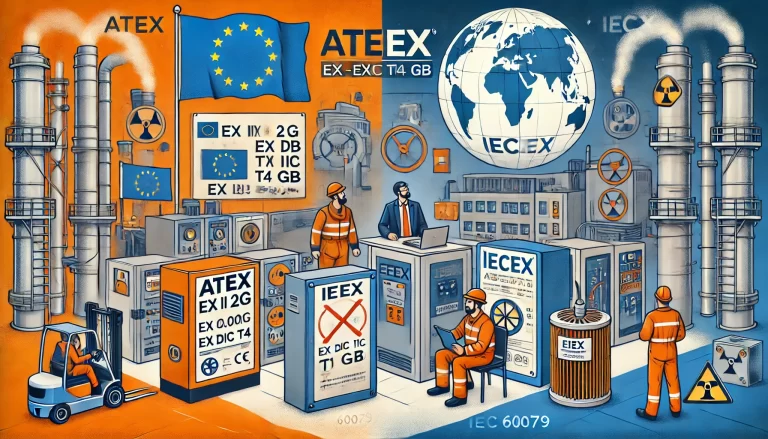
2. IECEx
IECEx is the international certification system established by the International Electrotechnical Commission (IEC).
Unlike ATEX, IECEx is not a regional regulation.
Instead, it is an international third-party certification system based mainly on the IEC 60079 standards series.
Under IECEx, equipment is usually tested and evaluated by IECEx-approved certification bodies and laboratories.
Manufacturers also undergo quality system audits.
Common IECEx documents include:
| Document | Description |
|---|---|
| ExTR | Test Report showing compliance with IEC standards |
| QAR | Quality Assessment Report for manufacturing consistency |
| CoC | Certificate of Conformity |
IECEx is widely used in:
- international EPC projects
- LNG projects
- offshore platforms
- chemical plants
- mining projects
One major advantage of IECEx is that its technical framework is relatively standardized and internationally recognized.
This makes communication easier among:
- project owners
- EPC contractors
- third-party inspectors
- multinational engineering teams
However, IECEx should not be considered a universal global market-access certificate.
Some countries accept IECEx certificates directly, while others may still require:
- local registration
- certificate conversion
- additional review
- national approval procedures
Therefore, project teams should always verify:
- local regulations
- owner specifications
- project approval requirements
- whether local conversion certificates are needed

3. PCEC
In Chinese industrial projects, customers often ask whether equipment has “PCEC certification.”
Strictly speaking, PCEC is not equivalent to ATEX or IECEx.
The three systems have different purposes:
| System | Nature |
|---|---|
| ATEX | EU regulatory requirement |
| IECEx | International certification system |
| PCEC | Chinese explosion-proof testing and certification framework |
PCEC-related certification indicates that equipment has been tested according to Chinese explosion-proof safety standards.
For the Chinese market, companies must also determine whether the equipment falls within the mandatory CCC Ex certification scope.
This is extremely important.
If the equipment belongs to the mandatory CCC Ex category:
- an explosion-proof certificate alone may not be sufficient
If the equipment is outside the mandatory CCC Ex scope:
- explosion-proof certificates
- test reports
- technical specifications
may still be required during project approval and inspection.
4. ATEX vs IECEx vs PCEC
| Item | ATEX | IECEx | PCEC |
|---|---|---|---|
| Type | EU Regulation | International Certification System | Chinese Certification Framework |
| Main Purpose | EU Market Access | International Project Acceptance | China Domestic Compliance |
| Standards | EN Standards | IEC 60079 | GB Standards |
| Common Documents | DoC, Technical File | ExTR, QAR, CoC | Explosion-proof Certificate |
| Geographic Focus | Europe | International Projects | China |
| Third-Party Involvement | Depends on Category | Usually Required | Required |
| Global Acceptance | Limited to EU Regulation | Widely Accepted | Mainly China |
5. Common Questions in Industrial Projects
Can IECEx Replace ATEX?
Usually not directly.
IECEx reports and certificates can support technical evaluation, but equipment entering the European market must still comply with ATEX requirements, including:
- conformity assessment
- technical documentation
- EU Declaration of Conformity
- CE/Ex marking
Can ATEX Be Used Worldwide?
Not automatically.
ATEX belongs to the EU regulatory system.
Acceptance outside Europe depends on:
- local regulations
- project specifications
- owner requirements
Does an Explosion-Proof Certificate Automatically Meet Chinese Requirements?
Not always.
If the equipment falls under mandatory CCC Ex regulations, additional CCC certification is required.
Explosion-proof certificates, test reports, and CCC certificates are not interchangeable.
What Should Engineers Check on Explosion-Proof Certificates?
In real projects, problems often occur not because equipment lacks certification, but because the certificate scope does not match the actual application conditions.
Engineers should carefully verify:
- equipment model
- protection type
- gas or dust group
- temperature class
- EPL level
- ambient temperature range
- ingress protection rating
- cable entries
- special conditions for use
- certificate validity

6. Practical Engineering Mistakes Commonly Seen in Projects
The following problems are extremely common in hazardous area projects:
Wrong Zone Selection
Using Zone 2 equipment in Zone 1 areas.
Temperature Class Mismatch
For example, using T4 equipment where T6 is required.
Non-Certified Cable Glands
Even certified instruments may become non-compliant if cable entries are incorrect.
Unauthorized Modifications
Drilling additional holes in Ex d enclosures can invalidate certification.
Assuming IECEx Is Accepted Everywhere
Some countries still require local approval or certificate conversion.

7. Conclusion
Explosion-proof certification is not simply about obtaining a certificate.
It directly affects:
- equipment design
- material selection
- enclosure structure
- thermal management
- grounding design
- sealing methods
- manufacturing quality systems
For manufacturers planning to serve:
- European markets
- international EPC projects
- Chinese industrial projects
it is highly recommended to plan certification strategies early, including:
- ATEX
- IECEx
- CCC Ex
- local approvals
Early planning can significantly reduce:
- redesign work
- retesting costs
- project delays
- certification risks
In hazardous area applications, understanding the certification scope is often more important than simply having a certificate itself.