
Pneumatic conveying is a widely used method for transporting powders and granular materials in modern industries. Utilizing compressed air as the driving force, it offers an efficient, dust-free, and flexible solution for long-distance material transport. This article covers the basic principles of pneumatic conveying, pressure requirements, mechanisms of pressure loss, causes of pressure fluctuations, characteristics of conveying tank pressure, and its industrial applications.
1. What is Pneumatic Conveying?
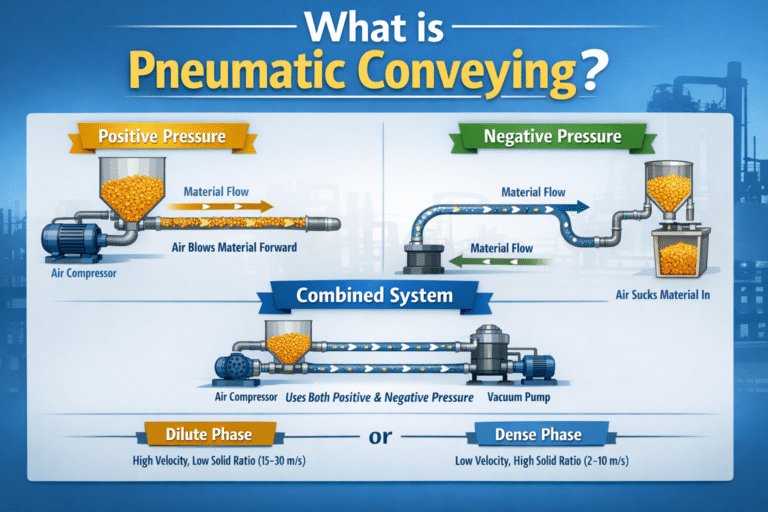
Pneumatic conveying refers to the transport of powdered or granular materials through pipelines by air flow. Based on the driving method and conveying form, it can be classified into:
- Positive Pressure Conveying: Air pushes the material forward (similar to air flowing particles forward).
- Negative Pressure Conveying: Air sucks the material in and moves it forward (similar to a vacuum cleaner).
- Mixed Pressure Conveying: Uses both positive and negative pressures simultaneously, often employed for complex or segmented systems.
Additionally, pneumatic conveying is classified by the solid-to-air ratio (G/S):
- Dilute Phase Conveying: Low solid concentration, high velocity (15–30 m/s), resembling dust suspension.
- Dense Phase Conveying: High solid concentration, low velocity (2–10 m/s), resembling granular flow.
2. Pressure Requirements in Pneumatic Conveying
The stability and efficiency of pneumatic conveying systems are largely dependent on the system’s pressure. Proper pressure must:
- Provide sufficient driving force to overcome pipeline friction and material gravity.
- Prevent blockages due to insufficient pressure.
- Minimize energy consumption at appropriate pressures, thereby enhancing efficiency.
- Ensure pressure is within the allowable range of equipment and pipelines to maintain safety.
Typical conveying pressure ranges from 0.1 to 0.6 MPa. For long-distance transport or higher-density materials, higher pressures are necessary.
Typical Conveying Pressure for Common Materials
3. Mechanisms of Pressure Loss
Pressure loss occurs during material movement through the pipeline due to several factors:
- Friction Along Pipeline Length: Smaller pipe diameters significantly increase pressure loss per unit length.
- Particle Characteristics: Heavier or rough-surfaced particles generate higher resistance.
- Local Resistance: Bends, elbows, and connections increase localized resistance.
- Low G/S Ratios: A lower ratio leads to higher losses.
Optimization Measures:
- Design pipelines with fewer bends and larger diameters.
- Adjust the G/S ratio to avoid particle deposition.
- Select appropriate conveying speeds.
- Use wear-resistant and smooth-lined materials for the pipeline.
4. Causes of Pressure Fluctuations
In practice, pressure in pneumatic conveying systems rarely remains constant. Common causes of pressure fluctuations include:
- Material Variations: Increased moisture content can raise resistance.
- Equipment Issues: Unstable compressor or conveying tank operation.
- Pipeline Wear: Increased roughness in the pipeline increases resistance.
- Operational Disturbances: Sudden valve changes can cause transient pressure changes.
Countermeasures:
- Continuous monitoring and preventive maintenance.
- Standardized operational procedures to minimize disturbances.

5. Pressure Characteristics of Conveying Tanks
Conveying tanks (or silos) are central to many dense-phase systems, and their internal pressure stability directly affects discharge performance. Key factors influencing pressure include:
- Feed Rate: Too fast increases pressure, while too slow reduces pressure.
- Discharge Rate: Slow discharge leads to material buildup, while fast discharge causes a sudden drop in pressure.
- Gas Source Stability: Fluctuations in air pressure and flow directly affect tank pressure.
- Seal Quality: Seal wear or leakage reduces internal pressure.
Stabilization Measures:
- Control the balance of feed and discharge rates.
- Ensure stable gas supply.
- Perform regular maintenance of seals.
6. Industrial Applications and Advantages
Pneumatic conveying systems are widely used in various industries:
- Food Industry: Conveying flour, sugar, milk powder with hygienic standards.
- Building Materials: Long-distance transport of cement and lime powder.
- Chemical Industry: Conveying resins and PVC powders, reducing pollution.
- Energy Industry: Conveying coal and fly ash in power plants.
Advantages:
- Closed-loop transport to prevent dust pollution.
- Flexible pipeline layout adaptable to complex factory environments.
- High automation reduces manual operations.
- Clean and safe, especially for the food and pharmaceutical industries.
Table 2 – Comparison of Industrial Applications and Pneumatic Conveying Advantages

Conclusion
Pneumatic conveying can be seen as a continuous air-based material transport system within factories, where pressure control plays a critical role in ensuring efficiency, safety, and stable operation.
- Design Stage: Consider pressure demands, loss mechanisms, and fluctuations.
- Operational Stage: Focus on monitoring, maintenance, and optimization.
With advancements in materials, system design, and intelligent control, pneumatic conveying will continue to evolve toward higher efficiency, energy savings, and environmental sustainability.