In modern industrial automation, sensors are the critical link between the physical process and the digital control system.
Whether in flow measurement, pressure monitoring, temperature control, or level detection, sensors serve as the “eyes and ears” of the entire system.
They detect physical changes in real time and convert them into usable signals for PLC, DCS, SCADA, or other control platforms.
Understanding how a sensor works is the foundation for selecting the right instrumentation solution.
What Is a Sensor?
A sensor is a device that detects a physical, chemical, or biological variable and converts it into a signal that can be transmitted, processed, displayed, and controlled.
Typical measured variables include:
Temperature
Pressure
Flow rate
Level
Humidity
Gas concentration
Position and displacement
In industrial control systems, if the PLC is the “brain,” then the sensor is the “sensory organ.”
Without accurate sensing, no control decision can be reliable.
Core Function of a Sensor
The essential function of a sensor is:
Physical Variable → Electrical Signal
This conversion process allows the control system to read real-time field data.
Common output signals include:
4–20 mA
0–10 V
Pulse output
Frequency signal
RS485 / Modbus
Digital communication protocols
These standardized outputs make it easy to integrate sensors into industrial automation systems.
The Three Core Components of a Sensor
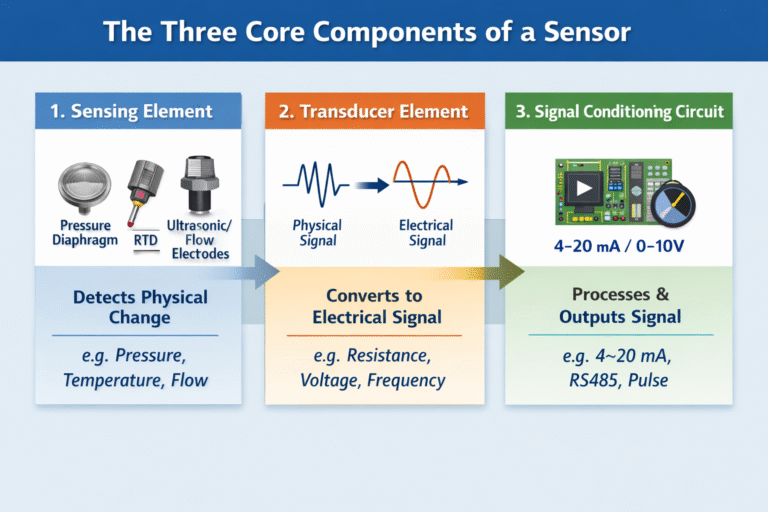
Most industrial sensors can be understood through three functional parts:
1. Sensing Element
The sensing element is the first part that directly contacts or detects the measured medium.
Its task is to respond to physical changes.
Examples include:
diaphragm in pressure transmitters
RTD / thermocouple junction in temperature sensors
ultrasonic transducer in level meters
electrodes in electromagnetic flowmeters
This is the component responsible for detecting the original physical signal.
2. Transducer Element
The transducer converts the sensed physical change into an electrical signal.
For example:
pressure deformation → resistance change
temperature difference → thermoelectric voltage
flow velocity → frequency signal
This is the key stage where physical information becomes measurable electronic data.
3. Signal Conditioning Circuit
The raw signal generated by the transducer is usually weak and unstable.
The signal conditioning circuit processes it into a standard output.
Typical functions include:
amplification
filtering
linearization
temperature compensation
analog-to-digital conversion
Finally, the signal is output as:
4–20mA / 0–10V / Modbus / Pulse
This is what the PLC or DCS system receives.
How Sensors Connect to Automation Systems
In a typical industrial process, the signal chain looks like this:
Process Variable → Sensor → Transmitter → PLC / DCS → Control Valve / Pump / Alarm
For example:
A pressure transmitter monitors pipeline pressure.
Once pressure changes, the sensor converts it into a 4–20mA signal, which is sent to the PLC.
The PLC then controls:
pump speed
valve opening
alarm logic
data logging
This is the core relationship between sensors and automation instrumentation systems.
Common Industrial Applications
Sensors are widely used in:
Flow Measurement
Examples:
Electromagnetic flow meter
Coriolis mass flow meter
Vortex flow meter
Pressure Monitoring
Examples:
pressure transmitters
differential pressure transmitters
pressure switches
Temperature Control
Examples:
RTD PT100
thermocouples
temperature transmitters
Level Measurement
Examples:
radar level transmitters
ultrasonic level sensors
guided wave radar
These devices form the sensing foundation of every modern plant.
Why Sensor Accuracy Matters
The performance of the entire control system depends on sensor quality.
A poor sensor may cause:
false alarms
unstable control loops
inaccurate batching
process deviations
product quality issues
Therefore, sensor selection should consider:
accuracy
repeatability
response time
output signal
process temperature
pressure rating
material compatibility
Final Thoughts
No matter how the internal structure varies, every sensor follows the same logic:
Sense → Convert → Process → Output
This is the foundation of industrial instrumentation and automation.
Understanding sensor components helps engineers choose the right device for reliable and precise process control.