
In industrial automation sites, two completely opposite statements are often heard:
“The equipment must be grounded, otherwise problems will definitely occur.”
“Never ground the signal loop carelessly — more grounding can make it worse.”
Both statements seem correct.
And in fact, both can be correct.
The real issue is not whether grounding is required, but:
What exactly are you grounding?
In most industrial environments, grounding problems are not caused by a lack of grounding.
They are caused by incorrect grounding type selection and improper grounding methods, which can lead to signal interference, unstable measurements, equipment faults, and even safety risks.
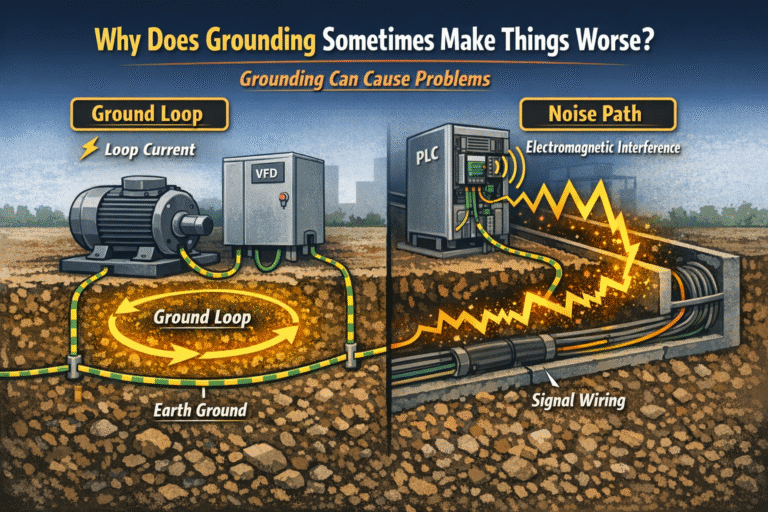
Why Does Grounding Sometimes Make Things Worse?
A common misunderstanding in industrial sites is that “ground” is always assumed to be a perfect zero-potential point.
In reality, this is rarely true.
Because of leakage current, harmonics, electromagnetic coupling, and potential differences across different plant areas, the ground itself is a complex electrical network rather than an ideal zero-voltage point.
If grounding is implemented without distinguishing its purpose, the grounding wire itself may become:
- a noise transmission path
- a loop current path
- a source of interference
This is why some systems perform worse after grounding modifications.
The Three Types of Grounding You Must Never Mix
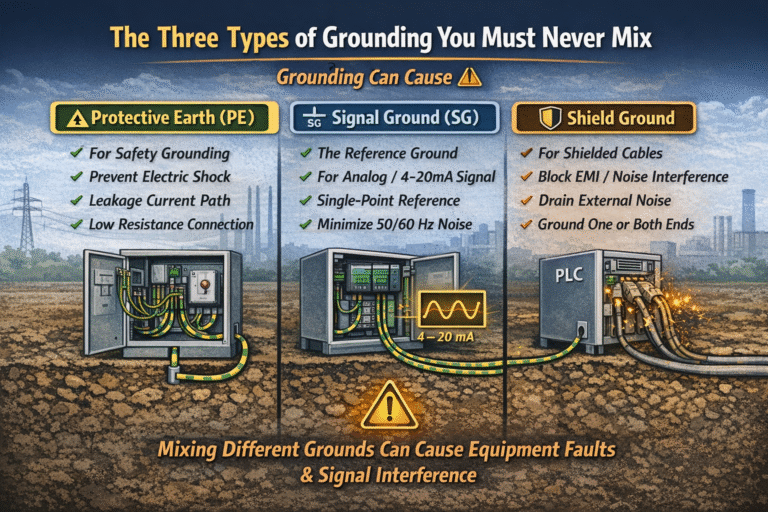
In industrial control systems, grounding is generally divided into three categories:
1. Protective Earth (PE)
This is the safety grounding.
Its purpose is to:
- prevent electric shock
- discharge leakage current
- provide fault current path
- protect equipment from overvoltage and lightning
This must be used for:
- control cabinets
- instrument enclosures
- flow meter bodies
- transmitter housings
- equipment frames
For example, field instruments such as electromagnetic flow meters and pressure transmitters must always have proper PE grounding.
2. Signal Ground (SG)
This is the reference ground for signal measurement.
It is especially important for:
- 4–20 mA analog signals
- PLC analog input cards
- DCS systems
- temperature / pressure transmitters
- flow measurement systems
This grounding directly affects measurement accuracy.
Improper multi-point grounding often creates:
- ground loops
- 50/60 Hz interference
- common-mode noise
- signal drift
This is one of the most common causes of unstable analog signals.
3. Shield Ground
This is used for EMC and anti-interference purposes.
Typical applications include shielded cables for:
- flow meters
- radar level transmitters
- RS485 communication
- pulse signals
- long-distance analog transmission
For standard analog signals, the shield is normally grounded at one end only, preferably on the control side.
Improper grounding at both ends often turns the shield into an “antenna” that introduces noise.
A Real Instrumentation Case: Why 4–20 mA Signals Become Unstable
A very common field issue is unstable output from instruments such as electromagnetic flow meter or pressure transmitter.
For example:
A DN150 electromagnetic flow meter installed near a VFD-driven pump shows output fluctuations.
The displayed flow is stable, but the PLC receives unstable 4–20 mA values.
In many cases, the root cause is not the flow meter itself.
The actual problem is:
- shield grounded at both ends
- SG and PE mixed together
- multi-point signal grounding
Once corrected to single-point grounding, the signal usually becomes stable immediately.
This kind of problem is extremely common in industrial sites.
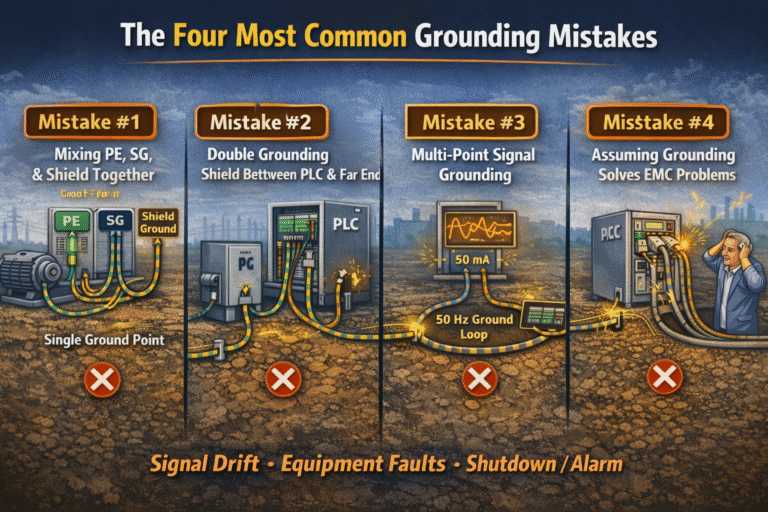
The Four Most Common Grounding Mistakes
The following mistakes are seen very frequently:
1. Mixing PE, SG, and shield ground together
This is one of the most dangerous mistakes.
Each type serves a different purpose.
They must not be mixed randomly.
2. Double-end shield grounding without design verification
This often introduces loop current.
Very common near VFDs and motors.
3. Multi-point signal grounding
This creates ground loops.
A major source of 50 Hz interference.
4. Assuming grounding solves all interference issues
Grounding alone cannot solve all EMC problems.
Proper cable routing, isolation modules, and signal separation are also essential.
Best Practice for Instrument Grounding
For field instruments, I usually recommend:
Equipment body
→ PE grounding (mandatory)
4–20 mA analog signal
→ single-point SG grounding
Shield cable
→ single-end grounding at DCS / PLC side
Strong interference environment
→ use isolators / signal conditioners
Especially near:
- VFD drives
- large motors
- power cabinets
- long cable runs
signal isolation is often necessary.

Final Conclusion
Most signal drift, intermittent faults, and unstable analog readings in industrial sites are not caused by the instrument itself.
They are caused by an improper grounding scheme.
Once PE, SG, and shield grounding are clearly separated and properly designed, most interference issues can be significantly reduced or completely eliminated.