
Steam is one of the most widely used energy carriers in industrial processes.
From food processing and pharmaceuticals to chemical plants, paper mills, and power generation, steam plays a critical role in both heat transfer and mechanical energy supply.
However, many industrial facilities still suffer from:
- inaccurate steam flow measurement
- excessive heat loss
- poor condensate recovery
- unstable pressure control
- high energy consumption
Understanding how an industrial steam system works is the first step toward improving efficiency and reducing operating costs.
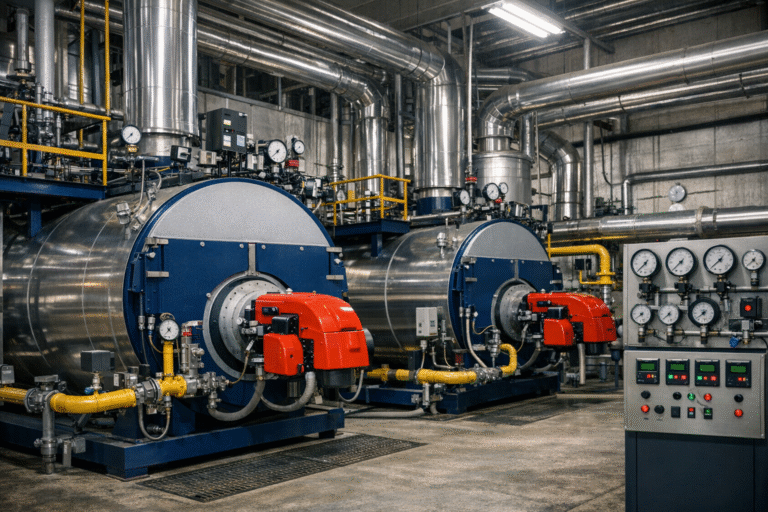
1. Boiler Room: The Heart of the Steam system
The boiler room is the energy center of the entire steam system.
Its main function is to convert fuel energy into thermal energy in the form of steam.
Modern fire-tube and water-tube boilers generate high-temperature steam through efficient combustion and heat transfer.
When the internal pressure reaches equilibrium with the steam generation rate, the system enters stable operation.
Higher pressure steam offers:
- higher energy density
- smaller pipe size requirements
- more efficient long-distance transmission
Maintaining stable pressure is essential because steam pressure directly determines temperature, which significantly affects process quality.
2. The Three Major Boiler Protection Systems
Feed Water System
Water quality directly impacts boiler efficiency and service life.
Untreated water may cause:
- scale buildup
- internal corrosion
- reduced heat transfer efficiency
For this reason, industrial systems typically include:
- water softening
- chemical treatment
- deaeration systems
A deaerator tank is commonly used to remove dissolved oxygen and prevent corrosion at the source.
Blowdown System
During continuous operation, dissolved solids gradually accumulate inside the boiler.
To maintain safe operation, automatic blowdown systems are used.
A TDS control system continuously monitors water conductivity and automatically discharges part of the boiler water when the concentration exceeds the preset limit.
This helps maintain chemical balance and reduces manual maintenance.
Water Level Control System
Abnormal water level is one of the most common causes of boiler failure.
- Low water level may cause overheating or tube rupture
- High water level may carry water into steam pipelines and affect process quality
Modern systems use automatic level control with dual alarm protection for safe operation.

3. Steam Distribution and Quality Control
Once generated, steam is transported through insulated pipelines to process equipment.
As steam flows, some heat loss causes partial condensation.
This natural pressure difference helps drive steam forward.
To ensure steam quality, the pipeline system is usually equipped with:
- strainers
- steam separators
- pressure reducing valves
- insulation layers
Dry and clean steam is essential for stable process performance.
4. Condensate Recovery System: Improve Energy Efficiency
This condensate still contains valuable sensible heat.
It can be:
- recoverable condensate → clean and reusable
- non-recoverable condensate → contaminated and discharged
A condensate recovery system returns hot condensate back to the boiler feed water system, forming a closed-loop energy cycle.
This significantly improves plant energy efficiency

5. Why Accurate Steam Flow Measurement Matters
This is where many industrial plants lose energy without realizing it.
Common steam-consuming equipment includes:
- heat exchangers
- sterilizers
- jacketed vessels
- corrugators
- vulcanizing machines
To maintain stable temperature and pressure, accurate steam flow control is critical.
For steam applications, vortex flowmeters are widely used because they offer:
- high accuracy
- stable long-term performance
- suitability for saturated and superheated steam
- easy integration with PLC and DCS systems
6. Smart Energy Monitoring and Cost Reduction
Modern factories are moving from traditional operation to data-driven management.
By installing:
- steam flowmeters
- pressure transmitters
- condensate temperature sensors
- remote monitoring systems
operators can:
- monitor steam consumption in real time
- detect energy losses
- improve boiler efficiency
- reduce operating costs
This is becoming an essential part of Industry 4.0 energy management.

Final Thoughts
A steam and condensate system is not just a piping network.
It is a highly integrated energy management system that directly affects:
- production efficiency
- product quality
- operating cost
- plant safety
Understanding the complete system logic is the foundation for optimization.
If you are looking for steam flowmeters, condensate measurement solutions, or industrial instrumentation support, feel free to contact us for professional technical recommendations.