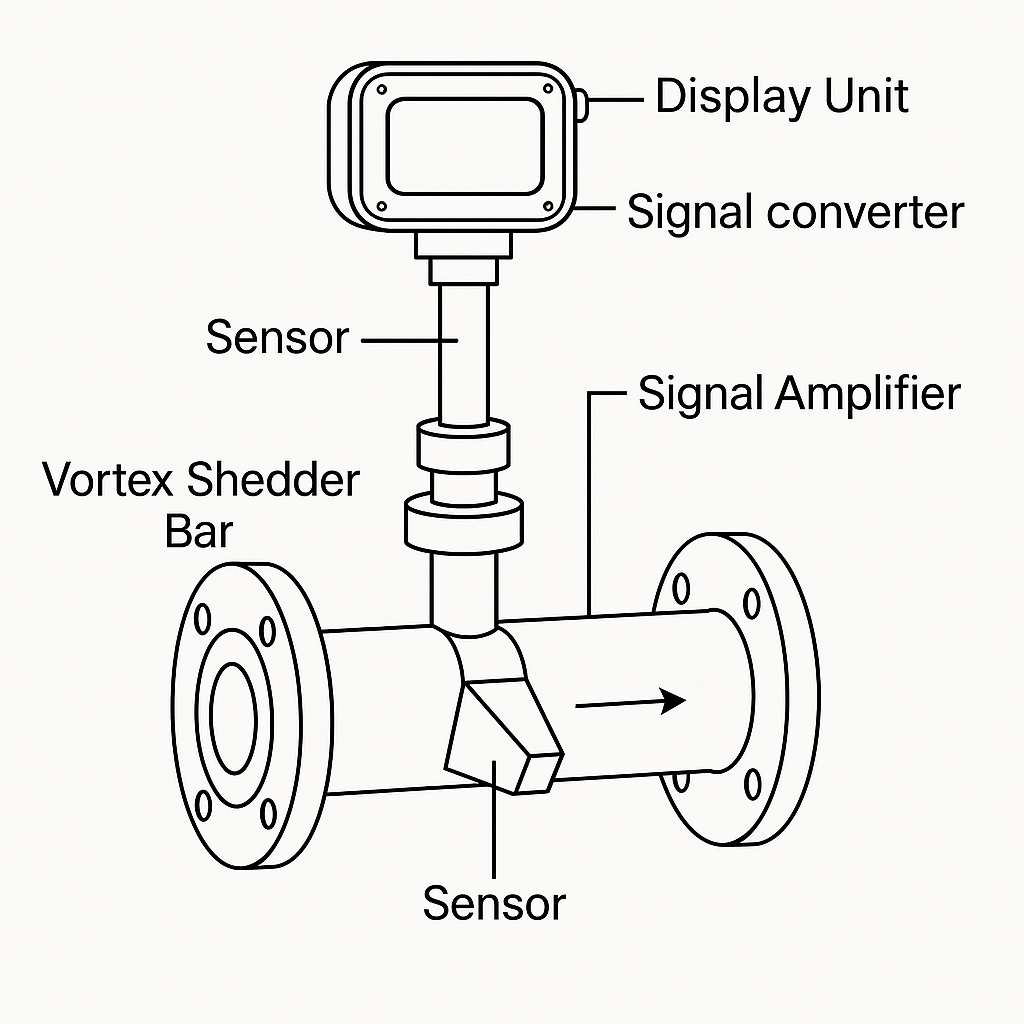
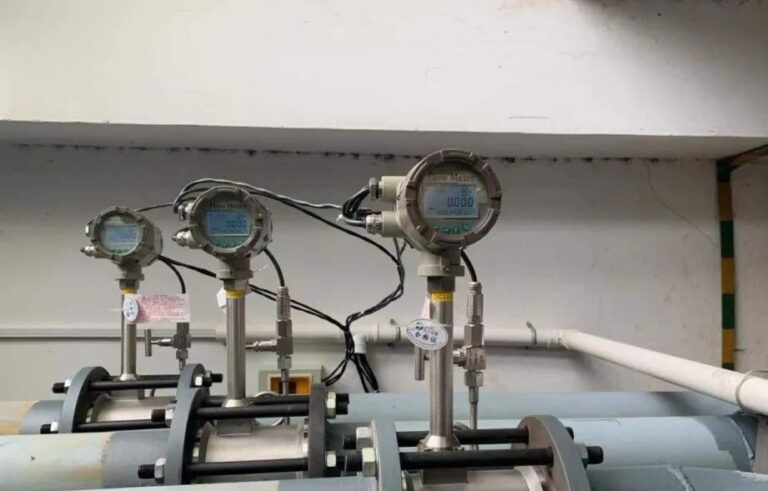
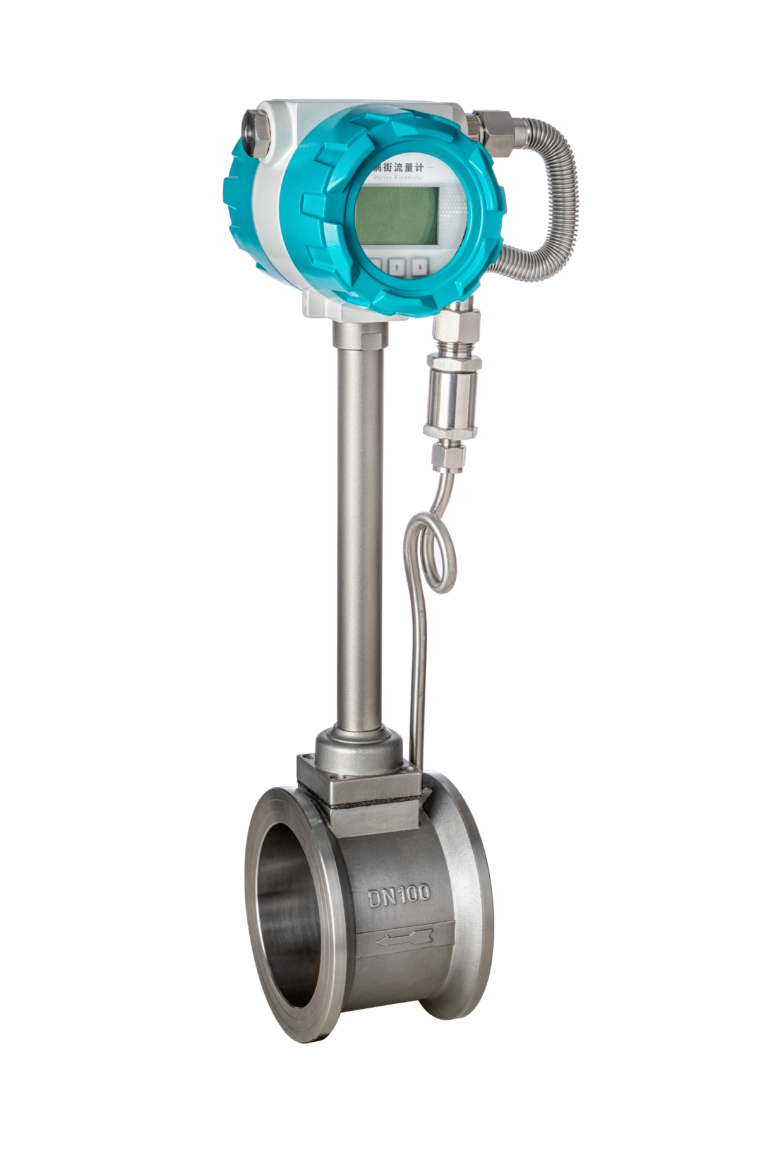
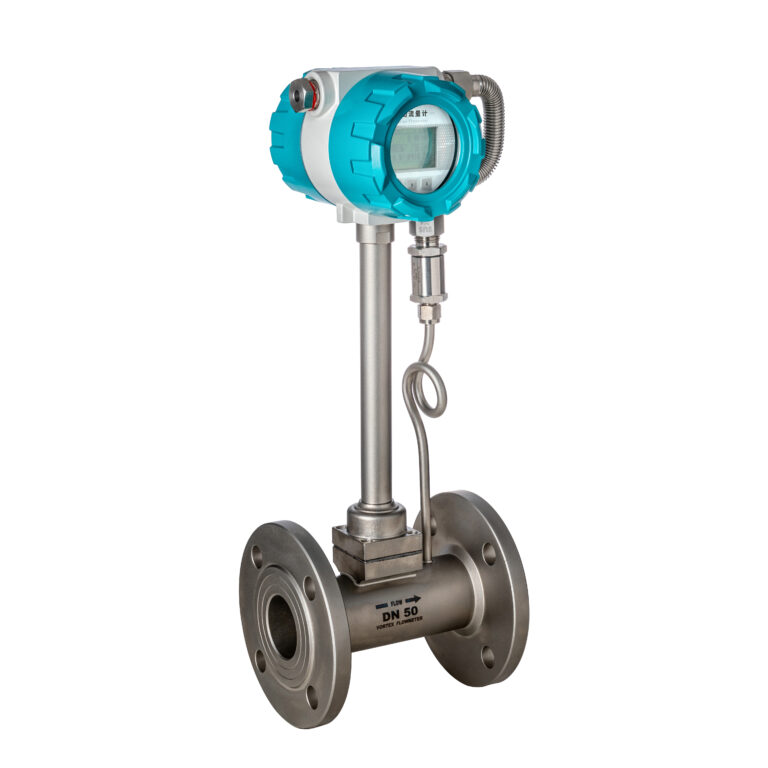
Vortex flow meters operate based on the Kármán vortex shedding principle. When fluid flows past a bluff body (vortex shedder), alternating vortices are generated downstream. The shedding frequency is directly proportional to the fluid velocity, allowing accurate flow measurement.
Although vortex flow meters are widely used for steam, gas, and liquid flow measurement, some common faults may occur during operation.
This guide summarizes the most common problems, possible causes, and troubleshooting solutions.
1. No Flow Display (Output Signal = 0 or Fixed Value)
This is one of the most common issues in field applications.
Possible Causes
Power Supply Failure
24VDC power interruption
fuse blown
reverse polarity wiring
Typical symptom: No display on the transmitter, output remains at 0 mA.
Sensor and Converter Connection Failure
broken signal cable
loose terminals
poor shield grounding
Typical symptom: The converter receives no input signal and shows zero flow.
Vortex Shedder or Sensor Probe Blockage
Particles, fibers, or sludge may accumulate around the bluff body or sensor probe.
Typical symptom: Fluid is flowing but no signal is detected.
Transmitter Damage
Internal electronic components such as:
amplifier circuit
frequency converter module
may fail.
Typical symptom: Power supply is normal but no output signal.
2. Unstable Flow Reading (Fluctuating Signal)
If the reading jumps up and down, the issue is usually related to the flow condition.
Disturbed Flow Profile
Insufficient straight pipe length upstream is the most common reason.
Recommended:
upstream ≥ 10D
downstream ≥ 5D
Disturbance sources include:
elbows
valves
pumps
reducers
Typical symptom: Reading fluctuation synchronized with pipeline vibration.
Two-Phase Flow / Air Bubbles / Condensate
For steam service:
condensate water may be present
For liquid service:
air bubbles may enter the pipeline
This causes unstable vortex frequency.
Typical symptom: Signal fluctuation changes with process pressure or temperature.
Incorrect Installation
If the sensor is not centered or installed at an angle, vortex detection becomes unstable.
Typical symptom: More obvious fluctuation at low flow rates.
Electromagnetic Interference
Nearby equipment such as:
motors
inverters
VFD drives
can interfere with the pulse signal.
Typical symptom: Random fluctuation with no process correlation.
3. Flow Reading Too High or Too Low
Wrong Parameter Settings
Common wrong settings include:
pipe size
medium density
flow range
K-factor
For example, if the actual pipe size is DN100 but set as DN80, the reading will be significantly higher.