
During routine field inspections, pressure gauges are always one of the key checkpoints.
Inspectors usually look for questions such as:
- Does the pointer return to zero?
- Is the calibration label still valid?
- Is the seal intact?
- Is there a red mark on the dial?
Most people understand the first few items.
But when it comes to the red line, arguments often start on site.
The inspector says:
“A pressure gauge without a red line is a safety hazard.”
The maintenance team replies:
“This is just a normal pipeline gauge. The calibration is still valid. Why should it be considered non-compliant?”
So who is right?
The truth is: not every pressure gauge is legally required to have a red mark line.
However, if the gauge is installed on equipment such as boilers or fixed pressure vessels where regulations clearly require it, then the absence of the red line cannot simply be ignored.
The key issue is not whether the gauge has a red line or not.
The real question is:
- Where is the gauge installed?
- Which regulation applies to that equipment?
- What level of operational risk does the process involve?
What Is the Red Line Actually Used For?
Many people casually call it:
- a “high-pressure line”
- a “warning line”
- a “danger line”
But these terms are not technically accurate.
In most regulations, the red line refers to the mark indicating the normal working pressure.
Its purpose is simple:
It provides operators with a quick visual reference.
With one glance, field personnel can immediately determine:
- whether the pressure is within the normal operating range
- whether it is approaching the control limit
- whether the process condition is deviating from normal operation
This becomes especially important on equipment such as boilers and pressure vessels, where pressure deviations may lead to:
- overpressure conditions
- safety valve release
- shutdowns
- equipment damage
- or even serious accidents
The red line is therefore not just decoration.
It is part of practical visual safety management.
However, that still does not mean every pressure gauge in a plant must automatically have one.
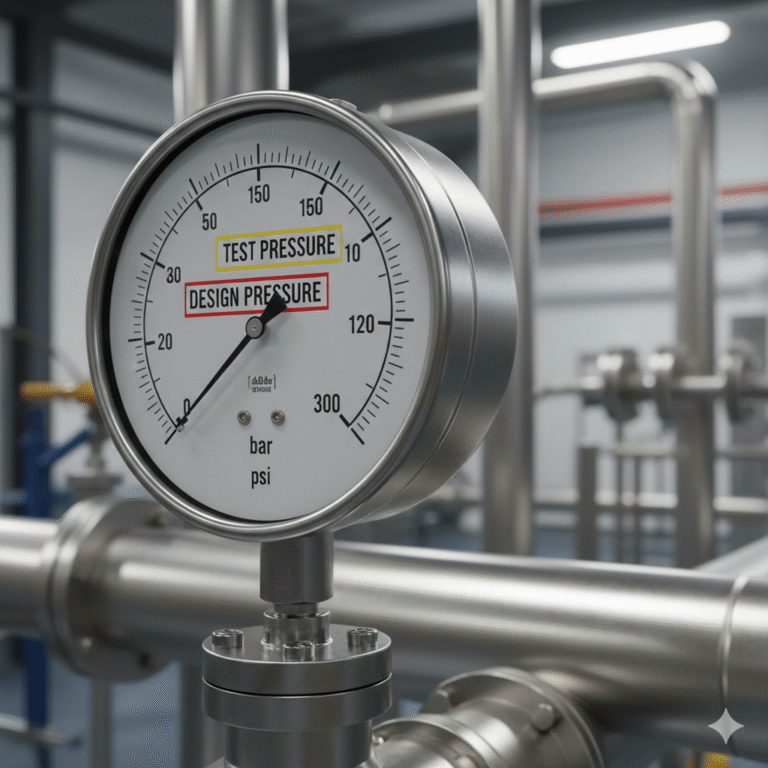
Pressure Gauges on Boilers and Fixed Pressure Vessels
If a pressure gauge is installed on a boiler or fixed pressure vessel, then specific regulations usually apply.
For example:
- TSG 21-2016 — Supervision Regulation on Safety Technology for Stationary Pressure Vessels
- TSG 11-2020 — Boiler Safety Technical Regulation
Both regulations clearly require several things after gauge verification:
- the pressure gauge must be calibrated before installation
- the working pressure red line must be marked on the dial
- the next calibration date must be indicated
- the gauge must be sealed after verification
This means that for these regulated equipment categories, checking only the calibration validity is not enough.
Inspectors should also verify:
- whether the red line exists
- whether the seal is intact
- whether the next calibration date is shown
- whether the range and accuracy are suitable
- whether the installation location is appropriate
If such gauges do not have a red mark line, they may fail to comply with the applicable inspection and identification requirements.
What About Storage Tanks?
Some articles online quote AQ 3053-2015 and claim that all storage tank pressure gauges must have red lines.
This should be interpreted carefully.
Two important points are often overlooked:
- The document is a safety technical code, not a universal mandatory rule for every gauge.
- The storage tank must actually fall within the scope of that standard.
In practice, engineers should avoid mechanically applying rules simply because the equipment is called a “tank.”
The actual equipment category, design basis, and applicable regulations must all be considered together.

Ordinary Pipeline Pressure Gauges
Most field disputes actually happen here.
Not on boilers.
Not on pressure vessels.
But on ordinary process pipelines.
Examples include:
- circulating water systems
- compressed air branch lines
- utility piping
- general process monitoring points
For these pressure gauges, if they are not directly governed by boiler or pressure vessel regulations, and if neither the design documents nor company procedures require a red line, then it is usually inappropriate to classify “no red line” alone as a safety hazard.
This is one of the most misunderstood areas in field inspections.
Requirements intended for regulated pressure equipment should not automatically be expanded to every pressure gauge in an industrial plant.
Can GB/T 1226 Be Used as the Basis for Mandatory Red Lines?
Another common statement is:
“GB/T 1226 is the pressure gauge standard, so all gauges must have red lines.”
This interpretation is also inaccurate.
GB/T 1226-2017 is primarily a product standard.
It mainly covers:
- gauge classification
- technical requirements
- testing methods
- marking
- packaging
It is not a direct legal basis for requiring every field-installed pressure gauge to have a red working-pressure mark.
In addition, GB/T standards are generally recommended national standards rather than mandatory regulatory enforcement documents.
Therefore, actual field judgment should still be based on:
- equipment category
- applicable regulations
- design requirements
- and company management procedures

How Should Site Personnel Judge the Situation Correctly?
The first step is to identify the equipment type.
- For boilers, refer to TSG 11.
- For fixed pressure vessels, refer to TSG 21.
- For storage tanks, refer to AQ 3053 together with design documentation.
- For ordinary pipelines, avoid directly applying boiler or pressure vessel requirements.
The second step is to review internal documentation.
Questions to check include:
- Does the design specify a normal operating pressure?
- Does the operating procedure define a pressure control range?
- Does the risk notification card mention pressure limits?
- Does the company instrument management procedure require red lines or visual pressure markings?
If the company procedure requires them, then the requirement should be followed.
Finally, evaluate the operational risk.
Even when regulations do not explicitly require red lines, they are still strongly recommended for:
- high-pressure systems
- flammable media
- explosive media
- toxic processes
- frequently operated equipment
- critical interlocks
- key control points
The cost of marking a red line is extremely low.
But a single operator misjudgment caused by unclear pressure indication can be very expensive.

How Should Inspection Records Be Written Properly?
Many inspection reports simply state:
“Pressure gauge has no red line and therefore presents a safety hazard.”
This wording is often too vague.
A better approach is to reference the actual applicable regulation.
For example, for a boiler system:
“This pressure gauge is installed on a boiler system. According to TSG 11-2020 Clause 5.2.3, the gauge shall be periodically verified, marked with the working pressure red line, provided with the next verification date, and sealed after verification. The red working-pressure mark was not observed during inspection and therefore does not comply with the requirement.”
For a fixed pressure vessel:
“This pressure gauge is installed on a stationary pressure vessel. According to TSG 21-2016 Clause 9.2.1.2, the pressure gauge shall be verified before installation, marked with the working pressure red line, provided with the next verification date, and sealed after verification. The working pressure red mark was not found during inspection.”
For ordinary pipeline gauges, a softer recommendation may be more appropriate:
“The pressure gauge does not include a visual working-pressure identification mark. It is recommended to improve visual pressure indication according to process control requirements, operational risk level, and company instrument management practices.”
There is a major difference between:
- “non-compliant”
and - “recommended for improvement”
Professional inspection records should clearly distinguish between the two.

Why More Plants Are Beginning to Use Red Lines Voluntarily
Even when regulations do not explicitly require them, many factories still choose to implement red-line marking practices.
The reason is practical.
Operators may not always remember the normal operating pressure of every system.
This becomes even more challenging during:
- night shifts
- emergency operations
- staff turnover
- startup and shutdown conditions
- multi-unit operations
A simple visual pressure mark can significantly reduce the risk of:
- operator misjudgment
- unnoticed pressure deviation
- delayed abnormal-condition response
- accidental overpressure
In many cases, the red line functions as a low-cost but highly effective layer of operational safety management.

Conclusion
The issue of pressure gauge red lines should neither be ignored nor exaggerated.
The correct approach is straightforward:
- If regulations require it, it must be marked.
- If company procedures require it, it must be followed.
- For high-risk processes, it is strongly recommended.
- For ordinary applications, avoid making unsupported judgments.
Pressure gauge red lines are not a universal “one-size-fits-all” requirement.
But where they are required, they should never be missing.