
Bus-type instruments (e.g., HART, FF, Profibus-PA) and 4-20mA instruments are two mainstream signal transmission solutions in industrial automation. While they share certain functional connections, they also have essential differences:
Core Differences
- Signal Type
- 4-20mA Instruments: Analog signal (continuous current signal, only transmitting a single variable).
- Bus-Type Instruments: Digital signal (data packets, can transmit multiple variables and statuses).
- Transmission Content
- 4-20mA: Transmits only one main measurement value (e.g., flow, pressure).
- Bus-Type: Can transmit multiple values (e.g., pressure, temperature, density), instrument status (fault, calibration info), and configuration parameters (range, damping).
- Wiring Method
- 4-20mA Instruments: Two-wire or three-wire setup (each instrument wired separately).
- Bus-Type: Multiple instruments are connected in series on the same cable.
- Wiring Cost
- 4-20mA Instruments: The more instruments, the higher the cost of cables and cable trays.
- Bus-Type: Multiple instruments share a single cable, significantly reducing wiring costs (especially for large systems).
- Interaction Capability
- 4-20mA Instruments: Unidirectional transmission (only from instrument to control system), local configuration requires a hand-held device.
- Bus-Type: Bidirectional communication (control system ↔ instrument), supports remote configuration, calibration, and diagnostics.
- Anti-Interference Ability
- 4-20mA Instruments: Analog signals are susceptible to electromagnetic interference (shielded cables required).
- Bus-Type: Digital signals include a verification mechanism, offering stronger resistance to interference.
- Expansion Capability
- 4-20mA Instruments: Each instrument supports only one variable; expansion requires additional hardware.
- Bus-Type: Single instrument can support additional functions (e.g., enabling temperature compensation in the future).
- Cost Variance
- 4-20mA Instruments: Low instrument cost, but high wiring/maintenance costs.
- Bus-Type: High instrument cost, but low wiring/maintenance costs.
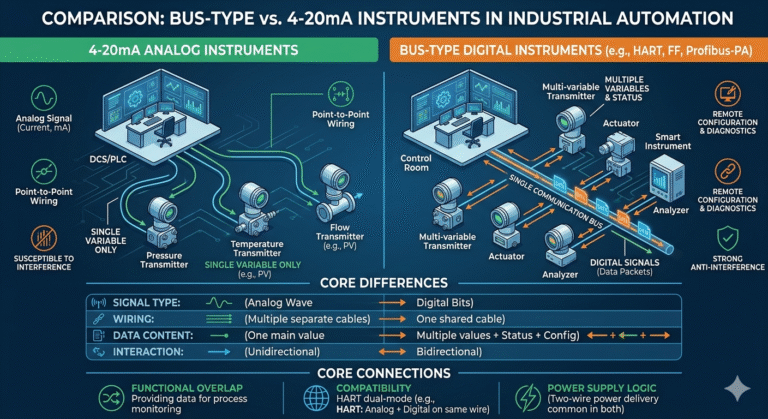
Core Connections
- Functional Overlap:
Both systems are primarily designed for transmitting process variables (e.g., flow, pressure). The ultimate goal is to provide data to the control system for process monitoring and control. - Compatibility and Integration:
Many bus-type instruments (e.g., HART instruments) support “analog + digital” dual-mode transmission: they can output 4-20mA analog signals (compatible with traditional systems) while also transmitting digital signals via HART protocol on the same cable (enabling bus functionality). - Power Supply Logic:
Most bus-type instruments (e.g., FF, Profibus-PA) use a two-wire bus power supply, which is consistent with the two-wire power supply logic of 4-20mA instruments (both power and signal transmission are combined in the same cable).
Key Takeaways:
- Fundamental Difference: 4-20mA is an “analog transmission solution for a single variable,” whereas bus-type is a “digital, bidirectional transmission solution for multiple variables.” The latter is more suitable for smart and large-scale industrial systems.
- Core Connection: Both serve process data transmission needs, and some bus instruments are compatible with 4-20mA signals, facilitating the transition between old and new systems.