
In industrial pressure measurement, many engineers focus only on pressure range, output signal, or installation size, while overlooking one critical factor:
Should the application use a gauge pressure transmitter or an absolute pressure transmitter?
In many normal applications, a gauge pressure transmitter is completely sufficient. However, in some special operating conditions — especially vacuum, low-pressure, or precision control systems — using the wrong pressure reference can lead to unstable readings, zero drift, inaccurate control, and even process failure.
This article explains the practical difference between gauge pressure and absolute pressure transmitters, and the industrial situations where absolute pressure measurement is essential.
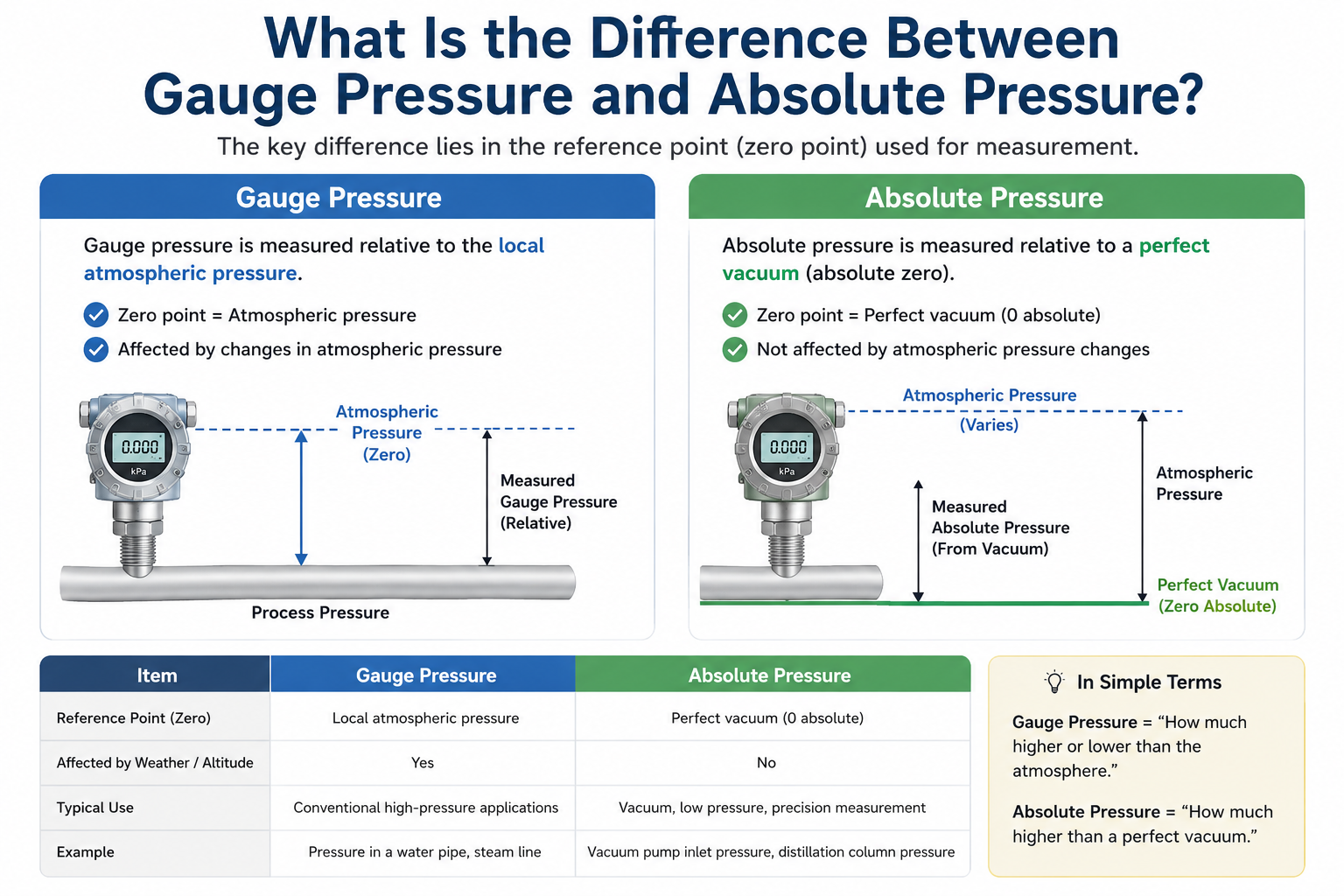
What Is the Difference Between Gauge Pressure and Absolute Pressure?
A gauge pressure transmitter uses the local atmospheric pressure as its zero reference point.
That means:
- Atmospheric pressure changes caused by weather, altitude, or environmental conditions can influence the measurement.
- The displayed value is pressure relative to the surrounding atmosphere.
An absolute pressure transmitter uses a perfect vacuum as its zero reference point.
That means:
- The measurement is independent of atmospheric pressure changes.
- The reading remains stable even when weather or altitude changes.
In simple terms:
| Type | Reference Point |
|---|---|
| Gauge Pressure | Atmospheric pressure |
| Absolute Pressure | Perfect vacuum |
This difference becomes extremely important in vacuum and low-pressure applications.
Why Gauge Pressure Becomes Unstable in Vacuum Applications
Vacuum systems are one of the most common applications requiring absolute pressure measurement.
Typical examples include:
- Vacuum pumps
- Vacuum tanks
- Vacuum distillation towers
- Condensers
- Evaporation systems
- Decompression processes
In these systems, the operating pressure is often very close to atmospheric pressure.
For example:
- Atmospheric pressure: 101.3 kPa
- Actual process pressure: 95 kPa absolute
The real vacuum level is only about 6.3 kPa below atmospheric pressure.
If the local atmospheric pressure changes due to weather or altitude, the measured gauge pressure may drift significantly, even though the actual process condition remains unchanged.
This is why vacuum applications almost always require an absolute pressure transmitter.
Applications That Typically Require Absolute Pressure Measurement
1. Vacuum and Negative Pressure Systems
This is the most important category.
Applications include:
- Vacuum distillation
- Vacuum drying
- Vacuum packaging
- Reactor vacuum systems
- Vacuum filtration systems
In these processes, stable vacuum measurement is critical for product quality and process control.
2. High Altitude or Areas with Large Atmospheric Pressure Changes
In mountainous or high-altitude regions, atmospheric pressure can vary significantly.
Typical issues with gauge pressure measurement include:
- Daily zero drift
- Seasonal measurement deviation
- Unstable low-pressure readings
Absolute pressure transmitters eliminate these problems because they are not affected by atmospheric pressure fluctuations.

3. Precision Chemical and Pharmaceutical Processes
Many precision industrial processes require pressure values referenced to absolute vacuum rather than atmospheric pressure.
Typical applications include:
- Fine chemical dosing systems
- Pharmaceutical reactors
- Distillation columns
- Extraction systems
- Food ingredient processing
These applications require highly stable pressure control for repeatable product quality.
4. Low Pressure and Micro-Pressure Measurement
Small pressure ranges are extremely sensitive to atmospheric pressure variation.
Typical applications include:
- Furnace negative pressure
- Micro vacuum monitoring
- Small differential pressure systems
- Laboratory pressure control
In these situations, even small atmospheric changes can create large measurement errors when using gauge pressure transmitters.
Absolute pressure measurement provides much better stability.
5. Sealed Tanks and Inert Gas Protection Systems
Applications include:
- Nitrogen blanketing systems
- Sealed storage tanks
- Explosion-proof sealed vessels
- Inert gas protection systems
Because internal pressure may be very close to atmospheric pressure, gauge pressure measurement can become unstable.
Absolute pressure measurement provides a more accurate indication of the true internal pressure.
6. Flow Measurement with Pressure Compensation
Many gas flow calculations require absolute pressure values.
Typical applications include:
- Natural gas flow compensation
- Compressed air systems
- Environmental monitoring
- Emission monitoring systems
Using gauge pressure in these systems can produce inaccurate compensated flow calculations.

When Is a Gauge Pressure Transmitter Still Sufficient?
Gauge pressure transmitters are still the best choice for many conventional industrial applications.
Typical examples include:
- Water pipelines
- Steam systems
- Hydraulic systems
- High-pressure process lines
- General industrial monitoring
When process pressure is much higher than atmospheric pressure, the influence of atmospheric variation becomes negligible.
In these cases, a gauge pressure transmitter is simpler and more economical.
Simple Selection Guide
| Application | Recommended Type |
| Vacuum systems | Absolute pressure |
| Low-pressure applications | Absolute pressure |
| High-altitude installations | Absolute pressure |
| Precision process control | Absolute pressure |
| Gas flow compensation | Absolute pressure |
| Conventional high-pressure pipelines | Gauge pressure |

Final Thoughts
Many pressure measurement problems in industrial systems are not caused by poor transmitter quality, but by choosing the wrong pressure reference type.
If your application involves:
- Vacuum
- Low pressure
- Micro-pressure
- Precision process control
- Gas compensation calculations
- Large atmospheric pressure variation
then an absolute pressure transmitter is usually the correct solution.
For normal high-pressure industrial piping systems, a standard gauge pressure transmitter is typically more than sufficient.
Understanding this difference can greatly improve measurement stability, process reliability, and long-term control accuracy.