
Both chemical and paper industry instruments belong to the category of process automation, but they differ greatly in terms of process media, operating conditions, control objectives, and safety levels. This results in significant differences in selection, structure, accuracy, protection, and functional priorities. Below is a detailed comparison across various dimensions:
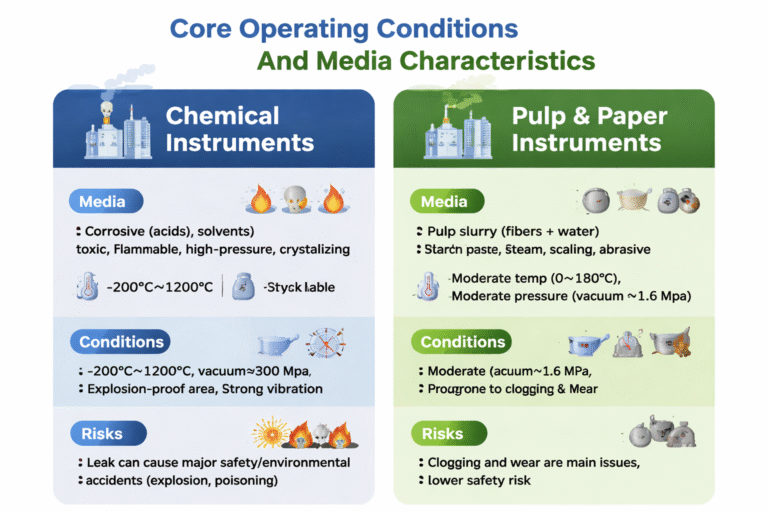
1. Core Operating Conditions and Media Characteristics
Chemical Instrumentation:
- Media: Highly corrosive (acids, alkalis, salts, organic solvents), toxic, flammable/explosive, high temperature/pressure, high purity, prone to crystallization and polymerization, and contains particles.
- Operating Conditions: Extreme temperatures from -200°C to 1200°C, vacuum to 300 MPa, explosive zones (Ex), strong vibration, and high radiation.
- Risks: Leaks can cause major safety/environmental accidents, and instrument failure can lead to explosions, poisoning, and fires.
Paper Industry Instrumentation:
- Media: Pulp (fiber + water), black liquor/white liquor (alkaline), white water, starch glue, calcium carbonate, clean water, steam.
- Operating Conditions: Medium temperature (0-180°C), medium pressure (vacuum to 1.6 MPa), high humidity, fibrous media, prone to scaling, clogging, and high wear.
- Risks: Clogging, wear, and material build-up are primary concerns, with safety risks much lower than those in the chemical industry.
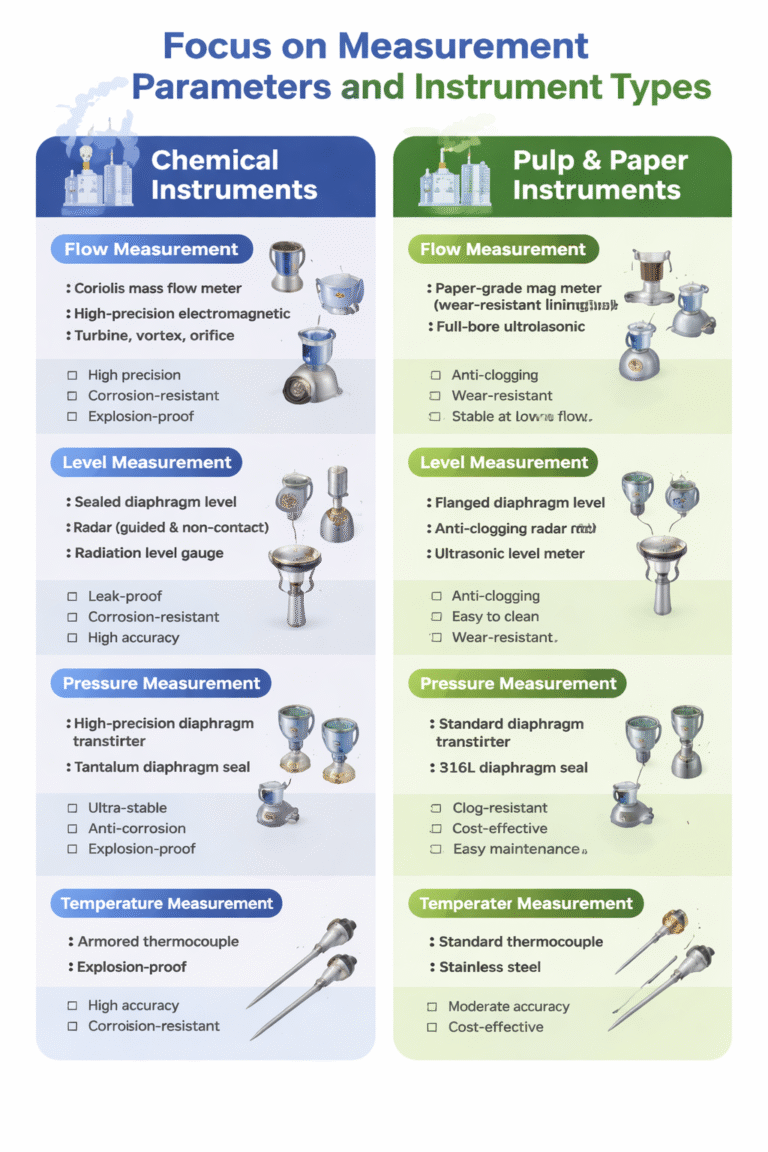
2. Focus on Measurement Parameters and Instrument Types
Flow Measurement:
Chemical Instruments:
- Media: Clean liquids, gases, steam, high viscosity, corrosive, high-precision trade settlements.
- Common Instruments: Coriolis mass flow meters (high precision ±0.1%), high-precision electromagnetic, turbine, vortex, orifice plates, and oval gear meters.
- Requirements: Explosion-proof, corrosion-resistant, high precision, clog-free (for clean media).
Paper Industry Instruments:
- Media: Pulp (high solid content, fibers, high wear), black liquor, white water, glue, lime slurry.
- Common Instruments: Paper-specific electromagnetic flow meters (abrasion-resistant linings like polyurethane, chloroprene, PTFE; abrasion-resistant electrodes like tungsten carbide), full-bore, clog-free structures, wedge flow meters, and ultrasonic.
- Requirements: Clog-resistant, fiber entanglement resistant, abrasion-resistant, stable at low flow speeds, and resistant to foam interference.
Level Measurement:
Chemical Instruments:
- Media: Toxic, highly corrosive, crystallization-prone, high temperature/pressure, polymerization.
- Common Instruments: Diaphragm-sealed level, radar (guided/non-contact), magnetic level (corrosion-resistant), radioactive level, servo, and dual flange.
- Requirements: Fully sealed, leak-proof, corrosion-resistant, explosion-proof, high precision.
Paper Industry Instruments:
- Media: Pulp pools, white water tanks, black liquor tanks, wood chip bins, chemical storage (fibers, viscous, scaling, material build-up).
- Common Instruments: Flanged diaphragm level, radar (anti-material build-up), ultrasonic, radioactive (wood chips/high-concentration pulp), and magnetostrictive.
- Requirements: Anti-material build-up, fiber clogging resistance, scaling resistance, abrasion resistance, easy to clean.
Pressure/Differential Pressure Measurement:
Chemical Instruments:
- Operating Conditions: Ultra-high pressure, highly corrosive, high temperature, prone to crystallization/clogging.
- Instruments: Single crystal silicon/capacitive high-precision transmitters (±0.075%), diaphragm seal (tantalum/hastelloy/titanium), explosion-proof.
- Requirements: Extremely stable, high precision, strong corrosion resistance, explosion-proof, clog-resistant, long life.
Paper Industry Instruments:
- Operating Conditions: Medium pressure, alkaline corrosion, slurry clogging, scaling, high humidity.
- Instruments: Standard intelligent transmitters, diaphragm seal (316L/duplex steel), general corrosion resistance.
- Requirements: Clog-resistant, alkaline-resistant, scaling-resistant, cost-effective, easy maintenance.
Temperature Measurement:
Chemical Instruments:
- Operating Conditions: Ultra-high/low temperature, strong corrosion, explosion-proof, strong vibration.
- Instruments: Armored thermocouples/RTDs, explosion-proof, corrosion-resistant casings (hastelloy), multi-point thermocouples.
- Accuracy: ±0.1~±0.5°C (critical control in reactors).
Paper Industry Instruments:
- Operating Conditions: Medium temperature, high humidity, steam, alkaline, slight wear.
- Instruments: Standard thermocouples/RTDs, general stainless steel casings.
- Accuracy: ±1°C (cooking/drying processes).
3. Material and Structural Design Differences
Chemical Instruments:
- Contact Materials: Hastelloy, tantalum, titanium, Monel, zirconium, PTFE, glass (for high corrosion).
- Seals: Metal hard seals, welded seals, double seals (for leak-proof).
- Explosion-Proof: Ex d IIC T6, Ex ia (flameproof/intrinsic safety).
- Structure: No dead zones, easy purging, anti-crystallization, anti-polymerization.
Paper Instruments:
- Contact Materials: 316L, duplex steel, polyurethane lining, chloroprene rubber, tungsten carbide electrodes (abrasion-resistant, alkaline-resistant).
- Structure: Full-bore, clog-free, large-diameter, easy to disassemble for cleaning, anti-fiber entanglement.
- Protection: IP67/IP69K (high humidity, wash-resistant).
- Explosion-Proof: Generally non-explosion-proof (except for chemical storage areas).
4. Control Precision and Response Requirements
Chemical Instruments:
- Accuracy: Very high (flow ±0.1~0.5%; pressure ±0.075%; temperature ±0.1°C).
- Response: Extremely fast (ms-level for preventing runaway reactions).
- Control: Complex cascade, ratio, feed-forward, interlock SIS (Safety Instrumented System).
- Stability: Annual drift <0.1%, long-term maintenance-free.
Paper Instruments:
- Accuracy: Moderate (flow ±0.5~2%; concentration ±0.5%; temperature ±1°C).
- Response: Fast (s-level, suitable for paper quality control).
- Control: Primarily PID, simple interlock, concentration/flow/tension closed-loop.
- Stability: Strong anti-interference (pulp foam, fiber interference).
5. Safety and Certification Requirements
Chemical Instruments:
- Mandatory Certifications: Explosion-proof (Ex), pressure pipeline components, SIL2/SIL3 safety levels.
- Leakage Level: VI-level (zero leakage).
- Compliance: API, ANSI, IEC, GB chemical industry standards.
Paper Instruments:
- Certifications: General CE, ISO, no mandatory explosion-proof/SIL.
- Leakage: No strict zero leakage requirement.
- Compliance: Light industry standards.

6. Typical Process Application Comparison
Chemical Industry (Refining/Chemicals):
- Reactor: High-precision temperature, pressure, flow, composition analysis, SIS safety interlock.
- Distillation Tower: Pressure, level, flow, high-precision control.
- Tank Area: Explosion-proof level, flammable/toxic gas detection.
- Pipelines: Mass flow meters for trade settlements, high-pressure corrosion resistance.
Paper Industry (Pulping + Papermaking):
- Pulping: Pulp pool level, black/white liquor flow, cooking temperature/pressure, concentration control.
- Stock Chest: Pressure ±0.5%, pulp flow, concentration ±0.5%.
- Paper Machine: Basis weight, moisture, speed, tension, drying temperature.
- Alkali Recovery: Alkali-resistant, medium temperature/pressure, anti-scaling.
7. Maintenance and Lifespan Differences
Chemical Instruments:
- Maintenance: Long cycle, high requirements, no on-pressure disassembly, specialized repairs.
- Lifespan: 10-15 years (high-end).
- Spare Parts: Expensive, specialized materials.
Paper Instruments:
- Maintenance: Frequent cleaning, anti-clogging, replacement of wear parts (linings/electrodes).
- Lifespan: 5-8 years (due to wear).
- Spare Parts: Cost-effective, common parts.

Conclusion: Core Differences in One Sentence
- Chemical Instrumentation: Designed for safety, corrosion resistance, high precision, explosion-proof environments, emphasizing zero leakage, ultra-stability, and high reliability.
- Paper Instrumentation: Designed for anti-clogging, abrasion resistance, fiber entanglement, and alkali scaling, focusing on interference resistance, ease of maintenance, and cost-effectiveness.