
Many people start a flowmeter inquiry with one simple question:
“I need a DN100 flowmeter. How much is it?”
After many years in industrial instrumentation, this is actually one of the most difficult questions to answer properly.
Not because a price cannot be given.
But because pipe size alone is nowhere near enough to select a flowmeter.
What is the fluid?
Is it a liquid, gas, or steam?
What are the minimum, normal, and maximum flow rates?
What are the operating temperature and pressure?
Is the fluid conductive?
Is it corrosive?
Does it contain solids, fibers, bubbles, or suspended particles?
Is the pipe always completely full?
What accuracy is required?
These questions can completely change the recommended measurement technology.
That is why there is no such thing as the “best flowmeter.”
There is only a flowmeter that is better suited to a particular application.
This guide explains 10 commonly used flow measurement technologies, where they work well, where they do not, and what engineers should consider before making a final selection.
1. Electromagnetic Flowmeter
Keywords: Water, wastewater, conductive liquids, slurry
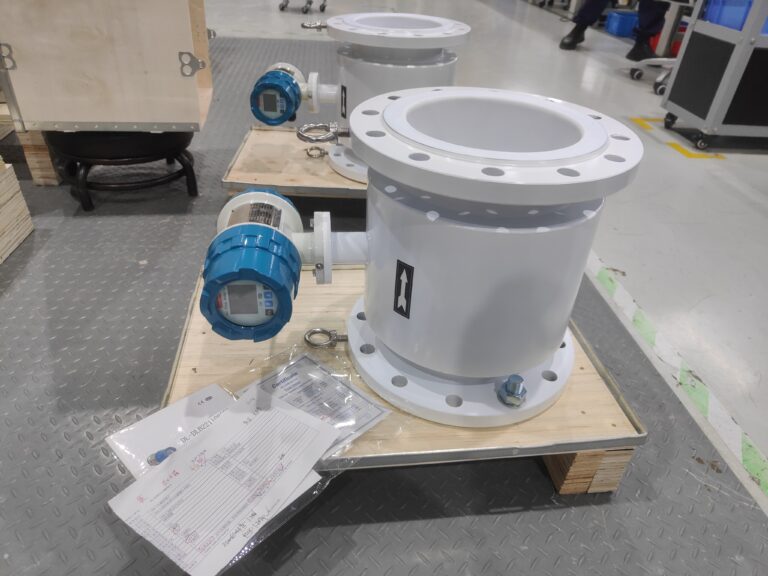
Electromagnetic flowmeters are among the most widely used flowmeters for industrial liquid measurement.
Their operating principle is based on Faraday’s law of electromagnetic induction. When a conductive liquid moves through a magnetic field, a voltage is generated. This signal can be used to determine the velocity and volumetric flow rate of the liquid.
One major advantage is that there are no mechanical moving parts inside the measuring tube.
This makes electromagnetic flowmeters particularly attractive for water, wastewater, corrosive liquids, and fluids containing suspended solids.
Typical Applications
- Potable water
- Raw water
- Wastewater
- Cooling and circulating water
- Acids and alkalis
- Salt solutions
- Industrial wastewater
- Slurries
- Pulp and paper applications
- Mining applications
They are commonly found in municipal water treatment, wastewater treatment, chemical processing, mining, metallurgy, pulp and paper, and many other industries.
Main Limitation
The liquid must have sufficient electrical conductivity for the meter to operate correctly.
Therefore, electromagnetic flowmeters are generally not suitable for gases, steam, or most hydrocarbon oils.
Another important point is pipe condition: conventional electromagnetic flowmeters normally require the measuring tube to remain completely filled with liquid.
Selection Tip
Do not select an electromagnetic flowmeter by nominal pipe diameter alone.
Flow velocity matters.
For example, a DN100 pipeline does not automatically mean that a DN100 meter is always the best choice. If the actual flow is very low, a smaller meter with suitable reducers may sometimes provide better measurement performance.
2. Vortex Flowmeter
Keywords: Steam, gas, liquid
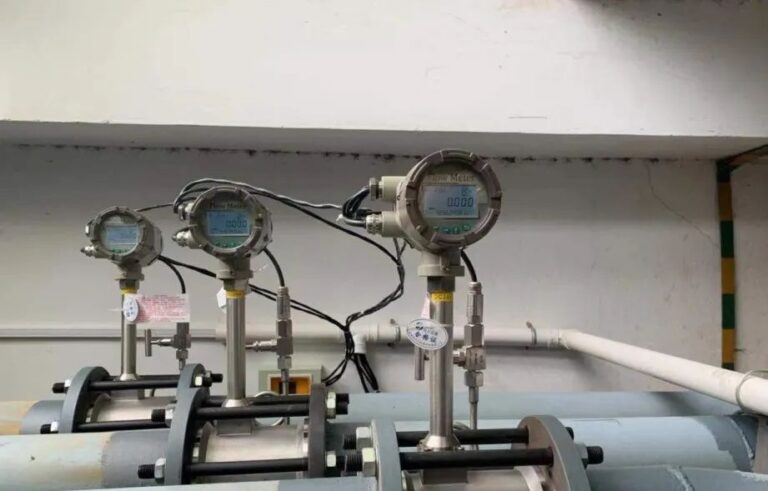
Vortex flowmeters are another common technology in industrial process measurement, particularly for steam applications.
When fluid passes a bluff body inside the meter, alternating vortices are generated downstream. The frequency of these vortices is related to fluid velocity and can therefore be used to calculate flow rate.
Typical Applications
Vortex flowmeters are frequently used for:
- Saturated steam
- Superheated steam
- Compressed air
- Nitrogen
- Process gases
- Some clean liquids
- Natural gas under suitable operating conditions
Steam is probably the application most strongly associated with vortex flowmeters.
However, a vortex meter is not simply a “steam flowmeter.” It can measure different fluids when the operating conditions are suitable.
Main Limitations
Vortex meters can be sensitive to:
- Very low flow velocity
- Excessive pipeline vibration
- Pulsating flow
- Poor upstream piping conditions
- Insufficient straight pipe runs
There must also be enough flow velocity to generate stable vortices.
For gases such as natural gas, additional factors including pressure, temperature, density compensation, flow range, and metering requirements should be considered.
3. Ultrasonic Flowmeter
Keywords: Clamp-on, large pipes, retrofit, no pipe cutting
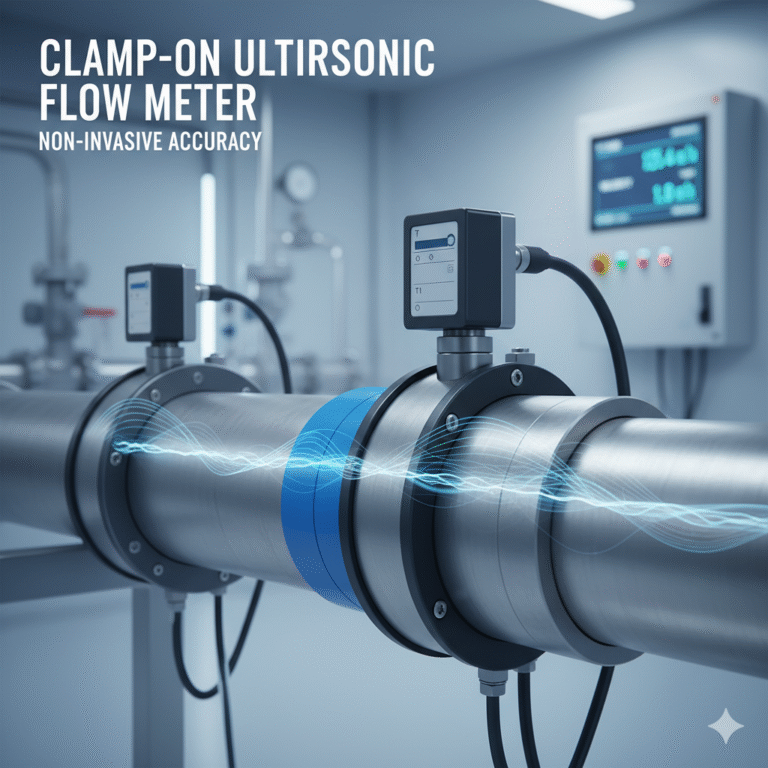
One of the biggest advantages of ultrasonic flow measurement is installation flexibility.
This is especially true for clamp-on ultrasonic flowmeters, where transducers can be installed on the outside of the pipe.
There is no need to cut the pipeline or install a measuring tube into the process.
Typical Applications
Clamp-on ultrasonic flowmeters can be particularly useful for:
- Large-diameter water pipelines
- Temporary flow measurement
- Pipeline surveys
- Energy audits
- Existing plant retrofits
- Applications where production cannot easily be stopped
Consider a DN1000 circulating-water pipeline.
Cutting such a large pipe and installing an inline flowmeter could involve significant shutdown time, fabrication work, lifting equipment, and installation cost.
A clamp-on ultrasonic flowmeter can therefore be an attractive alternative.
Main Limitations
“Clamp-on” does not mean “install it anywhere.”
Measurement performance can be affected by:
- Pipe material
- Pipe wall thickness
- Internal lining
- Pipe condition
- Fluid properties
- Entrained gas or solids
- Transducer positioning
- Acoustic signal quality
- Available straight pipe length
Correct pipe data and proper sensor installation are critical.
The greatest advantage of clamp-on ultrasonic technology is installation flexibility—not immunity to installation conditions.
4. Turbine Flowmeter
Keywords: Clean fluids, fast response, good accuracy
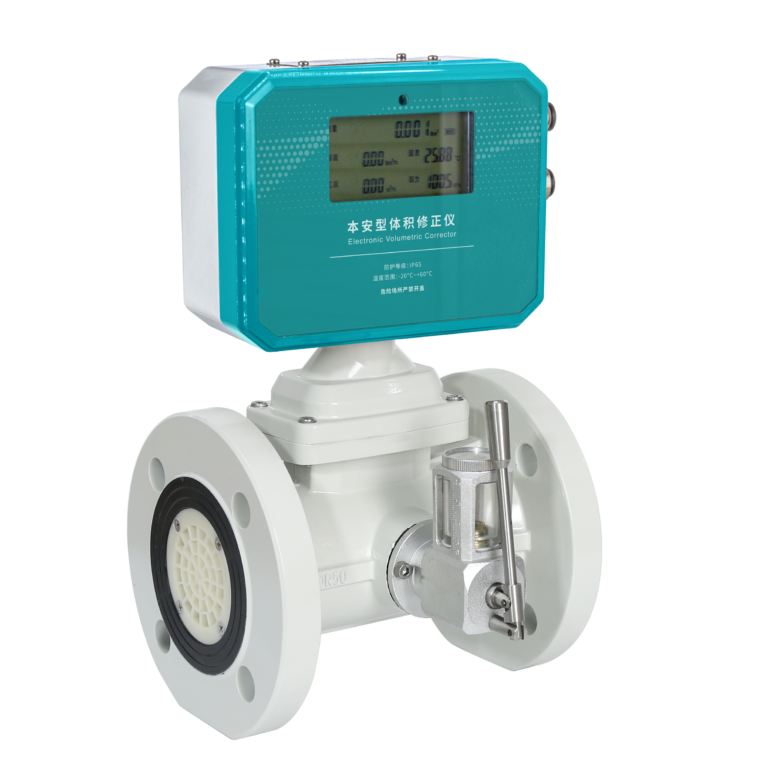
A turbine flowmeter contains a rotor positioned in the flowing fluid.
As the fluid passes through the meter, it rotates the turbine. Rotor speed is related to flow velocity and is converted into a flow signal.
Typical Applications
Turbine flowmeters are commonly considered for:
- Clean water
- Clean process liquids
- Some oils and fuels
- Clean gases
- Chemical liquids
They can offer good accuracy and fast response under suitable conditions.
Main Limitations
The turbine is a mechanical moving component.
This means turbine meters should be selected carefully for fluids containing:
- Large amounts of suspended solids
- Abrasive particles
- Fibers
- Deposits
- Contaminants that may damage or block the rotor
Viscosity changes can also influence meter performance, depending on the design and calibration.
For clean, stable fluids, turbine flowmeters can perform very well. For dirty, abrasive, or heavily contaminated media, another technology may be more appropriate.
5. Orifice Plate Flowmeter
Keywords: Differential pressure, mature technology, steam, gas
Orifice plate flow measurement is one of the most established differential-pressure flow measurement methods in industry.
An orifice plate creates a restriction in the pipeline.
As fluid passes through the restriction, a differential pressure is generated. This differential pressure can then be used to determine flow rate.
Typical Applications
Orifice-based systems can measure:
- Liquids
- Gases
- Saturated steam
- Superheated steam
- Compressed air
- Natural gas
- Process gases
The technology has been used for decades and is supported by well-established engineering practices and standards.
Advantages
- Mature technology
- Simple primary element
- Broad application range
- Well understood by engineers
- Suitable for high-temperature and high-pressure applications when properly designed
Main Limitation: Pressure Loss
The restriction that creates the differential pressure also creates permanent pressure loss.
That means the energy cost associated with the measurement should not be ignored.
The complete measurement system may also involve:
- Differential pressure transmitter
- Pressure taps
- Impulse lines
- Manifold
- Condensate pots for some steam applications
- Heat tracing
- Drain and vent arrangements
Therefore, an orifice plate may look simple, but the complete flow measurement system requires proper engineering and maintenance.

6. Thermal Mass Flowmeter
Keywords: Gas, compressed air, nitrogen, mass flow
Thermal mass flowmeters are widely used for industrial gas measurement, especially in compressed-air monitoring and energy-management projects.
The measurement is based on heat transfer between a heated sensor and the flowing gas.
One important advantage is that thermal technology can provide direct mass-flow measurement without requiring separate pressure and temperature compensation in many applications.
Typical Applications
- Compressed air
- Nitrogen
- Industrial gases
- Plant gas distribution networks
- Energy management
- Compressed-air consumption monitoring
- Leak detection programs
For example, suppose a production line is shut down at night but the compressed-air flow remains unexpectedly high.
Continuous flow monitoring can help identify excessive consumption or leakage.
Important Limitation: Gas Composition
Thermal mass flow measurement depends on the thermal properties of the gas.
Therefore, changes in gas composition can affect measurement accuracy.
A meter calibrated for air should not automatically be assumed to provide the same accuracy for another gas or a changing gas mixture.
Gas type and composition should always be confirmed during selection.

7. Coriolis Mass Flowmeter
Keywords: High accuracy, direct mass flow, density
If high-accuracy mass measurement is the priority, Coriolis technology is often one of the first options engineers consider.
Unlike conventional volumetric flowmeters, a Coriolis meter directly measures mass flow.
Depending on the instrument design, it may also provide:
- Density
- Temperature
- Volumetric flow
- Concentration-related calculations
Typical Applications
Coriolis flowmeters are widely used in:
- Petrochemical processing
- Fine chemicals
- Food and beverage
- Pharmaceutical production
- Oil and fuel measurement
- High-value liquids
- Precision batching and dosing
They are especially valuable when fluid density changes make simple volumetric measurement less desirable.
Advantages
- Direct mass-flow measurement
- Very high accuracy
- High repeatability
- Density measurement
- Suitable for many high-viscosity liquids
- Excellent for batching and high-value products
Main Limitation
Cost.
Coriolis meters are generally more expensive than many conventional flowmeter technologies, and cost can increase significantly with pipe size.
They may also create more pressure drop than some full-bore technologies, depending on meter design and application.
If you are simply measuring ordinary circulating water, installing an expensive Coriolis meter only because it is considered “high-end” usually makes little engineering or economic sense.
8. Variable-Area Flowmeter / Rotameter
Keywords: Small flow, local indication, simple operation
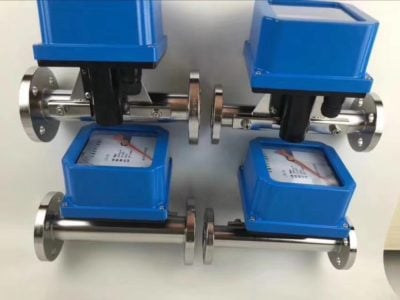
Variable-area flowmeters are among the simplest flow measurement devices used in industry.
A float moves vertically inside a tapered measuring tube as flow changes. The float position indicates the flow rate.
Typical Applications
They remain useful for:
- Small liquid flows
- Small gas flows
- Local indication
- Laboratory systems
- Equipment packages
- Auxiliary process measurement
Advantages
- Simple construction
- Easy visual indication
- Relatively low cost
- No complex electronics required for basic versions
Important Distinction
It is important not to treat every variable-area flowmeter as a simple glass-tube rotameter.
Basic glass-tube models are generally used for relatively simple, lower-pressure local indication.
Metal-tube variable-area flowmeters, however, can be designed for substantially higher pressures and temperatures and may provide electrical outputs such as 4–20 mA or digital communication.
Therefore, pressure capability and remote transmission depend strongly on the actual meter construction.
9. Positive Displacement Flowmeter
Keywords: High viscosity, oil, volumetric measurement
Positive displacement flowmeters measure fluid by repeatedly trapping and transferring known volumes through the meter.
You can think of the process as dividing the flowing liquid into many small, known volumetric portions and counting them.
Typical Applications
They are particularly useful for:
- Fuel oils
- Lubricating oils
- High-viscosity liquids
- Resins
- Additives
- Chemical products
- Certain high-accuracy liquid metering applications
Advantages
Positive displacement meters can perform very well at relatively low flow rates and with viscous liquids.
Unlike velocity-based meters, they can be particularly attractive where fluid viscosity makes other technologies less suitable.
Main Limitations
Most positive displacement designs contain moving mechanical components.
As a result, engineers need to consider:
- Fluid cleanliness
- Particle contamination
- Mechanical wear
- Pressure loss
- Maintenance requirements
- Installation conditions
The specific limitations depend on the PD meter design.

10. Open-Channel Flow Measurement
Keywords: Wastewater, channels, non-full pipes
Open-channel flow measurement is different from most of the technologies discussed above.
The objective is not to measure flow through a completely filled pressurized pipeline.
Instead, it is used for liquids flowing with a free surface.
Typical Applications
- Wastewater discharge channels
- Irrigation channels
- Industrial drainage
- Municipal wastewater systems
- Open canals
A common approach combines:
Level measurement + known hydraulic relationship of a flume, weir, or channel = calculated flow rate
Depending on the application, ultrasonic or radar level measurement may be used as part of the system.
So if you are looking at an open wastewater channel and asking:
“How should I install an electromagnetic flowmeter here?”
Stop for a moment.
You may be starting with the wrong measurement concept.
Open-channel flow measurement is better understood as an application category and measurement system, rather than one single flowmeter operating principle.
10 Flowmeter Technologies Compared
| Flowmeter Type | Typical Medium | Best-Suited Applications | Main Advantage | Main Limitation |
|---|---|---|---|---|
| Electromagnetic | Conductive liquids | Water, wastewater, slurry | No moving parts, low pressure loss | Requires sufficient conductivity |
| Vortex | Steam, gases, liquids | Steam and utility measurement | Versatile | Sensitive to low flow and vibration |
| Ultrasonic | Mainly liquids | Large pipes, retrofit projects | Clamp-on installation available | Installation and acoustic conditions matter |
| Turbine | Clean liquids/gases | Clean process fluids | Fast response, good accuracy | Moving parts |
| Orifice Plate | Liquid, gas, steam | General process and steam | Mature and widely standardized | High permanent pressure loss |
| Thermal Mass | Gases | Compressed air, nitrogen | Direct gas mass flow | Sensitive to gas composition |
| Coriolis | Liquids, some gases | High-accuracy mass measurement | Direct mass flow, very high accuracy | Higher cost |
| Variable Area | Liquids/gases | Small flow, local indication | Simple and economical | Application depends heavily on construction |
| Positive Displacement | Mainly liquids | Oils, viscous liquids | Excellent volumetric measurement | Moving parts and maintenance |
| Open Channel | Free-surface liquids | Wastewater and drainage | Designed for non-full-flow systems | Requires proper hydraulic conditions |
How Do You Actually Select a Flowmeter?
If you do not know where to start, forget the brand and model number for a moment.
Start with the process.
1. What Are You Measuring?
Is it:
- Water?
- Wastewater?
- Oil?
- Acid?
- Slurry?
- Compressed air?
- Natural gas?
- Steam?
- Another process fluid?
Fluid properties are the first filter.
2. What Is the Flow Range?
Whenever possible, provide three values:
Minimum flow
Normal flow
Maximum flow
This is much more useful than simply saying:
“The pipe is DN100.”
A flowmeter must operate within an appropriate measuring range.
Do not select a flowmeter by pipe size alone. Select it based on the required flow range first, then verify meter size, velocity, pressure loss, and installation requirements.
3. What Is the Operating Temperature?
Is the process:
- Ambient temperature?
- High temperature?
- Cryogenic or low temperature?
- Subject to large temperature changes?
Temperature affects sensor design, lining materials, seals, electronics, and installation.
4. What Is the Operating Pressure?
Consider:
- Normal operating pressure
- Maximum pressure
- Vacuum conditions
- Pressure fluctuations
- Required flange pressure rating
The meter body and process connections must be suitable for the actual design conditions.
5. What Are the Pipe and Installation Conditions?
Ask:
- What is the pipe diameter?
- Is the pipe always full?
- What is the pipe material?
- Is there an internal lining?
- How much straight pipe is available?
- Are pumps, valves, elbows, reducers, or tees located nearby?
- Can the process be shut down?
- Is vibration present?
- Is the meter installed indoors or outdoors?
A theoretically correct flowmeter can still perform badly if the installation conditions are wrong.
6. What Do You Actually Need to Measure?
Do you need:
- Volumetric flow?
- Mass flow?
- Totalized quantity?
- Local indication?
- Process control?
- Energy management?
- Batching?
- Custody-transfer measurement?
The measurement objective can completely change the appropriate solution.
A Simple First-Round Flowmeter Selection Guide
For beginners, the following rules can help narrow down the options:
Water and conductive liquids → Start by considering electromagnetic flowmeters.
Steam → Consider vortex or differential-pressure technologies.
Large pipes or pipelines that cannot easily be shut down → Consider clamp-on ultrasonic measurement.
Clean liquids → Turbine flowmeters may be worth considering.
Compressed-air energy management → Consider thermal mass flowmeters.
High-accuracy mass measurement → Consider Coriolis flowmeters.
Small flow with simple local indication → Consider variable-area flowmeters.
High-viscosity liquids and oils → Positive displacement meters may be attractive.
Open channels and non-full-flow systems → Consider open-channel flow measurement.
But remember:
This is only the first screening step—not the final selection.
Why Experienced Engineers Seem to Select Flowmeters So Quickly
New engineers sometimes wonder:
“How can an experienced instrumentation engineer ask only a few questions and already know which flowmeter to consider?”
It is not guessing.
Experience gradually creates a mental map:
Process condition → Suitable measurement technologies
See wastewater?
Electromagnetic flow measurement immediately comes to mind.
See steam?
Vortex and differential-pressure measurement become obvious candidates.
See a DN1000 circulating-water pipeline that cannot be shut down?
Clamp-on ultrasonic measurement deserves consideration.
See compressed-air energy monitoring?
Thermal mass flow measurement becomes an obvious candidate.
See high-value liquid requiring accurate batching?
Coriolis technology may move to the top of the list.
That is what engineering experience does.
It reduces the number of possibilities quickly—but it should never replace proper process data.
Never Treat an Application as the Final Selection Answer
This is extremely important.
For example:
“Wastewater means electromagnetic flowmeter.”
That is not a complete engineering answer.
You still need to know:
- Conductivity
- Solids content
- Corrosiveness
- Temperature
- Pressure
- Flow range
- Pipe condition
- Installation conditions
Domestic wastewater and concentrated industrial wastewater may both be called “wastewater,” but their actual measurement conditions can be completely different.
The same principle applies to steam, oil, compressed air, slurry, chemicals, and almost every other process fluid.
The Most Important Rule in Flowmeter Selection
After years of working with industrial instrumentation, one principle is worth remembering:
First determine whether the measurement technology can reliably measure the fluid. Then determine how it should be measured. Only after that should you select the specific flowmeter.
Many flowmeter problems do not come from poor instrument quality.
They come from incorrect selection.
A meter may fail to perform as expected because:
The measurement principle is unsuitable for the fluid.
The meter size is too large for the actual flow rate.
The minimum flow is below the meter’s effective measuring range.
The installation does not provide sufficient straight pipe.
The process contains solids, bubbles, vibration, or pulsation that were not considered.
Temperature, pressure, corrosion, or material compatibility was overlooked.
The lowest purchase price was prioritized without considering long-term operation and maintenance.
That is why professional flowmeter selection should never begin with:
“Which brand is the best?”
or simply:
“How much is a DN100 flowmeter?”
Instead, start with the process conditions.
Before requesting a quotation, try to provide at least:
Fluid + Minimum/Normal/Maximum Flow + Temperature + Pressure + Pipe Size + Installation Conditions + Required Accuracy + Measurement Purpose
With these parameters, an instrumentation engineer can quickly narrow down the appropriate technologies and recommend a much more reliable solution.
Final Thought
There is no universal flowmeter that is best for every application.
An electromagnetic flowmeter may be excellent for wastewater but useless for steam.
A vortex meter may work very well for steam but struggle at very low flow rates.
A Coriolis meter may deliver exceptional mass-flow accuracy, but it may be unnecessarily expensive for ordinary cooling water.
A clamp-on ultrasonic meter may save enormous installation cost on a large existing pipeline, but only when the pipe and acoustic conditions are suitable.
The best flowmeter is not the most expensive one, the most advanced one, or the most famous brand.
It is the one that matches the actual process conditions and delivers the required measurement performance reliably over the long term.
That is the real starting point of good flowmeter selection.
Need help selecting a flowmeter for your application?
Send us your:
Medium, pipe size, minimum/normal/maximum flow rate, operating temperature, operating pressure, process connection, required accuracy, output signal, and installation conditions.
Our engineers can help evaluate the application and recommend a suitable flow measurement solution.