
Introduction
For engineers working on Safety Instrumented Systems (SIS), one question will eventually come up:
What SIL level is required for this SIF loop?
Safety Integrity Level (SIL) is a key parameter used to define the risk reduction capability of a Safety Instrumented Function (SIF). It determines the required reliability level of safety-related components, including sensors, logic solvers, and final control elements.
Choosing a higher SIL level than necessary can significantly increase project costs, while selecting a lower SIL level may fail to meet safety requirements.
So, what are the different SIL levels? Which SIL levels are commonly used in process industries? This article will explain the basics of SIL classification.
What Is Safety Integrity Level (SIL)?
Safety Integrity Level (SIL) is a discrete level used to specify the required safety integrity of an Electrical/Electronic/Programmable Electronic (E/E/PE) safety-related system.
According to IEC 61508, SIL represents the ability of a safety function to perform correctly when required and reduce the risk of hazardous events.
There are four SIL levels:
- SIL 1 – Lowest safety integrity level
- SIL 2 – Medium safety integrity level
- SIL 3 – High safety integrity level
- SIL 4 – Highest safety integrity level
The higher the SIL level, the greater the required risk reduction capability and the lower the probability of dangerous failure.
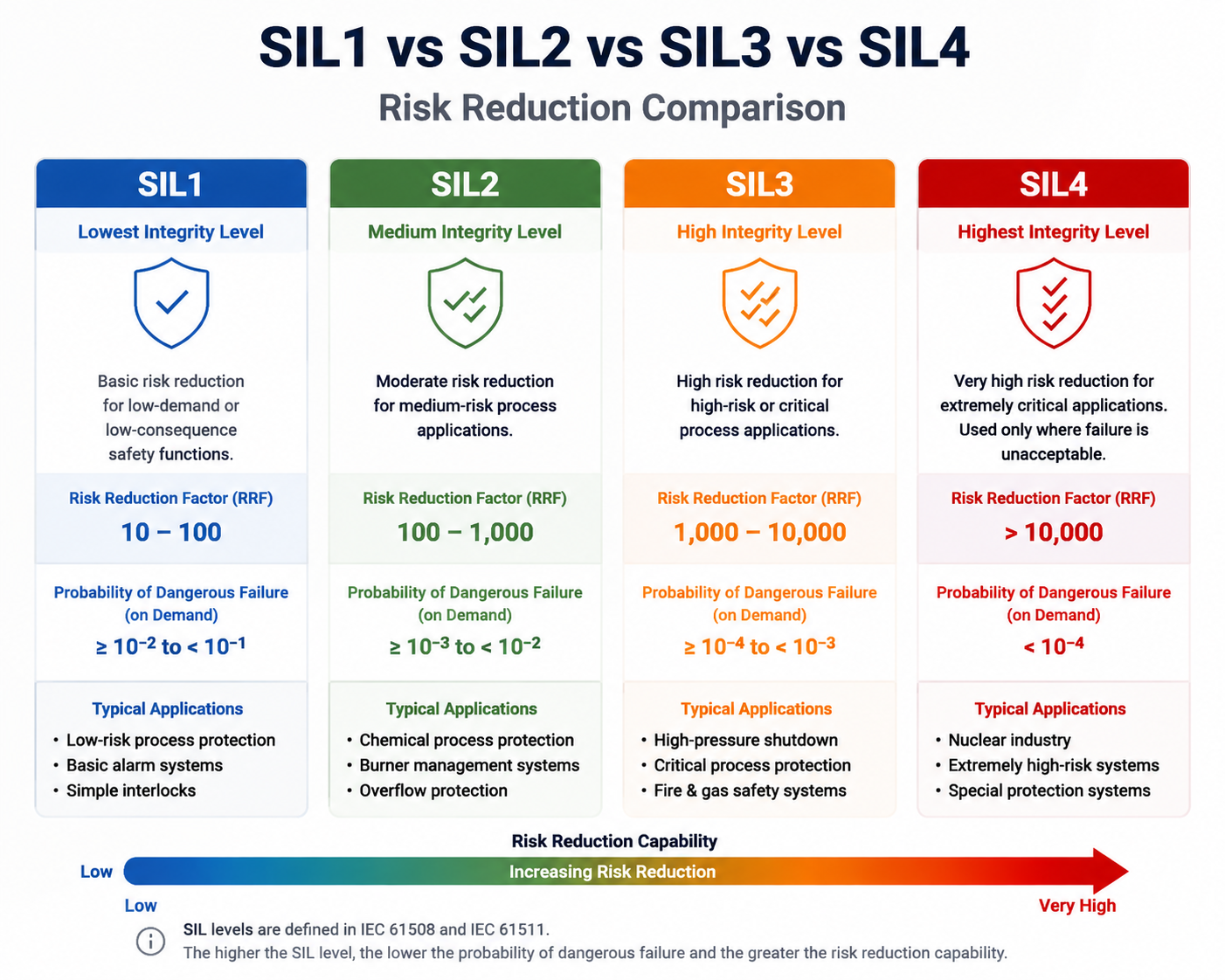
SIL Level Classification
The relationship between SIL levels and risk reduction capability is generally shown as follows:
| SIL Level | Risk Reduction Factor (RRF) | Typical Application |
|---|---|---|
| SIL 1 | 10 – 100 | Low-risk safety functions |
| SIL 2 | 100 – 1,000 | Chemical, oil & gas, and process applications |
| SIL 3 | 1,000 – 10,000 | High-risk process protection systems |
| SIL 4 | More than 10,000 | Extremely high-risk applications |
In practical engineering projects, SIL levels are usually determined based on risk assessment rather than equipment selection.
SIL Levels Used in Process Industries
Although SIL4 exists as the highest safety integrity level, it is rarely used in normal industrial applications.
SIL4 is mainly associated with extremely critical industries, such as nuclear power, where extremely high risk reduction requirements exist.
For process industries, including:
- Oil & Gas
- Chemical Plants
- Petrochemical Facilities
- Power Generation
most Safety Instrumented Functions are designed between:
SIL1 to SIL3
Among them, SIL2 is the most commonly applied level.
For example:
- Emergency shutdown systems (ESD)
- High-pressure protection
- High-temperature shutdown
- Burner management systems
- Overfill protection systems
are often designed according to SIL requirements determined by risk analysis.
What Is the Difference Between SIS, SIF and SIL?
These three terms are often confused.
SIS – Safety Instrumented System
A Safety Instrumented System is the complete system designed to protect a process from hazardous conditions.
A typical SIS consists of:
- Sensors
- Logic Solver (Safety PLC)
- Final Elements (Control valves, shutdown valves, etc.)
SIF – Safety Instrumented Function
A SIF is an individual safety function performed by the SIS.
Example:
High Pressure Shutdown Function
Each SIF has its own required SIL level.
How Is SIL Level Determined?
SIL level is not selected randomly.
The typical process is:
HAZOP → LOPA → SIL Determination → SIS Design
1. HAZOP (Hazard and Operability Study)
Engineers identify possible hazards and abnormal operating conditions.
Example:
- Excessive pressure
- High temperature
- Loss of containment
- Equipment failure
2. LOPA (Layer of Protection Analysis)
LOPA evaluates the existing protection layers and determines whether additional safety functions are required.
3. SIL Assignment
Based on the risk analysis results, the required SIL level is assigned to each SIF.
The goal is not to select the highest SIL level, but to select the appropriate SIL level that meets safety requirements efficiently.
Is Higher SIL Always Better?
No.
A higher SIL level means:
- Higher hardware reliability requirements
- More redundancy
- Higher engineering cost
- More complex verification and maintenance
For example:
A SIL3 system usually requires more advanced design than a SIL1 or SIL2 system.
Therefore:
- Too high SIL → unnecessary cost increase
- Too low SIL → safety risk and compliance problems
The correct approach is to determine the SIL level through proper risk assessment.

Conclusion
Safety Integrity Level (SIL) is a fundamental concept in Safety Instrumented Systems.
There are four SIL levels:
- SIL1
- SIL2
- SIL3
- SIL4
In most process industries, SIL1 to SIL3 are commonly applied, while SIL2 is the most frequently used level.
A reliable SIS design requires a systematic approach:
HAZOP → LOPA → SIL Determination → Safety System Design
By selecting the correct SIL level, companies can achieve both safety compliance and cost-effective engineering solutions.
Need SIL-rated pressure transmitters, level switches, or other safety instrumentation for your SIS application? Contact Zero Instrument for technical support and quotation.