
Purchasing a control valve may seem straightforward: confirm the size, pressure rating, material, and price, then place the order.
In reality, control valves are not ordinary isolation valves.
A control valve is a complete control element involving valve sizing, flow characteristics, pressure drop, actuator sizing, shutoff capability, materials, accessories, instrumentation, and sometimes functional safety requirements.
Many problems that appear during commissioning or operation—such as leakage, vibration, excessive noise, unstable control, sticking, insufficient shutoff force, and premature trim failure—can often be traced back to decisions made during the specification and procurement stage.
Here are nine common mistakes to avoid when purchasing control valves.
Mistake #1: Choosing the Lowest Purchase Price
One of the most common procurement mistakes is treating the lowest bid as the best offer.
When price becomes the primary selection criterion, suppliers may reduce costs through less obvious configuration changes, such as:
- Lower-grade packing materials
- Standard rather than heavy-duty diaphragms
- Lower-grade bearings
- Simplified trim materials
- Undersized actuators
- Removal of necessary accessories
The initial purchase price may be lower, but the operating cost can be significantly higher.
Frequent packing leakage, premature diaphragm failure, insufficient actuator thrust, repeated maintenance, spare-part replacement, and unplanned shutdowns can quickly eliminate the original savings.
Better Approach
Technical compliance should come before commercial comparison.
First ensure that every supplier meets the same technical requirements. Only then should prices be compared.
For critical control valves, consider the total lifecycle cost, including:
- Initial purchase price
- Maintenance
- Spare parts
- Expected service life
- Downtime risk
- Replacement cost
The cheapest valve to buy is not necessarily the cheapest valve to operate.

Mistake #2: Selecting Valve Size Based Only on Pipe Size
A DN100 pipeline does not automatically require a DN100 control valve.
This is one of the most important differences between purchasing an isolation valve and purchasing a control valve.
Control valve size should be determined by the required flow coefficient (Cv) and actual process conditions—not simply by copying the nominal pipe diameter.
An oversized valve may operate continuously at a very small opening. This can result in:
- Poor control resolution
- Unstable control
- Valve hunting
- Excessive velocity through the trim
- Noise
- Vibration
- Accelerated trim erosion
An undersized valve creates the opposite problem: it may not provide enough capacity at maximum process demand.
Another common shortcut is simply selecting a valve one nominal size smaller than the pipeline without performing an actual sizing calculation.
That approach can be particularly risky when the application involves high differential pressure, gases, steam, flashing, cavitation, or two-phase flow.
Better Approach
Require a control valve sizing calculation based on at least:
- Minimum flow
- Normal flow
- Maximum flow
- Upstream pressure
- Downstream pressure
- Operating temperature
- Fluid properties
The calculation should also identify whether cavitation, flashing, choked flow, or excessive noise may occur.
Pipe size determines the piping connection. Cv determines the control valve capacity. They are related, but they are not the same thing.
Mistake #3: Specifying Only the Valve Body Material
A specification such as:
Body Material: WCB / SS304 / SS316L
is often not enough.
Material selection must consider the actual process fluid, temperature, pressure, corrosion mechanisms, solids content, and erosion risk.
For example, simply specifying 316L does not guarantee suitability for every corrosive service. Certain combinations of chlorides, temperature, concentration, and process conditions can still create corrosion problems.
Abrasive particles can also destroy conventional valve trim long before the valve body itself shows significant damage.
Another frequent mistake is assuming that the body material and trim material are the same.
A valve may have a 316L body while using different materials for the plug, stem, seat, cage, or other internal components.
Better Approach
Specify wetted and critical components separately, including where applicable:
- Valve body
- Plug
- Stem
- Seat
- Cage
- Packing
- Gaskets
- Other wetted trim components
For erosive, abrasive, cavitating, or corrosive applications, evaluate whether hardened trim, hard-facing, special alloys, coatings, or other protective measures are required.
Mistake #4: Undersizing the Actuator
When a control valve fails to shut tightly, the first assumption is often:
“The valve leakage class is not good enough.”
But the problem may actually be the actuator.
If the actuator cannot generate sufficient thrust or torque against the maximum differential pressure, the valve may never achieve the required seat load—even if the valve itself is designed for a stringent leakage class.
A common mistake is sizing the actuator based only on the normal operating differential pressure.
The worst-case shutoff condition may be very different.
Pneumatic actuator sizing can also be affected by actual instrument air pressure. If the actuator is sized assuming a higher air supply pressure than is consistently available in the plant, the actual output force may be insufficient.
Electric actuators have similar considerations regarding available output torque.
Better Approach
Actuator sizing should consider:
- Maximum shutoff differential pressure
- Valve type and size
- Required seat load
- Packing friction
- Stem or shaft forces
- Minimum available instrument air pressure
- Fail-open or fail-close requirements
- Required safety margin
Do not select an actuator based only on normal operating conditions.

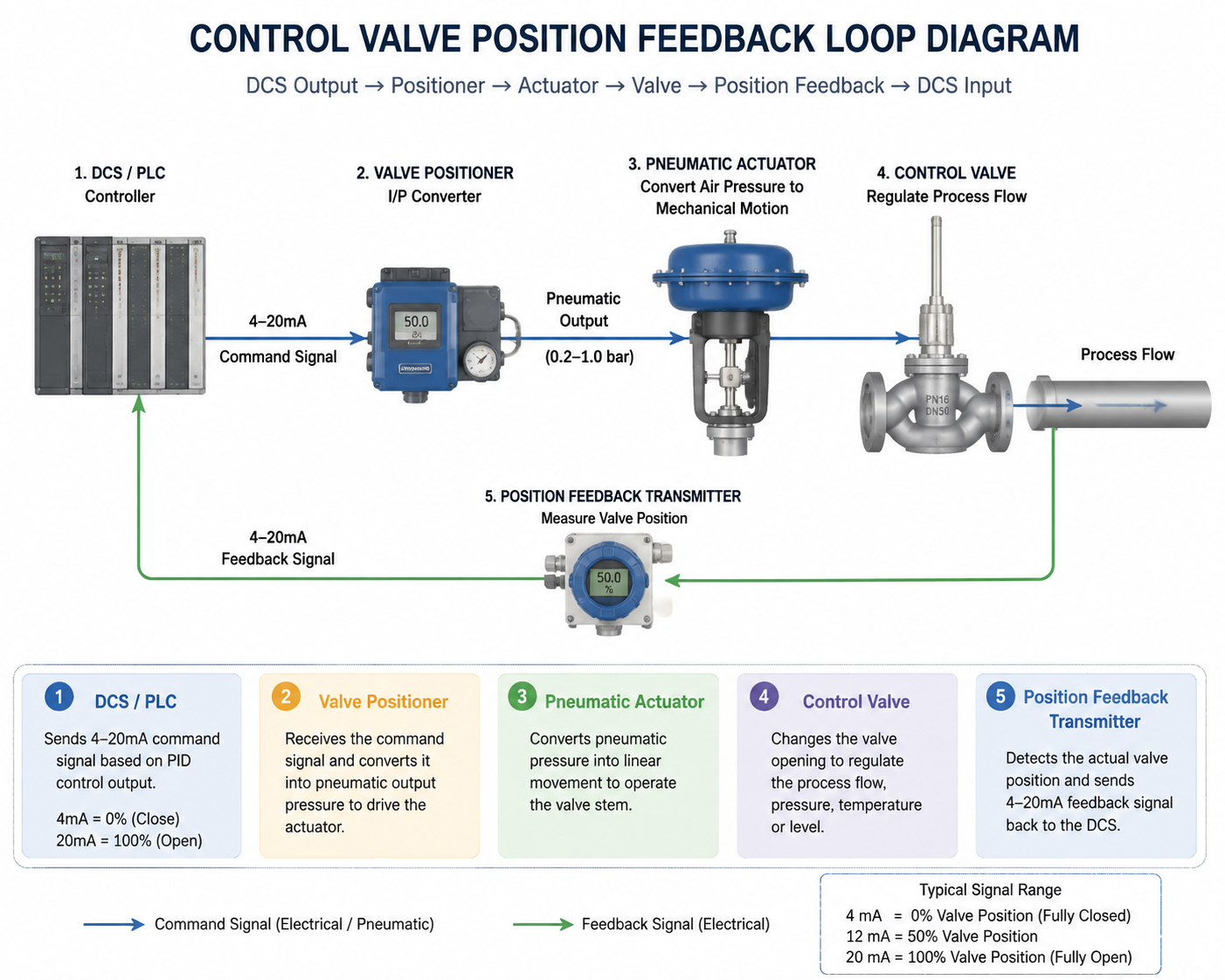
Mistake #5: Treating Accessories as an Afterthought
A control valve is rarely just a valve body plus an actuator.
Its accessories can directly affect control performance, reliability, diagnostics, and safety.
Positioner
Do not simply specify “smart positioner.”
Confirm:
- Input signal
- HART / FOUNDATION Fieldbus / PROFIBUS or other required communication
- Hazardous-area certification
- Environmental suitability
- Vibration requirements
- Compatibility with the plant control system
Solenoid Valve
For shutdown or safety-related valves, verify:
- Coil voltage
- Hazardous-area classification
- Electrical connection
- Pneumatic connection
- Energized/de-energized operating logic
- Required fail-safe action
Limit Switches
Mechanical switches may not be ideal for every corrosive, dusty, or high-vibration environment.
Where appropriate, non-contact proximity switches may provide better reliability.
Air Filter Regulator
Poor-quality instrument air can contaminate positioners and pneumatic components.
An appropriate filter regulator can therefore be an important part of the pneumatic package.
At the same time, over-specification should also be avoided.
A standard control loop does not necessarily need every advanced accessory available.
Better Approach
Define accessories according to the valve function.
A modulating control valve and an emergency shutdown valve may require very different accessory packages.
Mistake #6: Using Vague Ex, IP, and SIL Requirements
Writing only:
“Explosion-proof required”
is not a complete hazardous-area specification.
The required protection concept, applicable standard, gas or dust group, temperature class, and area classification should be defined according to the project requirements.
Similarly, specifying only IP65 may not adequately describe the actual environmental conditions.
Outdoor exposure, washdown, heavy rain, dust, humidity, corrosive atmosphere, and possible flooding may require different protection strategies.
Functional safety specifications require even more care.
A statement such as:
“Valve must be SIL 3.”
may be too simplistic.
For a valve assembly used as a final element in a Safety Instrumented Function (SIF), the relevant valve, actuator, solenoid valve, position feedback devices, and their failure data may all affect the safety assessment.
Better Approach
Where applicable, clearly define:
- Hazardous-area classification
- Required Ex protection concept
- Applicable certification standard
- Required IP rating
- Functional safety requirements
- Required certificates
- Failure-rate data
- FMEDA documentation where applicable
Do not rely solely on a supplier’s statement that a product is “SIL suitable.”
Mistake #7: Issuing an Incomplete Control Valve Specification
Some purchase specifications contain only a few lines:
- Model
- Size
- Pressure rating
- Body material
That may be sufficient for a simple manual valve.
It is usually not sufficient for a control valve.
If the technical specification is incomplete, the supplier may manufacture the valve according to its standard configuration.
The supplied valve may then be technically acceptable according to the manufacturer’s catalog but unsuitable for the actual application.
Worse still, if a disagreement occurs after delivery, there may be no clear contractual basis for determining which party is responsible.
Better Approach
A proper control valve datasheet or technical specification should address, as applicable:
- Process conditions
- Minimum / normal / maximum flow
- Inlet and outlet pressure
- Design pressure and temperature
- Cv calculation
- Valve type
- Valve size
- Pressure class
- Body material
- Trim material
- Flow characteristic
- Leakage class
- Actuator type and sizing
- Fail action
- Positioner
- Solenoid valve
- Limit switches
- Air filter regulator
- Instrument air requirements
- Electrical connections
- Pneumatic connections
- Hazardous-area requirements
- IP protection
- Functional safety requirements
- Testing requirements
- Documentation
- Spare parts
- Warranty
The more critical the valve, the more important the specification becomes.
Mistake #8: Ignoring Factory Testing and Incoming Inspection
A control valve should not arrive at site as an unknown quantity.
Yet some purchase contracts define the delivery date in detail while barely mentioning testing.
A manufacturer may perform only the tests included in its standard production procedure unless additional requirements are specified.
Problems may therefore remain undetected until installation or commissioning.
Better Approach
For important control valves, clearly define the required inspection and testing scope.
Depending on the valve and applicable standards, this may include:
- Body pressure test
- Seat leakage test
- Full-stroke functional test
- Actuator operation test
- Positioner calibration
- Fail-action verification
- Opening and closing time test where required
- Material certificate review
- Hazardous-area certificate review
- Functional safety documentation review where applicable
For critical projects, a formal Factory Acceptance Test (FAT) may also be appropriate.
Incoming inspection at site should verify that the delivered valve actually matches the approved specification and documentation.
Mistake #9: Leaving Spare Parts and Warranty Terms Undefined
Spare parts are often discussed only after the valve has already failed.
By then, procurement becomes urgent—and expensive.
The purchase contract should clearly distinguish between the warranty coverage of:
- Valve body
- Trim
- Actuator
- Positioner
- Solenoid valve
- Other accessories
- Consumable or wear components such as packing, diaphragms, and seals
It is also important to clarify what is excluded from the warranty.
Better Approach
Before placing the order, define:
- Warranty period
- Warranty start date
- Warranty exclusions
- Spare parts included with the valve
- Recommended commissioning spares
- Recommended two-year operating spares, where appropriate
- Spare-part availability
For critical valves, purchasing essential spares together with the original valve can reduce future downtime and procurement cost.
Control Valve Procurement Checklist
Before issuing a purchase order, verify the following:
Warranty terms and exclusions are clear
Minimum, normal, and maximum flow conditions are available
Upstream and downstream pressures are confirmed
Maximum shutoff differential pressure is defined
Cv sizing has been completed
Cavitation, flashing, choked flow, and noise have been evaluated where relevant
Valve size is based on sizing rather than simply copied from pipe size
Body and trim materials are separately specified
Leakage class is defined
Required flow characteristic is defined
Actuator sizing has been verified
Fail-open / fail-close / fail-in-place action is confirmed
Positioner requirements are defined
Solenoid valve requirements are defined where applicable
Limit switches or position feedback requirements are defined
Instrument air conditions are confirmed
Hazardous-area requirements are clearly specified
IP protection requirements are defined
Functional safety documentation is specified where required
Factory testing requirements are defined
Required certificates and documentation are listed
Spare parts requirements are defined

Final Thoughts
Buying a control valve is not simply about purchasing a piece of hardware.
You are selecting the final control element that must respond accurately, shut off when required, withstand the process conditions, communicate with the control system, and continue operating reliably for years.
Spending more time during the specification stage to calculate Cv correctly, evaluate process conditions, select suitable materials, size the actuator, define accessories, and establish testing requirements can prevent much larger problems later.
A correctly selected control valve may operate quietly for years. A poorly specified one will keep reminding you of every shortcut taken during procurement.
That is why successful control valve procurement should never begin with:
“What is your lowest price?”
It should begin with:
“What are the actual process conditions?”