
Environmental equipment suppliers often claim that:
- Wet FGD systems can achieve more than 95% SO₂ removal efficiency
- SCR DeNOx systems can reach 80% NOₓ reduction or even higher
But once the project is actually commissioned, the biggest challenge is often not whether the technology works in theory — it is whether the entire system can remain stable over the long term.
Coal quality changes, inlet SO₂ fluctuates.
Boiler load drops, flue gas temperature falls.
Ammonia injection deviates slightly, ammonia slip rises.
FGD slurry pH drifts, outlet SO₂ immediately starts fluctuating.
That is why stable operation of FGD and SCR systems should never be judged only by equipment specifications or laboratory efficiency values.
The real challenge is whether the entire flue gas treatment system can remain stable under continuously changing operating conditions.
SCR DeNOx Is NOT Just “Inject More Ammonia”
SCR (Selective Catalytic Reduction) is widely used to remove NOₓ from flue gas in coal-fired boilers.
The principle is simple:
Ammonia reacts with NOₓ under catalyst action and converts it into nitrogen and water.
Typical reaction:
In real operation, however, SCR instability usually comes from several common mistakes.
Common SCR Mistake #1: Only Watching NOₓ, Ignoring Temperature Window
SCR systems require a proper flue gas temperature range.
If temperature becomes too low:
- Reaction efficiency decreases
- Ammonia cannot fully react
- Ammonia slip increases rapidly
If temperature becomes too high:
- Catalyst aging accelerates
- Catalyst lifetime shortens
- Side reactions may occur
Many plants focus only on outlet NOₓ values while ignoring reaction-zone temperature stability.
In reality, stable SCR operation depends heavily on maintaining the correct temperature window.

Common SCR Mistake #2: Increasing Ammonia Injection Blindly
When NOₓ rises, many operators immediately increase ammonia injection.
But the real issue is often not insufficient ammonia quantity — it is poor ammonia distribution.
In actual systems:
- Some zones receive excessive ammonia
- Some zones receive insufficient ammonia
As a result:
- Excess-ammonia areas create ammonia slip
- Low-ammonia areas fail to reduce NOₓ effectively
Increasing total ammonia flow may temporarily reduce outlet NOₓ, but long-term consequences gradually appear:
- Air preheater plugging
- Ammonia smell in fly ash
- Ammonium bisulfate deposition
- Higher operating cost
A stable SCR system depends on:
- Proper flow distribution
- Uniform ammonia injection
- Stable temperature
- Healthy catalyst condition
—not simply “more ammonia equals safer operation.”
Common SCR Mistake #3: Ignoring Catalyst Aging
Catalysts do not remain “new forever.”
Over time, catalyst activity decreases due to:
- Dust accumulation
- Arsenic poisoning
- Alkali metal contamination
- Sulfur compounds
Typical field symptoms include:
- Increasing differential pressure
- Higher ammonia consumption
- Lower DeNOx efficiency
- Uneven reactor flow distribution
Many plants only notice problems after emissions exceed limits, while experienced operators monitor catalyst trends much earlier.

Wet FGD Is NOT “Higher pH Is Better”
Wet limestone-gypsum FGD is one of the most widely used SO₂ removal technologies.
The process itself is mature, but stable operation is far from simple.
One of the most misunderstood parameters is slurry pH.
Many beginners assume:
Higher pH means better SO₂ absorption.
But actual operation is much more complicated.
Common FGD Mistake #1: Excessively High pH
If pH becomes too low:
- SO₂ absorption capacity decreases
- Outlet SO₂ rises
But if pH becomes too high:
- Limestone consumption increases
- Scaling becomes more serious
- Gypsum quality deteriorates
Stable FGD operation requires balancing multiple parameters together:
- Inlet SO₂ concentration
- Liquid-gas ratio
- Slurry density
- Oxidation air flow
- Limestone quality
- Spray coverage
- Circulation rate
FGD stability is always a system-level issue.
Common FGD Mistake #2: Ignoring Slurry Condition
In many cases, outlet SO₂ fluctuation is not caused by insufficient limestone.
The real problem may be:
- Poor spray coverage
- Slurry quality deterioration
- Circulation pump abnormality
- Demister blockage
- Oxidation air insufficiency
Experienced operators usually observe process trends before emission alarms occur.
They monitor:
- Inlet SO₂ changes
- pH drift
- Pump current changes
- Demister differential pressure
- Slurry density trends
Because stack emission data is only the final result.
Process parameters are the real root cause.

Instruments Are the “Eyes” of the Entire System
Stable FGD and SCR operation relies heavily on instrumentation.
Typical critical instruments include:
- NOₓ analyzers
- SO₂ analyzers
- Oxygen analyzers
- Ammonia slip analyzers
- Temperature sensors
- Pressure transmitters
- Differential pressure transmitters
- Flow meters
- pH analyzers
- Density meters
- Level transmitters
- Dust monitors
These instruments are not installed merely for project acceptance or drawing completeness.
Their purpose is to help operators understand what is truly happening inside the system.
Instrument Problems Often Become Process Problems
For example:
Unstable pH Analyzer
May lead to excessive limestone dosing and severe scaling.
Plugged Differential Pressure Transmitter
May hide catalyst blockage or demister fouling.
Slow Ammonia Slip Analyzer Response
May cause delayed ammonia injection adjustment.
Inaccurate Temperature Measurement
May push SCR operation outside the optimal reaction window.
Many systems are not unstable because equipment is poor.
They become unstable because process data is inaccurate, ignored, or not properly analyzed.
A Good System Does NOT Rely on “Forcing the Numbers Down”
When emission data fluctuates, some plants immediately respond by:
- Increasing ammonia injection
- Adding more limestone
- Running more pumps
- Increasing fan flow
This may temporarily solve the problem.
But the cost quickly becomes obvious:
- Higher ammonia consumption
- Higher power consumption
- Increased limestone usage
- Faster equipment wear
- Poor gypsum quality
- More severe fouling
This is not stable operation.
It is simply “forcing emission numbers down.”
What Defines a Truly Stable FGD/SCR System?
A well-operated flue gas treatment system should achieve three things simultaneously:
1. Stable Emissions
The system should remain stable during:
- Load changes
- Coal quality changes
- Temperature fluctuations
- Process disturbances
—not only under ideal conditions.
2. Reasonable Operating Cost
Compliance should not depend on excessive reagent consumption.
Good systems achieve stable emissions with optimized:
- Ammonia usage
- Limestone consumption
- Energy consumption
- Equipment loading
3. Healthy Equipment Condition
Reducing NOₓ should not result in:
- Air preheater plugging
- Severe catalyst fouling
Reducing SO₂ should not lead to:
- Excessive tower scaling
- High pump energy consumption
- Poor gypsum quality
Long-term equipment health matters just as much as emission compliance.
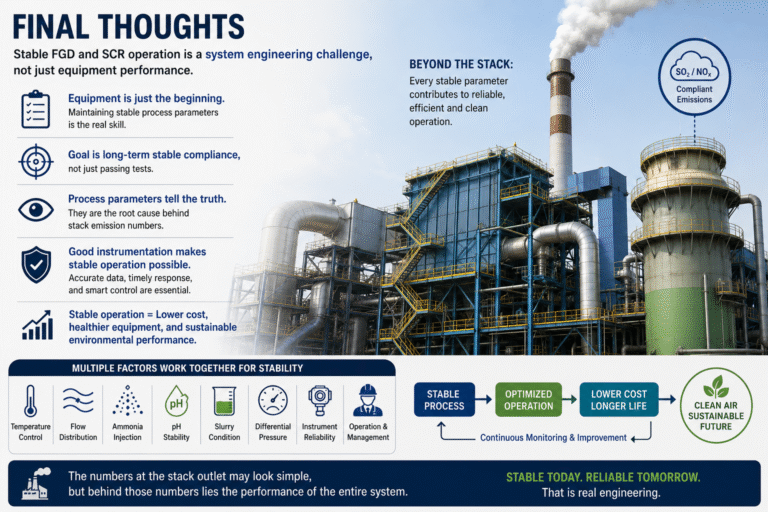
Final Thoughts
The real challenge of FGD and SCR systems is not whether a single piece of equipment is advanced.
The real challenge is whether the entire flue gas treatment system can operate stably for years under changing plant conditions.
Installing equipment is only the beginning.
Maintaining stable process parameters is the true skill.
That is why successful FGD and SCR operation depends not only on efficiency values, but also on:
- Temperature
- Flow distribution
- pH stability
- Ammonia injection uniformity
- Slurry condition
- Differential pressure
- Instrument reliability
- Operational management
The numbers displayed at the stack outlet may look simple.
But behind those numbers lies the performance of the entire system.