
Why Semiconductor Materials Depend on Advanced Chemical Technologies
If semiconductors are considered the “brain” of modern electronic devices, then semiconductor materials are the “cells” and “blood” that support this powerful brain.
Behind every advanced chip, there is a complex supply chain of high-purity chemical materials. Many of these critical materials come directly from the chemical industry.
So, what role does the chemical industry play in semiconductor manufacturing? And why are chemical materials becoming one of the most important foundations of the semiconductor supply chain?
1. Chemical Industry and Semiconductor Manufacturing: The Hidden Connection
In the semiconductor industry, chemical products are mainly involved in the upstream semiconductor materials sector.
These materials are essential for wafer fabrication, chip processing, and advanced packaging. Without high-quality chemical materials, even the most advanced semiconductor equipment cannot produce reliable chips.
The semiconductor supply chain can generally be divided into three major stages:
Upstream: Raw Materials and Manufacturing Materials
This is where the chemical industry plays a critical role.
Key materials include:
- Silicon wafers
- Electronic specialty gases
- Photoresists
- Wet electronic chemicals
- CMP polishing materials
- Sputtering targets
- High-performance polymers
Midstream: Chip Manufacturing and Packaging
Semiconductor manufacturers use these advanced materials to transform circuit designs into physical chips through processes such as:
- Photolithography
- Etching
- Deposition
- Cleaning
- Chemical Mechanical Planarization (CMP)
Downstream: Semiconductor Applications
Finished chips are widely used in:
- Artificial intelligence systems
- Automotive electronics
- Smartphones
- Industrial automation
- Data centers
Among these stages, chemical materials are the invisible foundation supporting the entire semiconductor ecosystem.
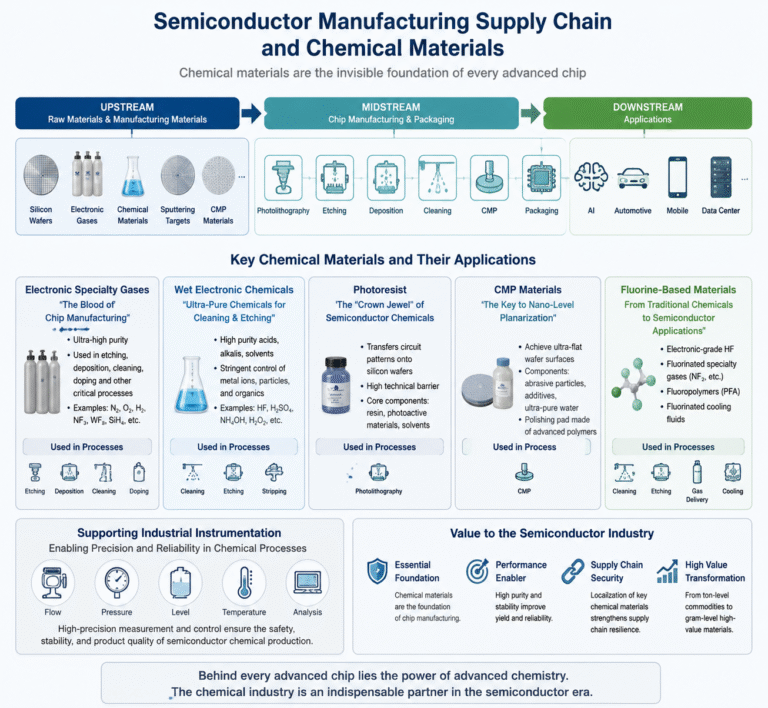
2. Key Chemical Materials in Semiconductor Manufacturing
Electronic Specialty Gases: The “Blood” of Chip Manufacturing
Electronic specialty gases are often described as the “blood” of the semiconductor industry.
They are widely used throughout wafer fabrication processes, including:
- Etching
- Thin-film deposition
- Cleaning
- Doping
Common examples include:
- Nitrogen
- Oxygen
- Hydrogen
- Nitrogen trifluoride (NF₃)
- Tungsten hexafluoride (WF₆)
These gases require extremely high purity because even trace contamination can affect wafer yield and device performance.
The production and purification of electronic gases rely heavily on advanced chemical technologies, making them one of the most critical areas in semiconductor manufacturing.
Wet Electronic Chemicals: Ultra-Pure Chemicals for Cleaning and Etching
During semiconductor fabrication, wafers must undergo repeated cleaning and etching processes.
This requires ultra-high-purity wet chemicals, including:
- Hydrofluoric acid (HF)
- Sulfuric acid (H₂SO₄)
- Ammonium hydroxide (NH₄OH)
- Organic solvents
Unlike conventional industrial chemicals, semiconductor-grade chemicals require extremely strict control of:
- Purity
- Metal ion contamination
- Particle levels
- Packaging environment
The difference between industrial chemicals and semiconductor chemicals is not only the chemical composition, but also the precision of purification and quality control.

Photoresist: The “Crown Jewel” of Semiconductor Chemicals
Photoresist is one of the most technologically demanding materials in semiconductor manufacturing.
During photolithography, photoresist transfers circuit patterns onto silicon wafers, creating the foundation for modern chip structures.
Photoresist is a precision chemical material containing:
- Resin
- Photoactive compounds
- Solvents
- Special additives
Advanced photoresists for leading-edge semiconductor processes require extremely sophisticated chemical synthesis and manufacturing technologies.
CMP Materials: The Key to Nano-Level Surface Planarization
Chemical Mechanical Planarization (CMP) is a critical process used to achieve ultra-flat wafer surfaces.
The main CMP consumables include:
- Polishing slurry
- Polishing pads
CMP slurry typically contains:
- Abrasive particles
- Chemical additives
- Ultra-pure water
Polishing pads are commonly manufactured from advanced polymer materials such as polyurethane.
Without CMP technology, it would be impossible to achieve the precise structures required for advanced semiconductor devices.
Fluorine-Based Materials: From Traditional Chemicals to Semiconductor Applications
Fluorine chemistry is one of the strongest examples of the connection between chemical industry and semiconductor manufacturing.
Fluorine-based materials are widely used in semiconductor processes:
Electronic-Grade Hydrofluoric Acid
Electronic-grade HF is produced through advanced purification of industrial hydrofluoric acid.
It is an essential chemical for:
- Wafer cleaning
- Oxide layer removal
- Etching processes
Fluorinated Specialty Gases
Materials such as nitrogen trifluoride (NF₃) are widely used in plasma cleaning and semiconductor processing.
Fluoropolymer Materials (PFA)
PFA provides excellent chemical resistance and ultra-clean performance.
It is widely used for:
- Chemical delivery pipelines
- Filters
- Semiconductor wet processing systems
Fluorinated Cooling Fluids
With the rapid growth of AI computing and high-performance data centers, advanced cooling technologies are becoming increasingly important.
Fluorinated cooling fluids are being explored for applications such as immersion cooling systems.
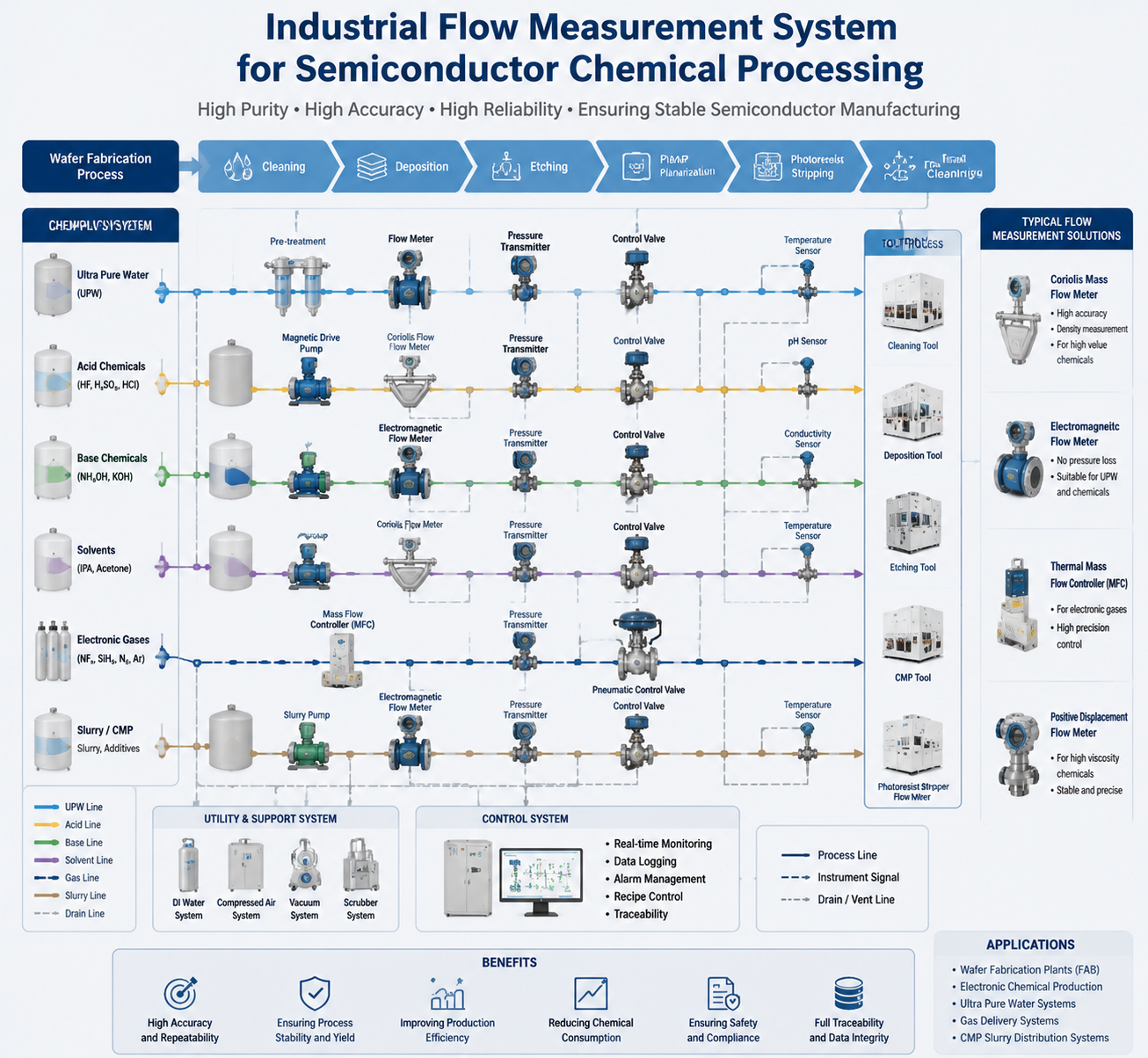
3. Chemical Industry: The Foundation Behind Semiconductor Innovation
So, what is the position of the chemical industry in the semiconductor supply chain?
The answer is simple:
Chemical materials are everywhere, and they form the foundation of semiconductor manufacturing.
They are the essential building blocks that enable:
- Advanced chip production
- Higher manufacturing yield
- Smaller process nodes
- More powerful electronic devices
The development of semiconductor technology does not only depend on advanced lithography machines or manufacturing equipment.
It also depends on the continuous innovation of chemical materials.
From traditional chemicals sold by tons to advanced semiconductor materials valued by grams, the chemical industry is undergoing a major transformation toward higher value and higher precision.
Semiconductors and chemical industries are becoming increasingly interconnected — one cannot develop without the support of the other.
The once-hidden chemical industry is now becoming a visible and strategic force driving the future of technology.