
Target flow meters are widely used for measuring challenging media such as high-viscosity fluids, slurry, liquids containing particles, and media prone to scaling. Compared with conventional flow meters, they are known for their excellent resistance to harsh operating conditions.
However, like any industrial instrument, target flow meters can also experience signal problems during operation.
Among the most common issues are:
- Flow exists but no output signal
- No flow but output signal exists
These two failures often cause confusion during field troubleshooting.
This article explains the possible causes and practical solutions step by step.
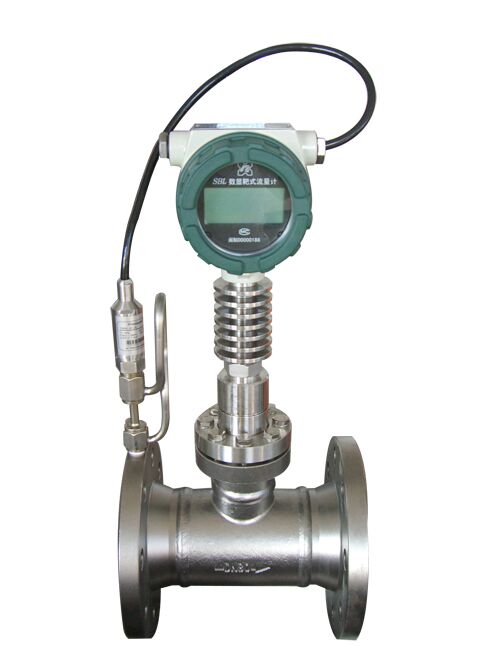
Problem 1: Flow Exists but No Output Signal
Possible Causes
When the pipeline has actual flow but the target flow meter produces no output signal, the common causes include:
- Loose or damaged connection between the sensor and electronic unit
- Failure of the force sensor or strain gauge sensor
- Incorrect installation direction or incorrect force direction on the target plate
Troubleshooting Methods
1. Check the Wiring Connection
First, check the connection cable between the sensor and the main circuit board.
Confirm that:
- The connector is properly inserted
- No wiring is loose or disconnected
- Terminals are free from oxidation or corrosion
A poor electrical connection is one of the simplest but most common causes of signal failure.
2. Check the Sensor Bridge Resistance
Use a multimeter to measure the bridge resistance of the sensor through the corresponding terminals.
The normal resistance value depends on the specific manufacturer and sensor design, so the measurement should be compared with the technical manual.
Results interpretation:
- Resistance within the specified range: The sensor bridge circuit is likely normal.
- Open circuit: The sensor may be damaged or the internal wire may be broken.
- Short circuit: The sensor may have an internal fault.
If the sensor resistance is abnormal, the sensor assembly usually needs replacement.
3. Check Mechanical Components
If the sensor electrical circuit is normal, remove the electronic head and inspect the mechanical structure.
Check:
- Whether the sensor mounting part is damaged
- Whether the target plate is loose or broken
- Whether the target plate is installed in the correct flow direction
The target flow meter relies on the force generated by fluid impact on the target plate. Incorrect installation direction can prevent the sensor from receiving the correct force signal.
Problem 2: No Flow but Output Signal Exists
Possible Causes
When there is no actual flow but the meter still outputs a signal, the possible reasons include:
- Incorrect installation level or mechanical alignment
- Target plate or rod generating additional force due to installation stress
- Zero point drift caused by long-term operation
- Sensor overload causing permanent zero shift
- Poor insulation or unreliable grounding
- Foreign materials blocking the target plate movement
Troubleshooting Methods
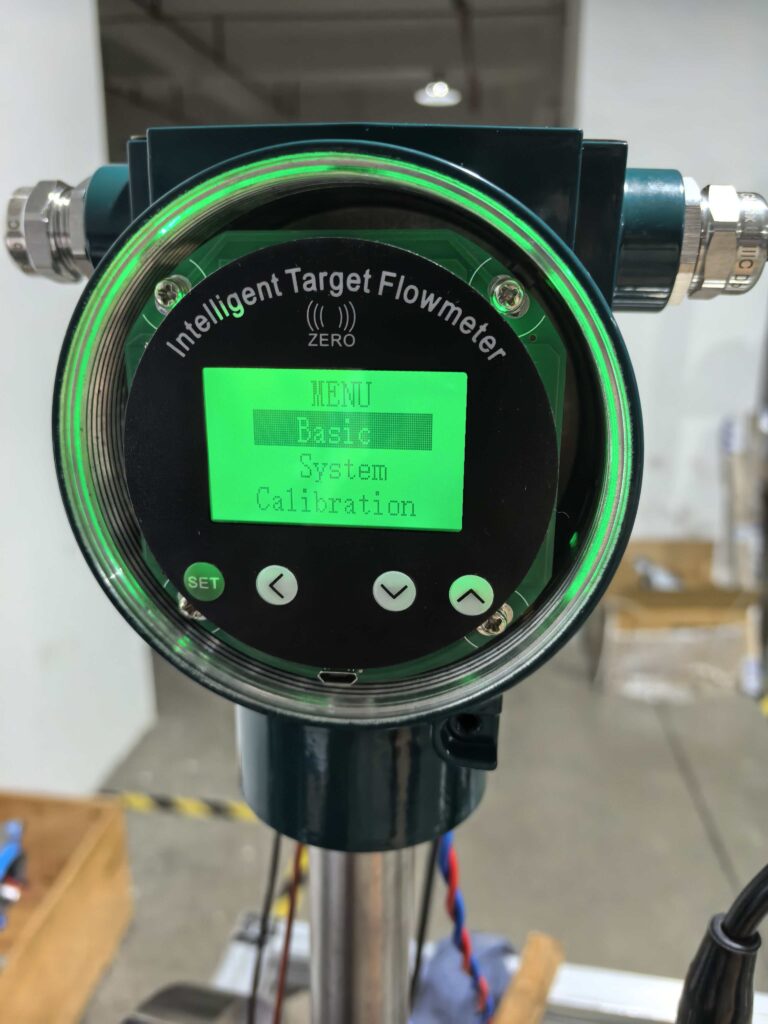
1. Perform Zero Calibration
First, perform a zero adjustment through the instrument menu according to the manufacturer’s instructions.
If the output returns to normal after zero calibration, the problem is likely caused by zero drift.
Common reasons include:
- Long-term mechanical stress
- Temperature changes
- Vibration
- Sensor aging
2. Check Sensor Insulation and Grounding
If zero adjustment does not solve the problem:
Use a multimeter to check:
- Sensor insulation condition
- Grounding reliability
- Electrical interference from surrounding equipment
Poor grounding or electrical noise can cause unstable output signals.
3. Check for Mechanical Blockage
If the instrument works normally after zero adjustment but the problem returns after a period of operation, the target plate may be blocked by foreign materials.
Possible contaminants include:
- Solid particles
- Scale deposits
- Sludge
- Process residue
Before inspection:
- Close the upstream and downstream valves.
- Release the connection between the measuring section and transition section.
- Carefully remove the internal assembly.
- Clean the target plate and restore the instrument.

Additional Check: Confirm Process Conditions
Besides instrument faults, changes in process conditions can also affect measurement accuracy.
Pay attention to:
- Medium density changes
- Viscosity changes
- Temperature variations
- Flow range changes
Because the measurement principle depends on the force generated by the flowing medium, significant changes in process conditions may require recalibration or parameter adjustment.
Summary
Most target flow meter signal problems do not require immediate replacement of the instrument.
By following a logical troubleshooting sequence:
- Check wiring connections
- Verify sensor resistance
- Perform zero calibration
- Inspect grounding and insulation
- Check mechanical blockage and installation conditions
the fault source can usually be identified quickly.
A systematic troubleshooting method helps reduce downtime and keeps your process measurement reliable.
For target flow meters used in high-viscosity, slurry, or difficult media applications, contact our technical team for model selection and application support.