
In power distribution, lightning protection, and industrial automation systems, SPD (Surge Protective Device) and surge arresters are often discussed together.
Because both are used to limit overvoltage caused by lightning and switching events, many people assume they are the same device.
However, they differ significantly in application level, system voltage, and protection purpose.
Misunderstanding these differences may lead to improper selection and reduced protection performance.
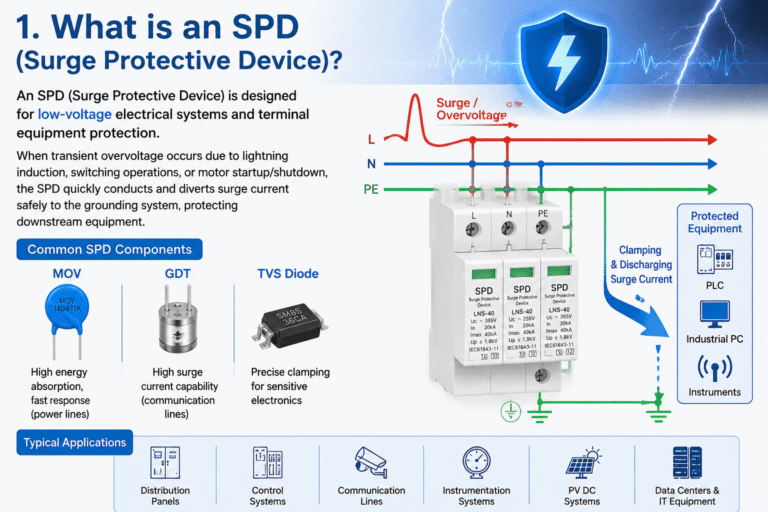
1. What is an SPD (Surge Protective Device)?
An SPD (Surge Protective Device) is designed for low-voltage electrical systems and terminal equipment protection.
It is widely used in:
- Low-voltage distribution panels
- PLC control systems
- Communication and signal lines
- Instrumentation systems
- Photovoltaic DC systems
- Industrial automation cabinets
When transient overvoltage occurs due to lightning induction, switching operations, or motor startup/shutdown, the SPD quickly conducts and diverts surge current safely to the grounding system, protecting downstream equipment.
Common SPD components:
- MOV (Metal Oxide Varistor) – high energy absorption, fast response (power lines)
- GDT (Gas Discharge Tube) – high surge current capability (communication lines)
- TVS diodes – precise clamping for sensitive electronics
Advanced SPD designs often combine these components to balance response speed, energy handling, and residual voltage control.
2. What is a Surge Arrester?
A surge arrester is mainly used in medium and high-voltage power systems to protect insulation systems of electrical equipment.
It is commonly installed in:
- Transmission and distribution lines
- Substations
- Transformers
- High-voltage switchgear
- Cable terminations
- Busbars and incoming lines
Under normal operation, a surge arrester presents high impedance, allowing only a small leakage current.
When overvoltage occurs, the internal metal oxide varistor blocks conduct, safely discharging surge energy and limiting voltage to a safe insulation level.
Important clarification:
A surge arrester is not a lightning rod.
- Lightning rod (external protection system) → intercepts lightning
- Surge arrester → protects electrical equipment from internal/external overvoltage
3. Key Differences Between SPD and Surge Arrester
| Item | SPD | Surge Arrester |
|---|---|---|
| Application | Low-voltage systems | Medium & high-voltage systems |
| Protection target | Electronic devices & terminals | Power system insulation |
| Installation location | Control cabinets, distribution panels | Substations, transformers, HV lines |
| Overvoltage type | Switching, induced lightning, internal surges | Lightning stroke, switching surges |
| Selection parameters | Uc, Up, In, Imax, Iimp | MCOV, rated voltage, discharge current, insulation coordination |
4. SPD Classification and System Configuration
Low-voltage SPDs are typically divided into three types:
Type 1 SPD
Installed at the main incoming power supply.
Used in buildings or systems exposed to direct lightning risk or with external lightning protection systems.
Type 2 SPD
Installed in distribution panels.
Used for secondary surge protection and system-level protection.
Type 3 SPD
Installed close to sensitive equipment.
Used for final protection of:
- PLC systems
- Industrial PCs
- Instrumentation devices
- Communication interfaces
👉 In modern industrial systems, multiple SPD layers are always required for effective protection.

5. Installation Quality Determines Protection Performance
Even with correct SPD selection, improper installation can significantly reduce protection effectiveness.
Key installation requirements:
- Keep connecting wires as short and straight as possible
- Ensure strong and low-impedance grounding
- Avoid unnecessary cable looping or bending
- Ensure proper equipotential bonding
Long lead wires can significantly increase residual voltage, reducing protection performance.
6. Surge Arrester Installation Considerations
For surge arresters, installation distance is also critical.
To ensure effective protection:
- Install as close as possible to protected equipment
- Minimize lead length
- Ensure reliable grounding connection
- Regular inspection for leakage current and surface condition
Poor grounding or excessive distance can reduce protection efficiency.
7. SPD and Surge Arresters Are Often Used Together
In modern power systems, both devices are required and complement each other.
Typical applications include:
Solar PV systems:
- DC side → SPD protection
- AC inverter side → SPD protection
- Substation / grid connection → surge arrester
Wind power systems:
- Control systems → SPD
- Power transmission systems → surge arresters
Industrial plants:
- PLC, instrumentation, communication systems → SPD
- Power distribution systems → surge arresters
Each device protects different voltage levels and system layers.

8. Conclusion
Although both SPD and surge arresters are designed for overvoltage protection, their applications are fundamentally different:
- SPD → low-voltage and signal system protection
- Surge arrester → medium/high-voltage power system protection
A complete protection system should combine:
- External lightning protection (air terminals & grounding)
- Surge arresters (power system protection)
- SPDs (equipment-level protection)
- Proper grounding and equipotential bonding
Only a properly designed layered protection system can effectively reduce equipment damage, downtime, and maintenance costs caused by lightning and switching surges.