
Walk through almost any modern chemical plant and you are likely to see radar level transmitters installed on storage tanks, process vessels, and reactors.
They are commonly used on:
- Raw material storage tanks
- Finished product tanks
- Intermediate storage vessels
- Solvent tanks
- Acid and alkali tanks
- Large vertical storage tanks
- Reactors and process vessels
Differential pressure transmitters, magnetic level gauges, displacers, and ultrasonic level instruments are still widely used. However, radar has become one of the most important technologies for continuous level measurement in chemical applications.
Why?
The answer is not simply that radar is newer or more advanced.
The real reason is that radar level measurement can solve many of the problems encountered when measuring difficult chemical media—provided that the transmitter is selected and installed correctly.
And that last point is important.
A radar level transmitter is not a universal instrument that can simply be mounted on any tank and expected to work perfectly.
1. How Does a Radar Level Transmitter Work?
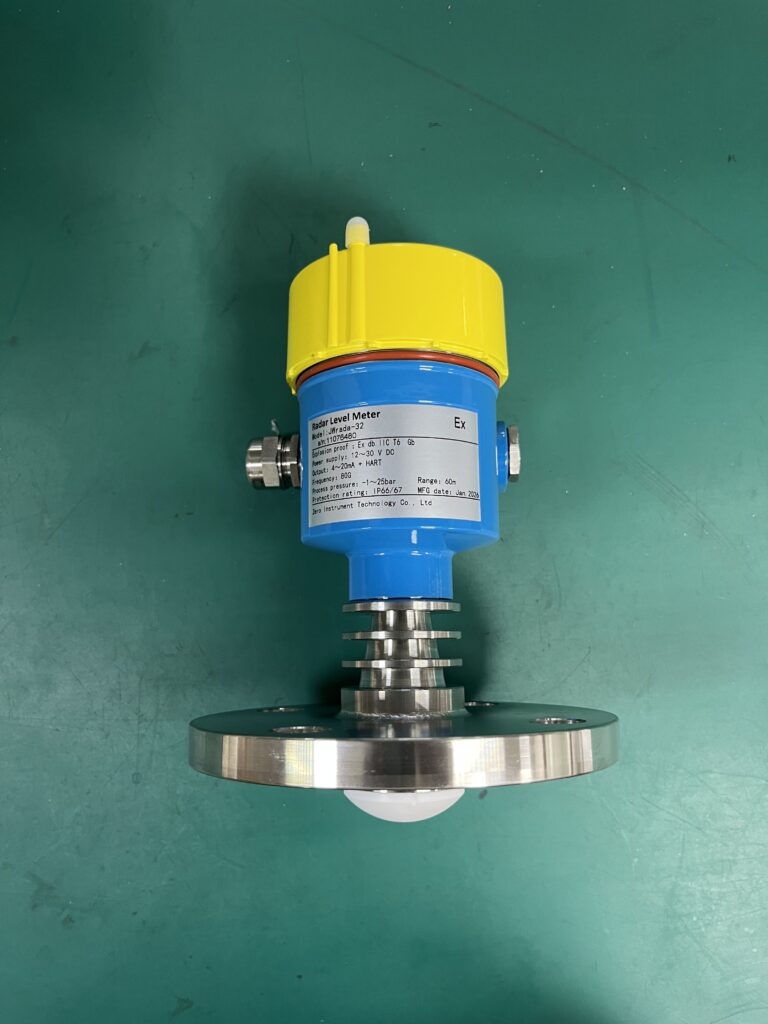
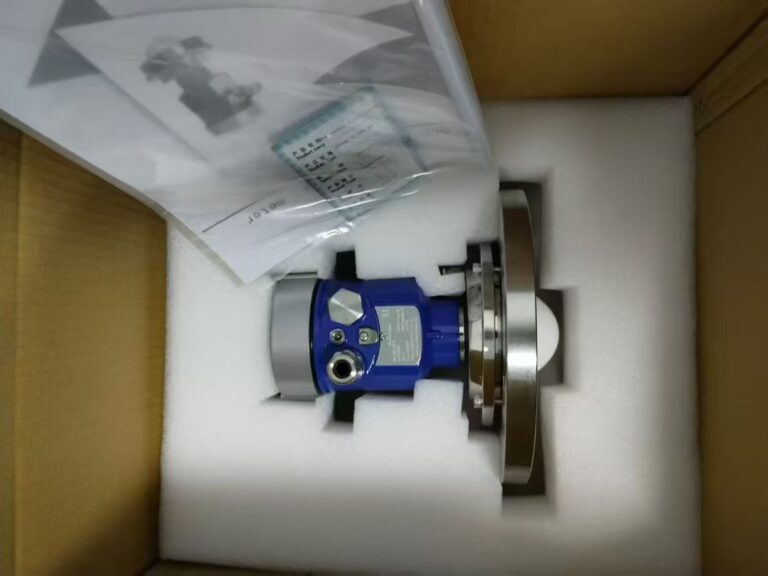
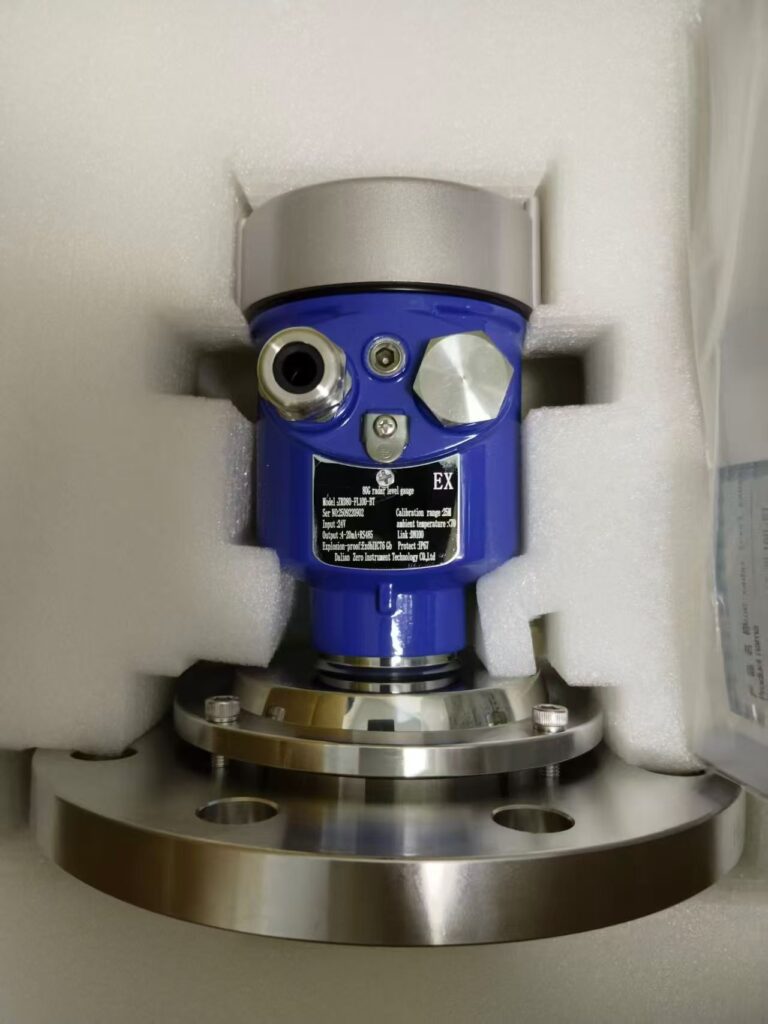
A non-contact radar level transmitter sends electromagnetic waves toward the surface of the material inside the tank.
When the signal reaches the liquid surface, part of the energy is reflected back toward the antenna.
The transmitter analyzes the returned signal and determines the distance between the antenna and the product surface.
In simplified form:
Radar signal transmitted → Signal reflected by product surface → Echo received → Distance calculated
Once the distance is known, the transmitter can calculate the actual level based on the configured tank geometry and measurement range.
In other words, a radar level transmitter essentially measures distance first and converts that distance into level.
This principle is one reason radar is so attractive for chemical storage tanks.
Unlike hydrostatic level measurement, radar does not calculate level from liquid pressure and therefore is generally not directly affected by changes in product density.
2. Why Is Radar So Widely Used on Chemical Storage Tanks?
Chemical tanks are often difficult measurement environments.
The product may be:
- Corrosive
- Toxic
- Volatile
- Hot
- Foaming
- Low in dielectric constant
- Prone to condensation
The vessel itself may also contain:
- Agitators
- Heating coils
- Ladders
- Reinforcement structures
- Support beams
- Inlet pipes
- Other internal obstructions
This combination can make conventional level measurement challenging.
One of the major advantages of non-contact radar is that the antenna does not normally need a mechanical measuring element extending deep into the liquid.
This can reduce problems associated with moving or immersed mechanical components, such as corrosion, buildup, wear, sticking, and mechanical damage.
For aggressive or difficult chemical media, that can be a significant advantage.
3. Key Advantages of Radar Level Measurement
The popularity of radar is not based on one single advantage.
Several characteristics make it particularly useful for chemical storage applications.
Less Sensitive to Product Density Changes
Differential pressure level measurement depends on the relationship between hydrostatic pressure, liquid density, and level.
If product density changes significantly, the relationship between measured differential pressure and actual level may also change unless compensation is applied.
Radar works differently.
It determines the position of the product surface from the reflected electromagnetic signal.
Therefore, density changes generally do not directly change the radar distance measurement.
However, measurement performance can still depend on factors such as dielectric properties, surface conditions, installation geometry, and signal quality.
Non-Contact Measurement
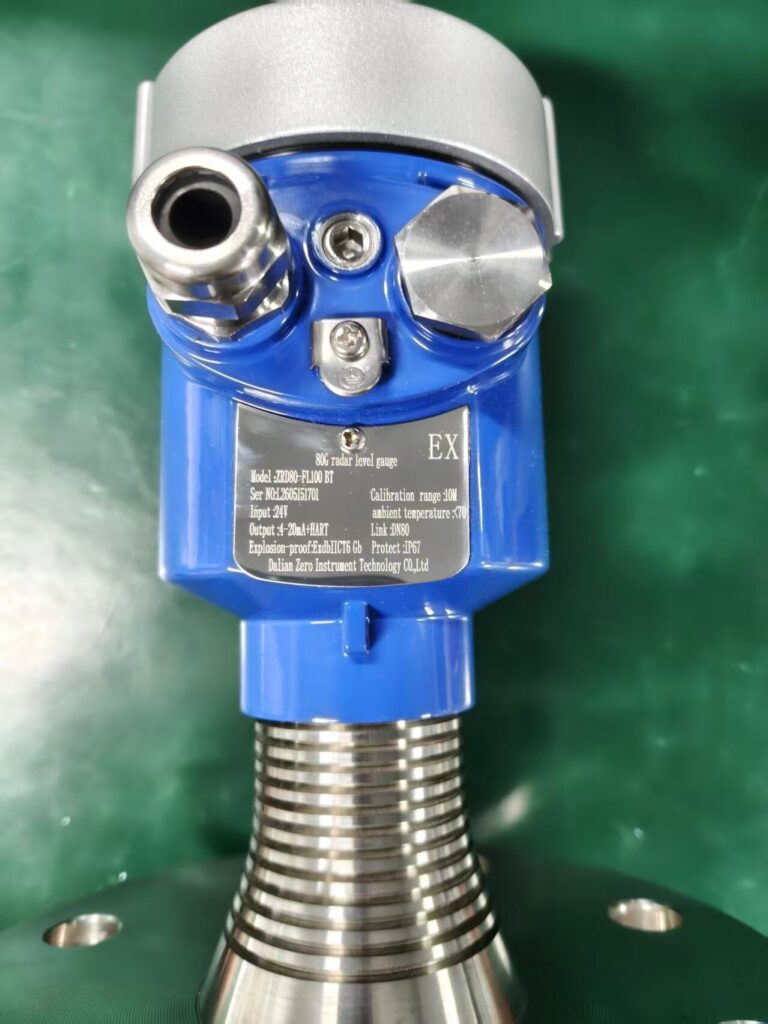
For many applications, the radar antenna can measure the liquid surface without a probe extending into the product.
This is especially attractive for:
- Corrosive liquids
- Toxic chemicals
- Hot liquids
- Volatile products
- Applications where mechanical contact should be minimized
It can also reduce some maintenance problems associated with immersed mechanical measuring elements.
Long Measuring Range
Radar transmitters can be used over relatively long measuring distances.
This makes them particularly useful for large vertical storage tanks where the level range may extend over many meters.
But measuring range alone should never determine transmitter selection.
A transmitter advertised with a 20-meter range is not automatically suitable for every 15-meter tank.
4. What Can Cause Problems with Radar Level Measurement?
A common mistake is to think:
“Radar is advanced technology, so installation should be easy.”
In reality, installation is one of the most important factors affecting radar performance.
The transmitter must be able to identify the true product-surface echo.
Unfortunately, a chemical vessel can contain many other objects capable of producing reflections.
Typical examples include:
- Agitator blades
- Heating coils
- Internal ladders
- Support structures
- Reinforcement members
- Pipes
- Vessel walls
- Inlet structures
These objects can create unwanted echoes.
The transmitter may therefore receive both:
True level echo + False echoes from internal structures
Modern radar transmitters use sophisticated echo processing to distinguish between them, but good signal processing cannot compensate for every poor installation.
That is why the mounting position matters so much.
5. Foam: One of the Most Important Application Conditions
Foam is common in chemical processes.
It may occur during:
- Filling
- Mixing
- Agitation
- Chemical reactions
- Fermentation
- Start-up
- Abnormal process conditions
Depending on the type, thickness, density, and electrical properties of the foam, the radar signal may be weakened or reflected differently.
In some applications, the instrument may respond to the foam surface rather than the actual liquid surface.
Therefore, when selecting a radar transmitter, simply asking:
“Does the tank normally have foam?”
is not enough.
It is better to ask:
- Is there foam during filling?
- Does agitation create foam?
- Does foam appear during a reaction?
- How thick can the foam layer become?
- Is the foam light and dry or dense and wet?
- Does the condition change during start-up or shutdown?
Instrumentation should be selected for the real operating envelope, not only for ideal steady-state conditions.
6. Vapor, Condensation, and Difficult Tank Atmospheres
The space above a chemical liquid is not always clean air.
It may contain:
- Vapor
- Volatile chemicals
- Condensation
- Hot gases
- Corrosive gases
Under severe process conditions, these factors should be considered during transmitter selection.
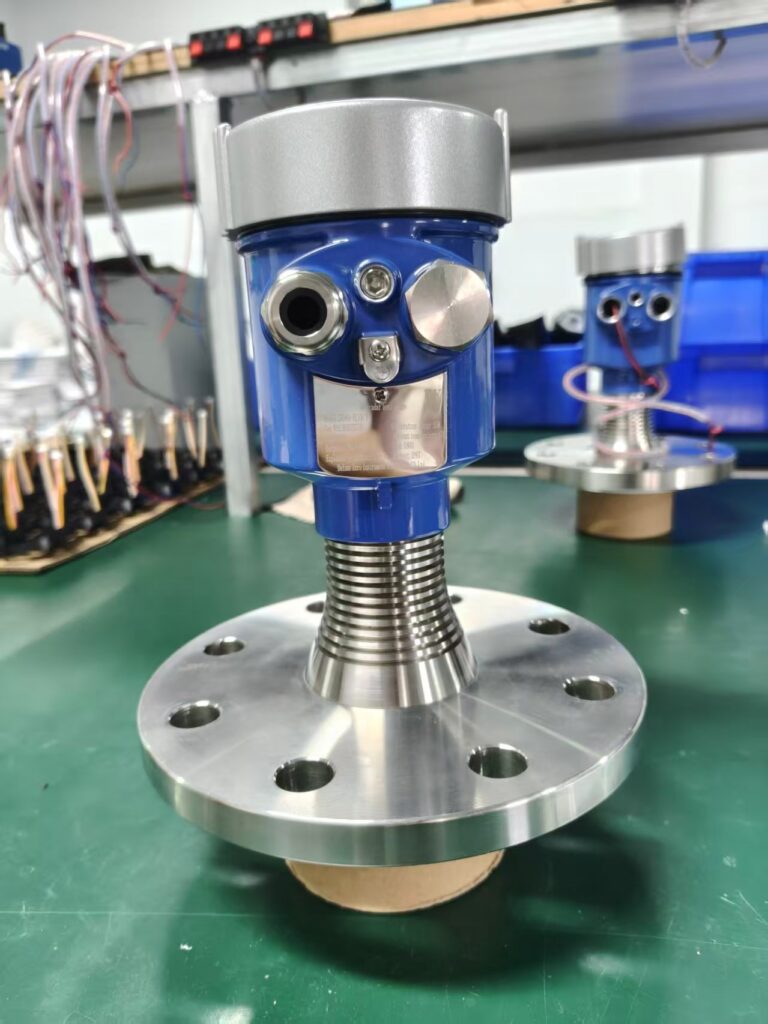
Condensation or buildup on the antenna is particularly important because it can affect signal transmission and reception.
Depending on the application, engineers may need to consider:
- Radar frequency
- Antenna design
- Antenna material
- Process seal
- Purging arrangements
- Mounting configuration
- Process temperature
- Process pressure
- Chemical compatibility
The correct solution is therefore not simply:
“Install a radar transmitter.”
It is:
“Install the right radar transmitter for the actual process conditions.”
7. Do Not Ignore the Dielectric Properties of the Medium
Radar level measurement depends on receiving a usable reflection from the product surface.
Different materials reflect radar energy differently.
Water, acids, alkalis, hydrocarbons, solvents, oils, resins, and other chemical products may have very different dielectric properties.
This is particularly important for media with relatively weak radar reflections.
Therefore, telling a supplier only:
“We have a 10-meter tank.”
is not enough.
The supplier should also know what is inside the tank.
This is one of the most important pieces of information in radar level transmitter selection.
8. How to Select a Radar Level Transmitter
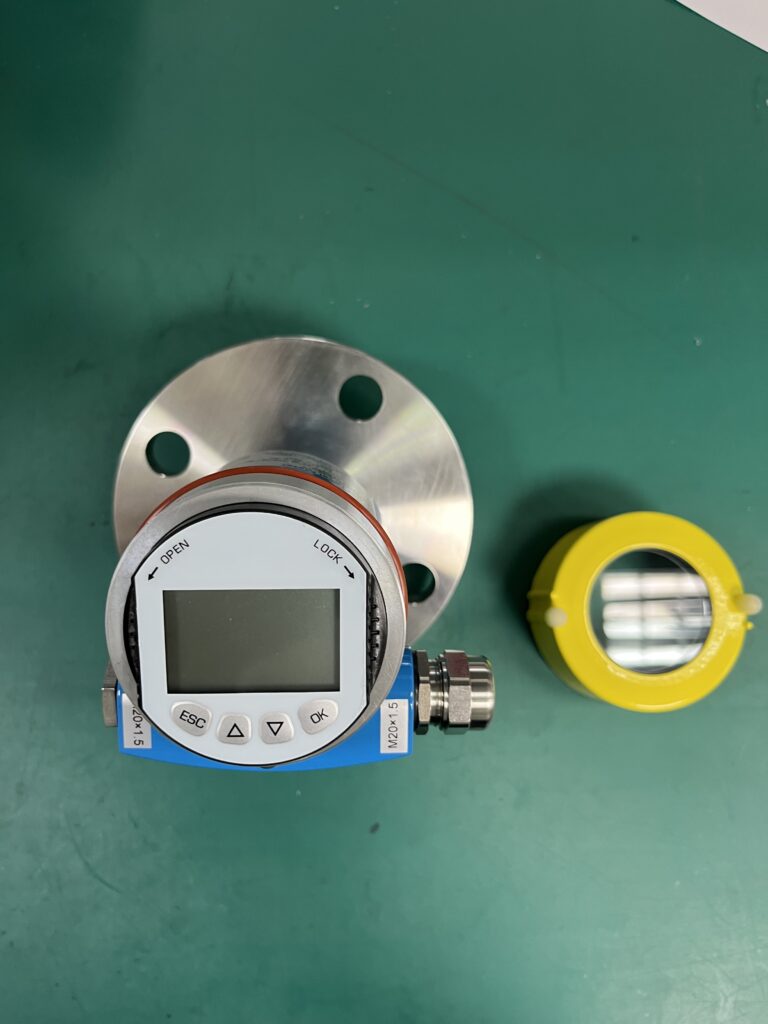
Before selecting a radar level transmitter, start with the application rather than the instrument catalogue.
At minimum, answer the following questions.
What Is the Medium?
Is it:
- Water?
- Acid?
- Alkali?
- Solvent?
- Oil?
- Slurry?
- Resin?
- Another chemical?
The medium influences echo strength, wetted-material requirements, antenna selection, and overall suitability.
What Is the Actual Measuring Distance?
Do not consider only the physical tank height.
Also consider:
- Mounting position
- Maximum level
- Minimum level
- Nozzle height
- Upper measuring limitation
- Required measurement span
Is Foam Present?
Consider not only normal operation but also filling, start-up, reaction, agitation, and abnormal conditions.
Does the Vessel Have an Agitator or Internal Structures?
Identify:
- Agitators
- Heating coils
- Ladders
- Pipes
- Supports
- Other large internal obstructions
These affect both mounting position and echo interpretation.
What Are the Process Temperature and Pressure?
Ambient tanks and high-temperature/high-pressure vessels are very different applications.
Also consider:
- Vacuum conditions
- Corrosive vapor
- Volatile gases
- Condensation
- Required pressure rating
9. Is a Higher Radar Frequency Always Better?
This is another common misunderstanding.
A higher radar frequency does not automatically mean better performance in every application.
Higher-frequency radar systems can provide a narrower beam and stronger focusing characteristics, which can be very useful when:
- The tank is narrow
- Internal obstructions are present
- The mounting location is restricted
- Better target separation is required
However, this does not mean that every tank should automatically use the highest available radar frequency.
The correct selection depends on the combination of:
Medium + Tank Geometry + Process Conditions + Installation
The frequency is only one part of the overall solution.
10. Non-Contact Radar vs. Guided Wave Radar
These two technologies are sometimes grouped together under “radar level measurement,” but their installation and application characteristics are different.
Non-Contact Radar
A non-contact radar transmitter is normally mounted at the top of the vessel and sends the radar signal toward the product surface without requiring a probe to extend through the entire measuring range.
It is widely used for:
- Storage tanks
- Large vertical tanks
- Chemical liquids
- Corrosive media
- Applications where contact with the product should be minimized
Guided Wave Radar
A guided wave radar (GWR) transmitter guides the electromagnetic signal along a rod, cable, or coaxial probe.
It can be useful in applications such as:
- Small vessels
- Restricted spaces
- Bypass chambers
- Certain interface measurements
- Applications where guided signal propagation provides an advantage
However, the probe enters the process medium.
Therefore, engineers must consider:
- Corrosion
- Coating
- Product buildup
- Mechanical forces
- Probe damage
- Chemical compatibility
Neither technology is universally better.
The correct choice depends on the application.
11. The Most Common Selection Mistake: Looking Only at Measuring Range
Consider this request:
“The tank is 15 meters high, so please supply a 20-meter radar level transmitter.”
That information is not sufficient.
Measuring range is only one selection parameter.
A proper selection should also consider:
- Maximum and minimum level
- Nozzle dimensions
- Upper measuring limitation
- Product dielectric properties
- Foam
- Vapor
- Condensation
- Internal structures
- Antenna type and material
- Process connection
- Temperature rating
- Pressure rating
- Enclosure protection
- Hazardous-area requirements
Ignoring any of these factors can create measurement problems after installation.
12. Why Does a Radar Level Reading Sometimes Jump?
One of the most frustrating problems is an instrument that works normally most of the time but occasionally produces an unexpected reading.
For example:
50% → suddenly 80% → back to 50%
Do not immediately assume that the transmitter has failed.
A more systematic troubleshooting procedure is useful.
Step 1: Verify the Actual Level
Did the real process level change, or only the indicated value?
Step 2: Check the Echo Curve
Is the transmitter tracking the true product-surface echo?
Are strong false echoes present?
Step 3: Check the Process Condition
Did something change?
For example:
- Filling started
- Agitator started
- Foam appeared
- Product properties changed
- Condensation increased
Step 4: Check Internal Obstructions
Could an agitator, coil, pipe, or other structure be creating a competing echo?
Step 5: Check the Installation
Is the antenna:
- Too close to the tank wall?
- Pointing toward an inlet?
- Too close to an agitator?
- Installed on an unsuitable nozzle?
Step 6: Check the Configuration
Review settings such as:
- Measuring range
- Upper/lower limits
- Echo suppression
- False-echo mapping
- Signal thresholds
- Application parameters
This approach is usually more effective than immediately replacing the transmitter. The original article similarly recommends checking the actual level, echo, process condition, vessel internals, installation, and configuration in sequence.
13. Radar vs. Differential Pressure Level Measurement
Which is better?
There is no universal answer.
Differential Pressure Level Measurement
DP level measurement is mature technology with decades of industrial experience.
However, depending on the installation, engineers may need to consider:
- Product density
- Impulse lines
- Capillaries
- Heat tracing
- Plugging
- Leakage
- Installation
- Maintenance
Radar Level Measurement
Radar provides different advantages:
- Non-contact measurement is possible
- Density changes generally have little direct effect on distance measurement
- Long measuring ranges are possible
- No impulse lines are required for the level measurement itself
However, radar performance depends strongly on:
- Proper instrument selection
- Correct mounting
- Product reflection characteristics
- Vessel geometry
- Echo processing
Therefore:
Radar does not simply replace differential pressure measurement.
Different applications require different technologies.
14. Typical Chemical Tank Applications
Different tank conditions require different priorities.
| Application | Key Selection Considerations |
|---|---|
| Clean liquid storage tank | Range, connection, accuracy, installation |
| Corrosive liquid tank | Antenna material, seal, process connection, chemical compatibility |
| Foaming tank | Foam characteristics, dielectric properties, signal processing |
| Agitated vessel | Mounting position, beam angle, false echoes |
| High-temperature/high-pressure vessel | Temperature rating, pressure rating, seal and antenna design |
| Volatile or condensing medium | Condensation, antenna design, buildup, possible purging |
| Low-dielectric liquid | Echo strength, antenna/frequency selection, installation |
| Hazardous-area tank | Required explosion-protection certification and electrical classification |
This is why there is no single “best radar level transmitter” for every chemical storage tank.
15. Do Not Select a Radar Transmitter Based on Price Alone
For a simple atmospheric storage tank containing a clean liquid with:
- Normal temperature
- Normal pressure
- No foam
- No agitator
- No severe vapor
- No difficult internal structures
an unnecessarily complex and expensive radar transmitter may provide little additional value.
The opposite mistake can be more costly.
If the application involves:
- High temperature
- High pressure
- Strong corrosion
- Heavy vapor
- Severe condensation
- Significant foam
- Complex vessel internals
selecting the cheapest general-purpose transmitter may result in unstable measurement, repeated maintenance, or even complete application failure.
The right radar level transmitter should be selected for the application—not simply for the lowest price or the longest advertised measuring range.
16. Radar Level Transmitter RFQ Checklist
Before requesting a quotation, provide as much of the following information as possible:
| Parameter | Information Required |
|---|---|
| Medium | Liquid/product name |
| Measuring range | Minimum, normal, and maximum level |
| Tank height | Total vessel height |
| Temperature | Normal and maximum |
| Pressure | Normal and maximum |
| Dielectric constant | If known |
| Foam | None / light / heavy |
| Agitator | Yes / No |
| Internal structures | Coils, ladders, pipes, supports, etc. |
| Installation | Tank-top, nozzle, bypass, etc. |
| Process connection | Thread/flange size and pressure rating |
| Material requirements | Especially process-contact materials |
| Output | 4–20 mA, HART, RS485/Modbus, etc. |
| Power supply | According to site requirements |
| Hazardous area | Required certification/classification |
| Protection rating | According to installation environment |
A request such as:
“Radar level transmitter, DN50, 10 m, Qty. 10”
does not provide enough information for reliable engineering selection.
The more complete the process data, the more reliable the final selection will be.
Conclusion
Radar level transmitters have become one of the most widely used continuous level measurement technologies for chemical storage tanks—and for good reason.
They can offer long measuring ranges, non-contact measurement, relatively low sensitivity to density changes, and good performance in many difficult industrial applications.
But radar is not a universal solution.
Successful measurement depends on much more than the range printed on the datasheet.
Engineers should consider:
Medium properties → Measuring range → Radar technology → Antenna → Vessel geometry → Internal obstructions → Foam → Vapor → Condensation → Temperature → Pressure → Installation → Hazardous-area requirements
Many apparent “instrument failures” are ultimately caused by inappropriate selection or installation rather than a defective transmitter. This is also the central conclusion of the original article.
When these factors are properly evaluated, a radar level transmitter can become one of the most reliable ways to continuously monitor liquid level in a chemical storage tank.
Need Help Selecting a Radar Level Transmitter?
If you are selecting a radar level transmitter for a chemical storage tank, reactor, process vessel, or other industrial application, send us your:
Medium, tank dimensions, measuring range, temperature, pressure, process connection, internal structure, and hazardous-area requirements.
We can help evaluate the application and recommend a suitable radar level measurement solution.