
In industrial environments with acid-base corrosion, instrumentation gas supply lines (such as compressed air pipelines) are highly susceptible to damage from acid mist, splashes, or volatile gases. This can result in gas leakage, contamination, and disruptions to the normal operation of instruments. Therefore, it is crucial to implement protective measures across various aspects of materials selection, pipeline protection, installation layout, and ongoing maintenance.
1. Material Selection for Gas Supply Lines (Core Protection)
1.1 Using Corrosion-Resistant Materials
Stainless Steel Pipes:
316L stainless steel is recommended due to its superior corrosion resistance compared to 304 stainless steel, especially in medium to high concentrations of acids and alkalis (such as sulfuric acid, nitric acid, sodium hydroxide).
316L contains molybdenum, which enhances its resistance to chemical corrosion in harsh environments.
Plastic Pipes:
For highly corrosive environments (e.g., hydrofluoric acid, high-concentration hydrochloric acid), PTFE (Polytetrafluoroethylene) or PP (Polypropylene) pipes are ideal. These materials are highly stable chemically and can withstand most acids and alkalis.
Avoid Carbon Steel and Galvanized Pipes:
Carbon steel and galvanized pipes are prone to corrosion under acidic and alkaline conditions, leading to rust, contamination, and potential leakage.
1.2 Valve and Fitting Compatibility
Ensure that valves (such as gate valves, ball valves) and fittings (such as tees and elbows) match the material of the pipeline (e.g., 316L stainless steel valves, PTFE fittings) to avoid galvanic corrosion.
Sealing materials should be chosen carefully, such as using fluoroelastomer O-rings to prevent failure due to exposure to acid or alkaline environments.

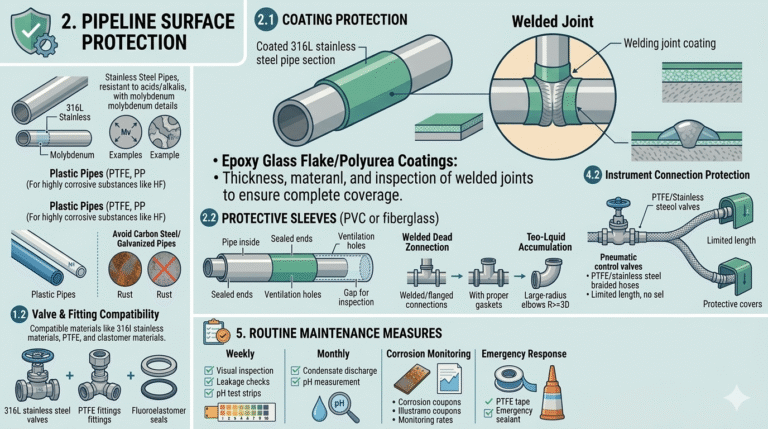
2. Pipeline Surface Protection
2.1 Coating Protection (for Stainless Steel Pipes)
For 316L stainless steel pipes, applying a corrosion-resistant coating is essential to protect against acid mist. Common coatings include:
Epoxy Glass Flake Coatings
Polyurea Coatings
These coatings form a protective layer, preventing direct contact with the pipe surface. The coating should be uniformly applied to:
The outer surface of the pipe
Welded joints (which are more prone to corrosion due to oxidation)
The coating thickness should be at least 0.3 mm and should be inspected for integrity every 1–2 years. If any damage is found, it should be repaired promptly.
2.2 Protective Sleeves
For pipelines exposed to acid or alkali splashes, protective sleeves (e.g., rigid PVC or fiberglass sleeves) should be installed to prevent direct exposure.
The sleeves should be sealed at both ends, with small ventilation holes to balance pressure.
Leave a gap of 5–10 mm between the pipe and the sleeve to allow for regular inspection for leaks or corrosion.
3. Optimizing Installation Layout
3.1 Keep Distance from Corrosive Sources
Gas supply lines should be placed as far as possible from corrosive sources such as acid and alkali tanks, reaction vessels, and leak points. A minimum distance of 1.5 m should be maintained.
If the pipeline must cross a corrosive area, ensure it is as short as possible and consider using overhead installation (height ≥1.8 m) to avoid immersion in liquids.
3.2 Pipeline Slope and Drainage
The pipeline slope should range from 1:100 to 1:50 to ensure proper drainage.
Install drain valves at the lowest points of the pipeline (made of materials compatible with the pipeline) to regularly discharge condensation and prevent corrosion.
3.3 Avoid Dead Zones and Liquid Accumulation
Welded connections and flanged connections (with corrosion-resistant gaskets) should be prioritized for pipeline installation to reduce gaps where corrosive media can accumulate.
Large-radius elbows (R ≥ 3D) should be used to prevent localized corrosion caused by turbulence.

4. Gas Supply Purification and Terminal Protection
4.1 Enhance Gas Supply Purification
Install multi-stage filtration systems at the gas supply inlet:
Pre-filters (for water and oil removal) to prevent moisture and acidic gases from reacting and forming corrosive liquids.
Precision filters (with a precision of ≤5 μm) to prevent particulate impurities from entering the instruments (such as positioners or pneumatic valves), which could lead to blockages or malfunctions.
4.2 Instrument Connection Protection
Gas supply lines connected to instruments (e.g., pneumatic control valves, transmitters) should use corrosion-resistant materials like:
PTFE hoses
Stainless steel braided hoses
Hose length should be limited to 1.5 meters to minimize long-term contact with corrosive media. Protective covers (e.g., fluoroplastic sleeves) should be installed at hose connections and secured with brackets to prevent corrosion from splashing liquids.

5. Routine Maintenance Measures
5.1 Regular Inspections
Weekly: Inspect the pipeline surface for signs of corrosion or coating damage. Check valves and flange seals for leakage. pH test strips can be used to detect acid or alkali residues.
Monthly: Discharge condensate and measure its pH level (should be neutral). If it is acidic or alkaline, it indicates potential pipeline leakage or increased corrosion.
5.2 Corrosion Monitoring
Install corrosion coupons (made of the same material as the pipeline) in critical sections to monitor corrosion rates.
If the corrosion rate exceeds 0.1 mm/year, the pipeline should be replaced.
5.3 Emergency Response
Have corrosion-resistant repair materials on hand, such as PTFE sealing tape and emergency sealant. In the event of localized corrosion or leakage:
Cut off the gas supply
Clean the affected area
Perform temporary repairs
Arrange for permanent replacement afterward

6. Conclusion
The core principle of protecting gas supply lines in acid-base corrosive environments is to block corrosive agents and enhance material corrosion resistance. By selecting corrosion-resistant materials such as 316L stainless steel and PTFE, optimizing the installation layout, improving air purification, and implementing regular maintenance, the service life of pipelines can be significantly extended, ensuring stable and clean gas supply to instrumentation.