
PLC vs DCS: Is PLC Really an Automation System? Understanding the Difference
Some engineers believe that process control must use a DCS system, while PLCs should only be used for machine control and cannot be considered a true automation system.
This statement sounds reasonable at first glance, but is it really correct?
What is the actual difference between a DCS (Distributed Control System) and a PLC (Programmable Logic Controller)?
Does a process plant always need a DCS?
And is a PLC really part of an automation system?
Let’s take a closer look.
What Are DCS and PLC?
First, we need to understand the basic concepts.
DCS (Distributed Control System) and PLC (Programmable Logic Controller) are both widely used industrial control systems.
Their main purpose is the same:
- Collect signals from field instruments
- Execute control logic
- Operate industrial equipment
- Maintain stable production processes
In other words, both DCS and PLC are important components of industrial automation.
The difference is mainly related to their original design purpose and typical application areas.
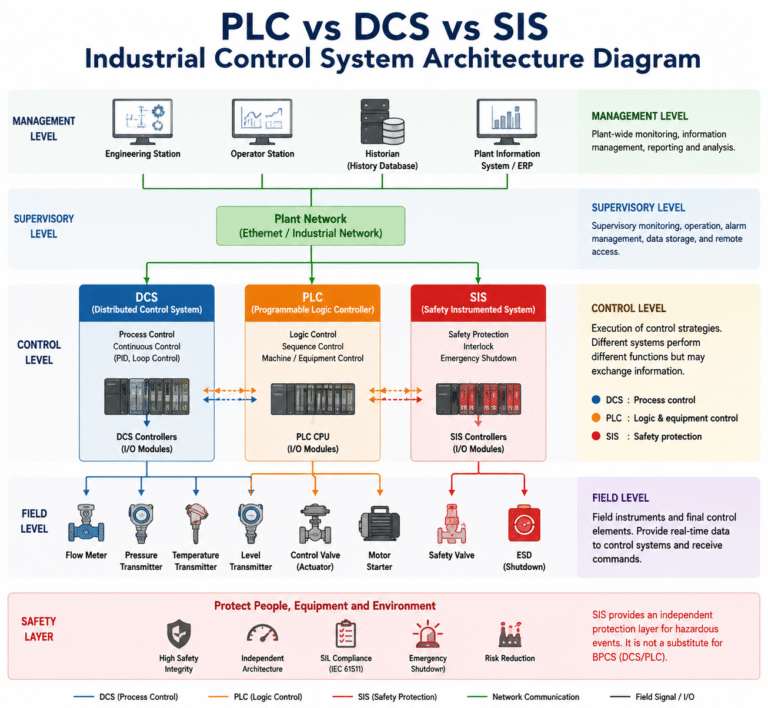
BPCS: The Basic Process Control System
In process industries, the term BPCS (Basic Process Control System) is commonly used to describe the system responsible for normal production control.
A BPCS can be implemented using different control platforms, including:
- DCS
- PLC
- PAC (Programmable Automation Controller)
- Other industrial control platforms
Industrial standards generally focus on achieving safe and reliable process control rather than specifying that a particular industry must use DCS or PLC.
The selection depends on:
- Process complexity
- Control requirements
- System architecture
- Investment budget
- Maintenance capability
Traditional Difference Between DCS and PLC
Historically, DCS and PLC had relatively clear application boundaries.
DCS: Designed for Continuous Process Control
DCS was originally developed for large-scale continuous processes.
Typical applications include:
- Oil and gas processing
- Petrochemical plants
- Power generation
- Chemical production
DCS systems are particularly strong in:
- Analog signal processing
- Regulatory control loops
- Process optimization
- Alarm management
- Operator stations
- Historical data management
Typical process variables include:
- Temperature
- Pressure
- Flow
- Level
- Composition

PLC: Designed for Logic and Equipment Control
PLC was originally developed for discrete control applications.
Its advantages include:
- Fast logic execution
- Reliable equipment control
- Sequence control
- Interlocking
- Machine automation
Typical applications include:
- Packaging machines
- Assembly lines
- Water treatment equipment
- Skid-mounted systems
- Manufacturing equipment
Are DCS and PLC Functions Still Different Today?
With the development of modern automation technology, the boundary between DCS and PLC has become increasingly blurred.
Modern DCS systems have strong:
- Logic processing capability
- Sequence control functions
- Communication capability
Modern PLC systems also support:
- Analog input/output processing
- PID control
- Industrial networking
- Remote monitoring
Therefore, many applications can technically be controlled by either a PLC or a DCS.
However, their design philosophy remains different:
DCS focuses more on large-scale process management and operator-oriented control.
PLC focuses more on fast logic execution and equipment-level automation.

Can PLC Be Used in Large Process Plants?
The answer is yes.
A PLC can be used in many large industrial applications, especially where:
- Fast response is required
- Control logic is complex
- Equipment operation is the main focus
For example:
- Compressor control systems
- Pump stations
- Utility systems
- Package units
- Auxiliary process systems
However, in many large continuous process plants, a common architecture is:
- DCS → Normal process control
- SIS → Safety protection
- PLC → Package equipment or auxiliary systems
The final choice depends on the plant design philosophy.

Can DCS Handle Logic Control?
Absolutely.
Modern DCS systems can perform:
- Sequence control
- Interlocking
- Start/stop control
- Logic operations
The idea that “DCS can only handle analog signals” is outdated.
Which One Is Faster: PLC or DCS?
PLC systems are generally designed for high-speed logic execution and can achieve very fast scan cycles.
DCS systems are designed differently, focusing more on:
- Process stability
- Control optimization
- Large-scale data handling
- Operator interaction
Therefore, comparing only scan speed does not determine which system is better.
A faster controller does not always mean better process control.
For example:
- Motor protection may require millisecond response
- Temperature control may only require seconds of response time
The correct system depends on the process requirements.

Why Do Many Process Industries Prefer DCS?
Many chemical and energy companies prefer DCS mainly because of two reasons.
1. Better Process Management
DCS platforms usually provide integrated functions such as:
- Operator stations
- Alarm management
- Trending
- Historical data
- Engineering tools
This makes large process plants easier to operate and maintain.
2. Standardized Engineering and Maintenance
Large plants often have:
- Thousands of instruments
- Hundreds of control loops
- Multiple operators
A DCS provides a unified engineering environment, which simplifies long-term operation and maintenance.
Relationship Between PLC, DCS, and SIS
In modern process industries, these systems often work together:
Field Instruments
(Flow, Pressure, Temperature, Level)
              ↓
      PLC / DCS
(Basic Process Control System)
              ↓
          SIS
(Safety Instrumented System)
              ↓
 Emergency Shutdown / Protection
The roles are different:
BPCS (DCS/PLC):
Controls normal production.
SIS:
Protects people, equipment, and the environment during dangerous conditions.
So, Does Process Control Require DCS?
The answer is:
No. Process control does not always require DCS.
Both DCS and PLC can be used for industrial automation.
The correct selection depends on:
- Process characteristics
- System reliability requirements
- Safety requirements
- Project budget
- Maintenance resources
The statement that “PLC is not automation” is incorrect.
PLC is one of the most important automation technologies in modern industry.
DCS, PLC, SIS, and SCADA are all different parts of the industrial automation ecosystem.
The best control system is not the one with the most advanced technology, but the one that best matches the process requirements.