
Introduction
For atmospheric storage tanks containing flammable, toxic, or volatile liquids, nitrogen blanketing is an important safety protection method widely used in the chemical, petroleum, and pharmaceutical industries.
A nitrogen blanketing system maintains a slight positive pressure inside the storage tank by introducing nitrogen gas, preventing external air from entering the tank. This helps reduce oxidation, minimize product evaporation losses, control VOC emissions, and reduce the risk of fire or explosion caused by oxygen mixing.
A complete nitrogen blanketing system usually works together with a breather valve, pressure control valve, and pressure measurement instruments to maintain stable tank pressure during filling, emptying, and temperature changes.
This article explains when nitrogen blanketing is required, relevant standards, and how to properly configure a nitrogen blanketing system.
1. Why Do Storage Tanks Need Nitrogen Blanketing?
Atmospheric storage tanks experience pressure fluctuations caused by:
- Liquid filling and discharge operations
- Ambient temperature changes
- Product evaporation
- Atmospheric pressure variations
Without proper protection, air may enter the tank during negative pressure conditions. Oxygen inside the tank can create risks including:
- Fire and explosion hazards
- Product oxidation and quality degradation
- Increased VOC emissions
- Corrosion problems
Nitrogen blanketing creates an inert atmosphere above the liquid surface, improving storage safety and product reliability.

2. Regulations Requiring Nitrogen Blanketing Systems
Different countries and industries have specific requirements for nitrogen protection systems. In China, several standards specify when nitrogen blanketing is required.
SH/T 3007-2014
For storage tanks containing Class A flammable liquids with Class I or II toxicity, nitrogen or other inert gas blanketing protection shall be provided under specified conditions.
Key points:
- Toxicity classification and fire hazard classification determine whether inert gas protection is required.
- Nitrogen is commonly used, but other inert gases may also be applicable.
- The system reduces the possibility of fire and explosion accidents.
GB50160-2008 (2018 Edition)
For fixed roof tanks storing heavy oil with a storage temperature above 120°C, nitrogen protection shall be provided.
Key requirements:
- Applicable to heavy oil storage applications.
- Nitrogen protection helps reduce oxygen concentration inside the tank.
- It provides additional safety protection during abnormal conditions.
AQ3063-2025
For newly built storage tanks, nitrogen blanketing systems shall be installed under conditions including:
- Large capacity tanks storing Class A or Class B flammable liquids
- Fixed roof tanks or internal floating roof tanks
- High-temperature storage of combustible liquids
The standard also requires nitrogen blanketing for:
- Oily wastewater storage tanks
- Hydrogen sulfide-containing acidic water tanks
- Storage tanks with vapor collection systems
GB51428-2021 and GB50074-2014
These standards also specify nitrogen sealing protection requirements for:
- Highly toxic and extremely toxic Class A/B liquids
- High-temperature heavy oil storage tanks
- Volatile chemical storage tanks requiring special protection
3. Main Components of a Nitrogen Blanketing System
A typical nitrogen blanketing system includes the following components:
3.1 Nitrogen Blanketing Valve
The nitrogen blanketing valve controls nitrogen supply into the storage tank.
Main functions:
- Maintain tank pressure at the required set point
- Automatically supply nitrogen when tank pressure decreases
- Prevent excessive nitrogen consumption
Typical parameters:
- Inlet nitrogen pressure
- Tank operating pressure
- Pressure setting range
- Valve material
- Flow capacity (Cv)
3.2 Pressure Transmitter
The pressure transmitter monitors tank pressure and provides measurement signals for control systems.
Typical specifications:
- Measuring range: Low pressure range (kPa level)
- Output: 4-20mA / HART
- Accuracy: ±0.075% or better
- Explosion-proof option available for hazardous areas
The pressure transmitter helps maintain stable nitrogen pressure and provides alarm signals for abnormal conditions.
3.3 Breather Valve
The breather valve protects the storage tank from excessive positive or negative pressure.
Functions:
- Release excessive tank pressure
- Prevent tank vacuum conditions
- Protect tank mechanical structure
The breather valve works together with the nitrogen blanketing valve to maintain safe operating pressure.
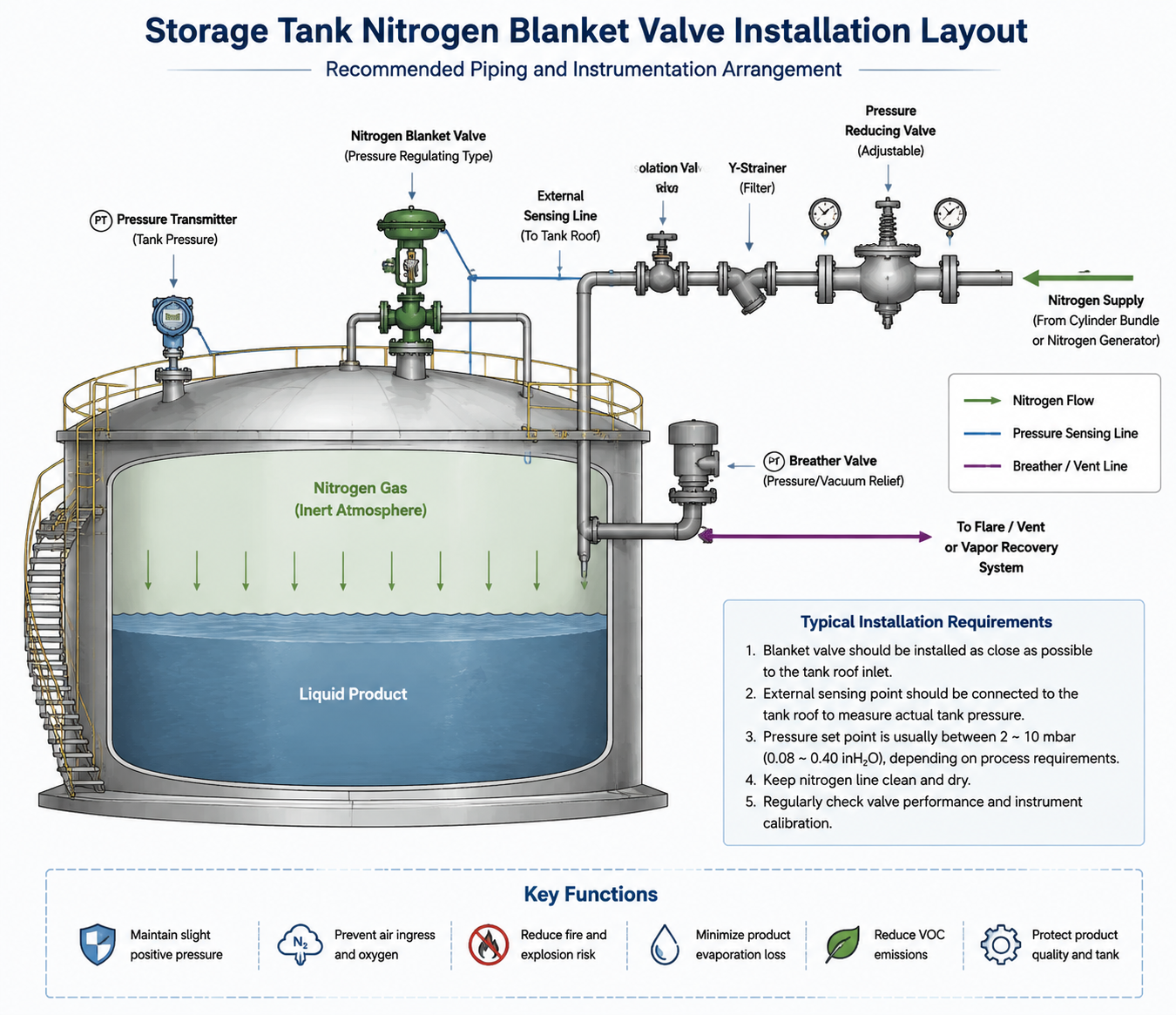
4. Nitrogen Blanketing System Installation Guidelines
According to SH/T 3184, nitrogen sealing systems should follow several installation requirements:
Nitrogen blanketing valve installation:
- The valve should be installed on the nitrogen supply pipeline close to the tank roof inlet.
- External pressure sensing piping should preferably connect to the tank roof to measure actual tank pressure.
- The pressure setting point should match the normal operating pressure of the storage tank.
- The adjustable pressure range should cover the maximum operating pressure.
Proper installation ensures stable pressure control and reliable operation.
5. Typical Nitrogen Blanketing Control Process
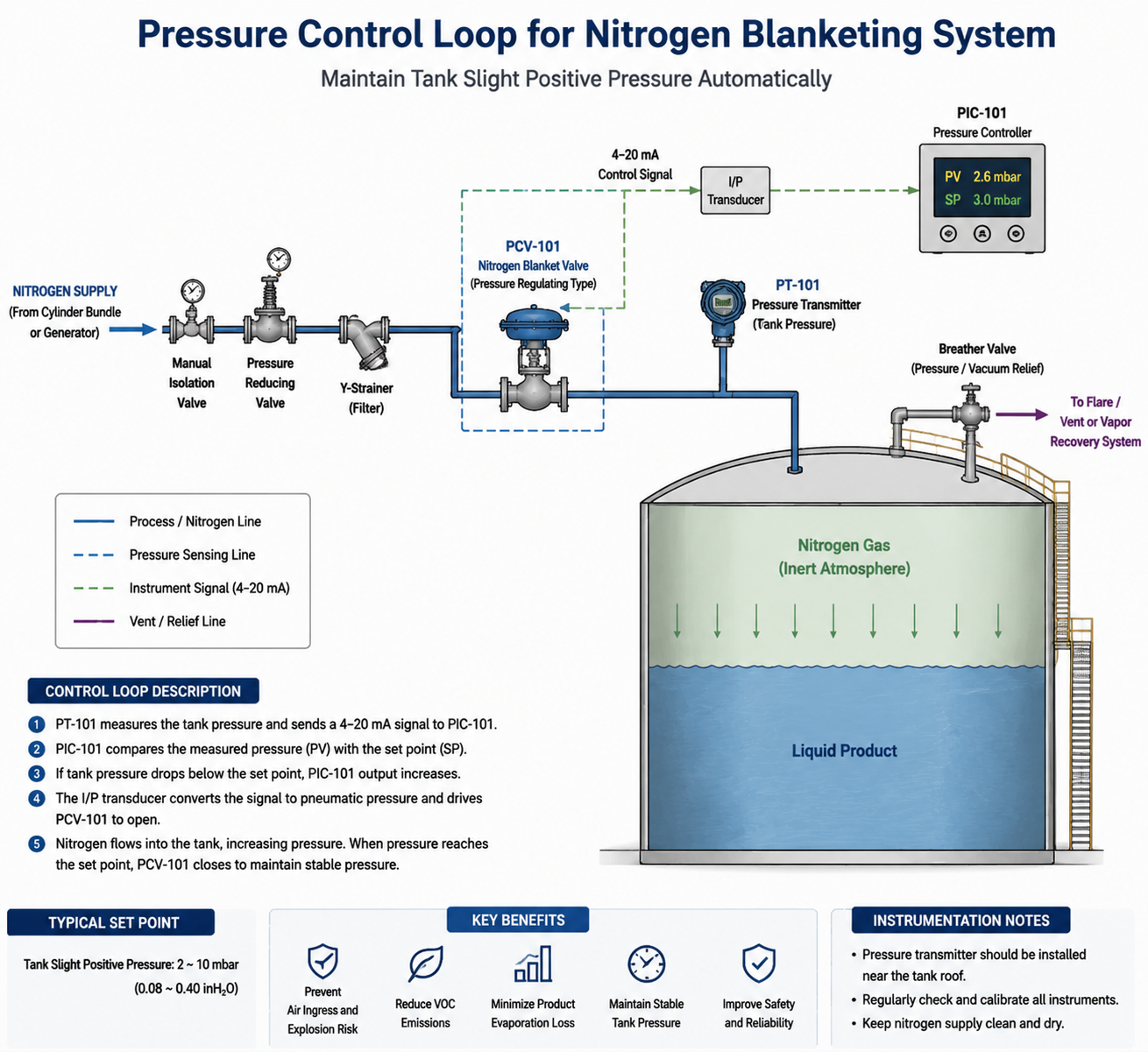
The working principle is:
Nitrogen Supply
        |
        ↓
Pressure Reducing Valve
        |
        ↓
Nitrogen Blanketing Valve
        |
        ↓
Storage Tank
        |
        ↓
Pressure Transmitter
        |
        ↓
Control System
        |
        ↓
Breather Valve
When tank pressure decreases due to liquid discharge or temperature changes, the nitrogen valve opens automatically and supplies nitrogen.
When tank pressure returns to the normal range, nitrogen supply stops.
6. Common Problems in Nitrogen Blanketing Systems
Excessive Nitrogen Consumption
Possible causes:
- Incorrect pressure setting
- Nitrogen valve leakage
- Improper valve sizing
Solutions:
- Check pressure set point
- Inspect valve sealing performance
- Verify flow capacity calculation
Unstable Tank Pressure
Possible causes:
- Incorrect pressure transmitter installation
- Blocked sensing line
- Improper control valve selection
Solutions:
- Check pressure measurement system
- Clean sensing lines
- Recalculate valve parameters
Insufficient Protection
Possible causes:
- Incorrect nitrogen supply pressure
- Wrong system configuration
- Missing pressure monitoring instruments
Solutions:
- Review system design
- Check instrument specifications
- Verify operating conditions
7. How to Select Instruments for Nitrogen Blanketing Systems?
When selecting instruments, engineers should consider:
- Tank volume
- Storage medium characteristics
- Operating temperature
- Operating pressure
- Hazardous area requirements
- Required control accuracy
Recommended instrumentation:
| Equipment | Function |
|---|---|
| Nitrogen Blanketing Valve | Nitrogen pressure control |
| Pressure Transmitter | Tank pressure monitoring |
| Pressure Switch | High/low pressure alarm |
| Breather Valve | Tank overpressure/vacuum protection |
| Control System | Automatic regulation |
Conclusion
Nitrogen blanketing is an important safety technology for atmospheric storage tanks containing hazardous or volatile liquids.
A properly designed nitrogen blanketing system can:
- Reduce oxygen exposure
- Minimize VOC emissions
- Improve storage safety
- Protect product quality
For storage tanks requiring nitrogen protection, correct selection of nitrogen valves, pressure transmitters, and pressure control instruments is essential for reliable operation.
Need assistance selecting pressure instruments or nitrogen blanketing system components for your storage tank application? Contact our technical team for professional support.