
Introduction
In industries such as oil & gas, petrochemical, power generation, metallurgy, water treatment, and chemical processing, pressure transmitters and differential pressure (DP) transmitters are among the most widely used process instruments.
They act as the “sensing nerve” of industrial control systems, providing critical measurement data for process control, safety protection, and equipment operation.
However, many field failures are not caused by poor product quality. In many cases, the problems are already created during the instrument selection stage, such as:
- Incorrect wetted material causing corrosion and diaphragm failure
- Oversized measuring range reducing measurement accuracy
- Improper transmitter structure causing clogging and frequent maintenance
Therefore, selecting the correct pressure or differential pressure transmitter requires a complete understanding of the process conditions, measurement purpose, installation environment, and long-term maintenance requirements.

1. Basic Selection Principle: Process Conditions Come First
Match the Instrument to the Application Before Considering Cost
The first rule of transmitter selection is:
Ensure reliable operation under actual process conditions before optimizing cost.
A lower initial purchase price does not always mean lower total cost.
For example:
A standard pressure transmitter may be cheaper initially, but when installed in a high-viscosity or corrosive application, it may suffer from:
- Impulse line blockage
- Diaphragm corrosion
- Frequent calibration requirements
- Unexpected downtime
A properly selected transmitter with a suitable structure can significantly reduce maintenance costs throughout the equipment lifecycle.
2. Key Factors Affecting Pressure Transmitter Selection
2.1 Medium Characteristics Determine Materials and Structure
The process medium is the first factor to evaluate because it directly affects the transmitter’s service life and safety.
Clean and Non-Corrosive Media
For applications such as:
- Water
- Air
- Steam
- General industrial fluids
Standard pressure transmitters with 304 or 316L stainless steel wetted parts are usually sufficient.
Corrosive Media
For applications involving:
- Acids
- Alkalis
- Chemical solutions
- Chlorine-containing media
the wetted material must be carefully selected.
Typical material options:
| Application | Recommended Material |
|---|---|
| General corrosive service | 316L stainless steel |
| Strong chemical corrosion | Hastelloy alloy |
| Extremely corrosive media | Tantalum diaphragm |
Incorrect material selection may cause:
- Diaphragm leakage
- Corrosion damage
- Process contamination
- Safety risks
2.2 Temperature and Pressure Define the Operating Limits
High Temperature Applications
When process temperature exceeds approximately 200°C, standard transmitter structures may experience:
- Fill fluid expansion
- Measurement drift
- Sensor damage
For high-temperature applications, consider:
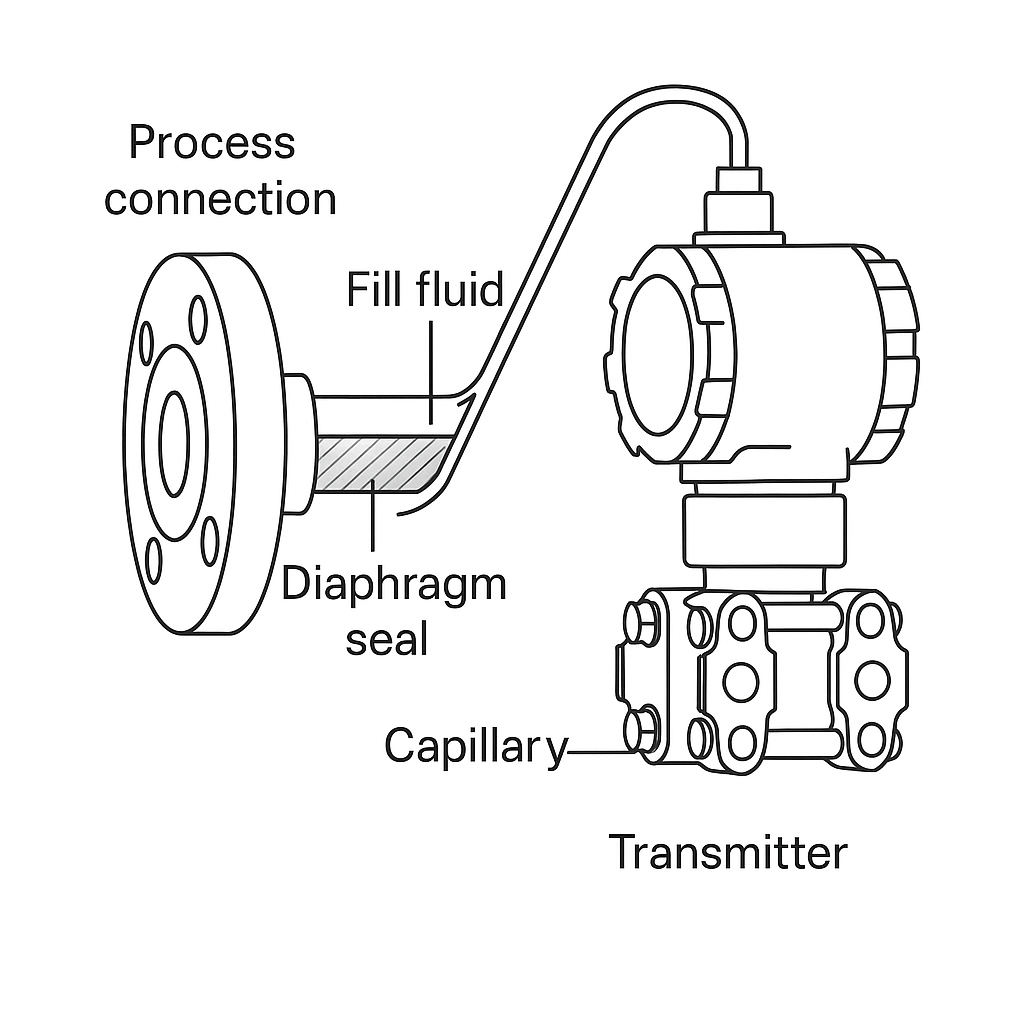
- Remote seal systems
- Cooling extensions
- Heat dissipation structures
- High-temperature transmitter models
Pressure Rating Selection
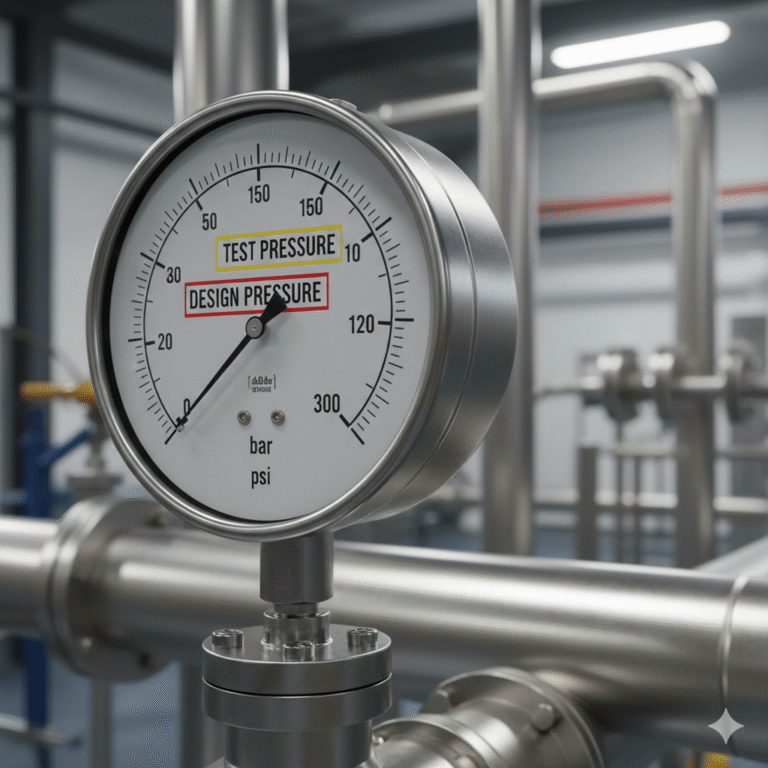
The transmitter pressure rating must always be higher than the maximum process pressure.
A proper selection should consider:
- Normal operating pressure
- Maximum pressure
- Pressure spikes
- Safety margin
The wetted components must meet process requirements, while non-contact components can sometimes use more economical materials to reduce overall cost.

3. Structural Selection: Standard Pressure Transmitter vs Remote Seal Type
Standard Pressure Transmitter
Suitable for:
- Clean liquids
- Clean gases
- Normal temperature applications
Advantages:
- Lower cost
- Simple installation
- Easy maintenance
Limitations:
- Risk of impulse line blockage
- Requires regular inspection
- Not suitable for crystallizing or highly viscous media
Remote Seal Pressure Transmitter
Recommended for:
- High viscosity fluids
- Slurry applications
- Crystallizing materials
- Strong corrosive media
- High-temperature processes
Advantages:
- Prevents clogging
- Reduces maintenance
- Protects the sensing element from direct contact with the medium
Typical applications:
- Chemical reactors
- Storage tanks
- Wastewater treatment
- Petrochemical processes
4. Measuring Range and Accuracy Selection
Correct range selection is essential for measurement accuracy.
Although modern smart transmitters provide wide turndown ratios, the best measurement performance is usually achieved when the normal operating point is located within the optimized range.
General recommendations:
- Avoid selecting an excessively large measuring range
- Consider normal operating pressure rather than only maximum pressure
- Ensure sufficient overload protection
For critical applications:
- High accuracy models may be selected for custody transfer or advanced control loops
- Standard industrial applications usually do not require extremely high accuracy
5. Differential Pressure Transmitter Applications
A differential pressure transmitter measures the pressure difference between two points.
It is widely used for:
- Level measurement
- Flow measurement
- Density measurement
5.1 DP Transmitter for Level Measurement
Differential pressure measurement is one of the most common solutions for industrial tank level measurement.
Applications include:
- Open tanks
- Closed vessels
- Reactors
- Distillation columns
The relationship is:
Differential Pressure = Liquid Density × Gravity × Height
For difficult applications:
- Use remote diaphragm seals for corrosive media
- Use capillary systems for high-temperature vessels
- Consider density changes caused by temperature variation
5.2 DP Transmitter for Flow Measurement
When combined with primary elements such as:
- Orifice plates
- Venturi tubes
- Flow nozzles
DP transmitters can measure:
- Liquid flow
- Gas flow
- Steam flow
The principle is based on:
Flow rate is proportional to the square root of differential pressure.
For steam applications:
Temperature and pressure compensation are required to calculate accurate mass flow.
5.3 DP Transmitter for Density Measurement
Differential pressure can also be used for online density measurement.
Common applications:
- Slurry
- Crude oil
- Chemical mixtures
The transmitter should have:
- High static pressure capability
- Excellent low differential pressure resolution
- Stable long-term performance
6. Pressure Transmitter Applications
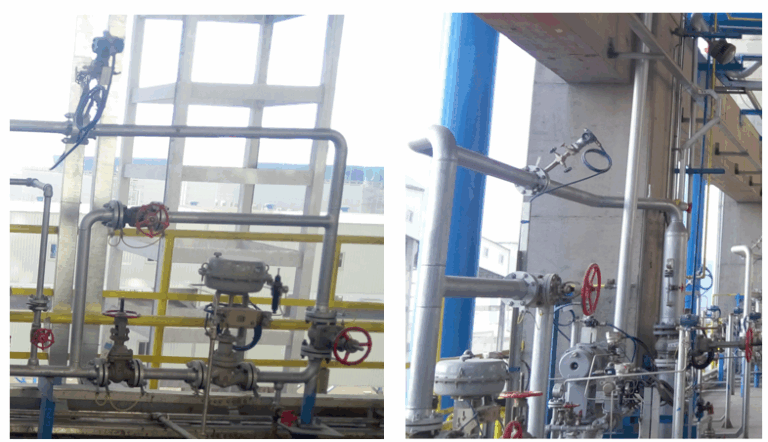
Pressure transmitters directly measure pressure at a single point.
They are commonly classified as:
Gauge Pressure Transmitter
Reference point:
Atmospheric pressure
Applications:
- Pump outlet pressure
- Pipeline pressure
- Process vessel pressure
Selection considerations:
- Operating pressure range
- Overpressure protection
- Wetted material compatibility
Absolute Pressure Transmitter
Reference point:
Absolute vacuum
Applications:
- Vacuum systems
- Vacuum distillation
- Low-pressure processes
Important:
Absolute pressure transmitters cannot be replaced by gauge pressure transmitters because atmospheric pressure variation will affect measurement accuracy.
7. Five-Step Pressure Transmitter Selection Process
Step 1: Define the Measurement Purpose
First determine what needs to be measured:
| Measurement Requirement | Recommended Instrument |
|---|---|
| Tank level / flow measurement | Differential Pressure Transmitter |
| Pipeline pressure monitoring | Pressure Transmitter |
| Vacuum measurement | Absolute Pressure Transmitter |
| Corrosive or crystallizing media | Remote Seal Transmitter |
Step 2: Confirm Process Conditions
Important parameters include:
Medium
- Corrosion characteristics
- Viscosity
- Crystallization tendency
- Solid particles
Temperature
- Process temperature
- Ambient temperature
- Need for cooling or insulation
Pressure
- Normal operating pressure
- Maximum pressure
- Overpressure conditions
Step 3: Select Accuracy and Turndown Ratio
Consider:
- Required measurement accuracy
- Control loop requirements
- Calibration frequency
Smart transmitters usually provide:
- Wide turndown ratio
- Digital configuration
- Remote diagnostics
Step 4: Confirm Output Signal and Communication
Common options:
4-20mA + HART
The most widely used industrial communication method.
Advantages:
- Compatible with PLC/DCS systems
- Remote configuration
- Device diagnostics
Fieldbus Communication
Examples:
- Foundation Fieldbus
- Profibus PA
Suitable for:
- Large-scale plants
- Digital instrumentation networks
WirelessHART
Recommended for:
- Remote locations
- Difficult cable installation areas
Step 5: Confirm Installation and Accessories
Common process connections:
- Thread connection
- Flange connection
- Sanitary clamp connection
Common accessories:
- 3-valve manifold
- 5-valve manifold
- Condensate pot
- Remote seal system
- Mounting brackets
Correct accessories ensure reliable operation and easier maintenance.

8. Special Requirements in Oil & Gas and Petrochemical Industries
Petrochemical applications usually involve:
- High pressure
- High temperature
- Corrosive chemicals
- Explosive environments
Additional requirements may include:
Functional Safety
For SIS applications:
- SIL2 / SIL3 certification may be required
High Static Pressure Capability
High-pressure processes such as:
- Hydrogenation
- Reforming units
require high static pressure DP transmitters.
Sour Gas Service
For H₂S-containing applications:
- NACE MR0175 compliance
- Anti-sulfide stress cracking materials
may be required.
Explosion Protection
Hazardous areas require:
- ATEX certification
- IECEx certification
- Intrinsically safe or explosion-proof designs
9. Common Pressure Transmitter Selection Mistakes
1. Selecting an Excessively Large Range
Problem:
- Reduced resolution
- Poor low-pressure measurement
Solution:
Select the smallest suitable range with enough overload protection.
2. Ignoring Temperature Effects
Problem:
- Fill fluid expansion
- Measurement drift
- Sensor failure
Solution:
Use remote seals or high-temperature models.
3. Using Standard Transmitters for Difficult Media
Problem:
- Blocked impulse lines
- Corrosion
- Frequent maintenance
Solution:
Choose remote diaphragm seal structures.
4. Incorrect Communication Selection
Problem:
The transmitter cannot communicate properly with existing control systems.
Solution:
Confirm PLC/DCS compatibility before purchase.
5. Reducing Material Grade to Save Cost
Problem:
Short-term savings create long-term maintenance problems.
Solution:
Select materials based on process compatibility.

Conclusion
Selecting a pressure transmitter or differential pressure transmitter is not simply about choosing the highest specification product.
The correct selection should balance:
- Process compatibility
- Measurement accuracy
- Installation requirements
- Maintenance cost
- Long-term reliability
A properly selected transmitter improves process stability, reduces downtime, and provides safer operation throughout the equipment lifecycle.
Need help selecting a pressure or differential pressure transmitter for your application? Send us your process conditions, and our engineers will recommend the suitable model and configuration.