
Many people think dust is just a housekeeping problem — dirty floors, clogged equipment, or poor workshop conditions.
But in industries handling combustible powders, dust can become far more dangerous.
When fine particles become suspended in the air and encounter sparks, static electricity, hot surfaces, or friction heat, what looks like an ordinary layer of dust can instantly turn into a violent explosion.
Wood dust, aluminum powder, flour, sugar, plastic powder, coal dust, textile fibers, and grain dust may appear harmless during normal operation. Yet under the right conditions, they can create devastating industrial accidents within seconds.
Dust explosions are rarely “bad luck.”
In most cases, risks build up slowly over time until one small ignition source triggers a disaster.
Why Do Dust Explosions Happen?
Solid materials in large pieces usually do not burn rapidly because their exposed surface area is limited.
However, when the same material is ground into very fine particles, the surface area increases dramatically.
Once these particles are dispersed in air:
- oxygen mixes more efficiently,
- combustion accelerates rapidly,
- and pressure rises extremely fast inside confined spaces.
Under these conditions, even a small ignition source may trigger an explosion.
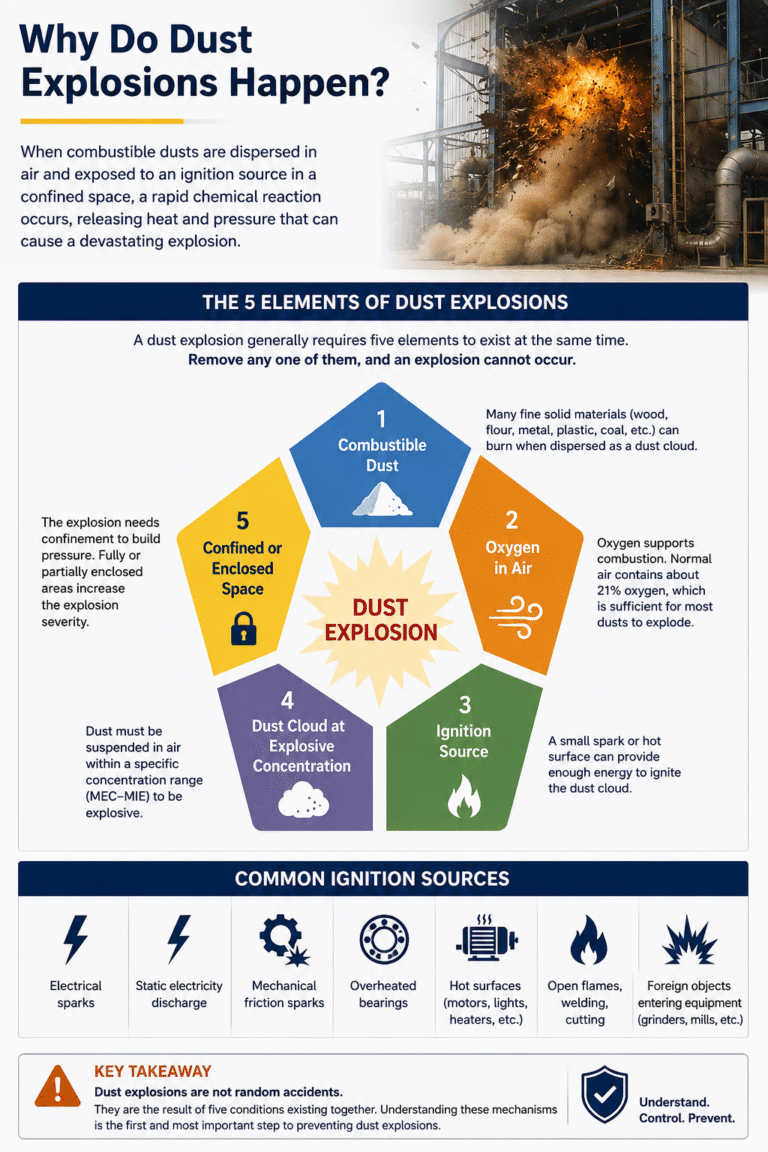
Typical ignition sources include:
- Electrical sparks
- Static discharge
- Hot bearings
- Mechanical friction
- Overheated motors
- Welding and cutting operations
- High-temperature surfaces
A combustible dust explosion generally requires five elements:
- Combustible dust
- Oxygen (air)
- Ignition source
- Dust suspension at explosive concentration
- Confined or semi-confined space
When these five conditions exist simultaneously, explosion risks become very real.
Therefore, dust explosion prevention is not only about eliminating open flames.
It also requires controlling dust accumulation, ignition sources, ventilation systems, static electricity, maintenance quality, and housekeeping practices.
Dangerous Areas Are Often the Least Visible
In many facilities, workshops may appear relatively clean on the surface.
However, the most dangerous dust accumulation points are often hidden inside:
- Dust collectors
- Duct bends
- Hoppers
- Motor housings
- Structural beams
- Cable trays
- Elevated platforms
- Grinding and polishing stations
- Crushing and screening systems
- Pneumatic conveying lines
The real danger is not always the visible layer of dust.
It is the invisible, continuous accumulation over time.
A small initial explosion can shake loose dust deposits from roofs, pipes, and elevated structures, creating a much larger dust cloud and triggering a secondary explosion.
In many catastrophic incidents, secondary explosions cause the majority of fatalities and structural damage.
1. Control Dust Before It Spreads
The first step in dust explosion prevention is not buying expensive equipment.
It is reducing dust generation and preventing dust escape.
Dust-producing equipment should be properly enclosed.
Inspection ports, access doors, and equipment connections should not leak continuously during operation.
Processes such as:
- Grinding
- Polishing
- Crushing
- Screening
- Powder conveying
should be equipped with effective ventilation and dust collection systems.
A dust collection system should not merely “remove visible dust.”
Poor airflow design may allow dust to settle inside ducts.
Improper duct routing can create dead zones and dust buildup areas.
Damaged filters, blocked bags, or abnormal differential pressure can transfer explosion risks directly into the dust collector itself.
Key inspection points include:
- Is the suction hood close enough to the dust source?
- Is dust accumulating inside ducts?
- Is the dust collector differential pressure abnormal?
- Are filter bags damaged or clogged?
- Is the discharge system operating properly?
- Are explosion venting or suppression systems installed where required?
- For aluminum or magnesium dust systems, are liquid level and flow interlocks functioning properly?
Dust collection systems are not just environmental equipment.
They are critical explosion protection systems.

2. Ignition Sources Are More Common Than Most People Realize
Many facilities focus only on open flames during inspections.
But combustible dust environments contain many other ignition risks.
Common ignition sources include:
- Electrical arcing
- Static electricity discharge
- Friction sparks
- Bearing overheating
- Belt slippage
- Foreign objects entering grinders or mills
- Welding and hot work
- Overheated lighting fixtures and motors
Electrical equipment installed in hazardous dust areas must match the appropriate explosion protection classification.
Ordinary switches, sockets, temporary wiring, and standard lighting fixtures may become serious hazards in combustible dust environments.
Hot work operations require strict control procedures.
Before welding or cutting:
- Dust deposits must be cleaned,
- work permits approved,
- isolation measures implemented,
- fire monitoring arranged,
- and gas or dust hazards verified.
After hot work is completed, the area should not immediately return to operation until temperatures return to safe levels.
3. Static Electricity Is Not a Minor Issue
Static electricity is generated easily during:
- Powder conveying
- Mixing
- Pneumatic transport
- Filling operations
- Material discharge
The finer the dust, the easier it becomes airborne.
The drier the environment, the harder static charges are to dissipate.
Without reliable grounding and bonding, electrostatic discharge risks increase significantly.
Effective static control requires:
Proper grounding and equipotential bonding
All equipment, ducts, and metallic structures should be electrically bonded and grounded properly.
Anti-static materials
Flexible connectors, dust bags, hoses, and conveying components should meet anti-static requirements.
Personnel and portable equipment control
Workers, tools, packaging containers, and mobile devices should also be considered in electrostatic risk management.
It is important to note that grounding effectiveness cannot simply be judged by one resistance value alone.
Testing and compliance requirements depend on:
- Equipment type
- Dust characteristics
- Hazard classification
- Applicable standards
4. Explosion Venting, Isolation, and Suppression Are Different
Many managers assume that installing an explosion vent panel alone is enough.
This is a dangerous misunderstanding.
Explosion Venting
Explosion venting releases pressure and flames in a controlled direction before equipment ruptures.
However, improper vent direction may expose nearby workers or equipment to flames and shock waves.
Explosion Isolation
Isolation systems prevent explosions from propagating through connected ducts and process equipment.
Explosion Suppression
Suppression systems detect explosions in their early stages and rapidly inject suppressant agents to stop pressure development.
Inerting
Inerting reduces oxygen concentration inside equipment, making combustion difficult.
Explosion-Resistant Design
Explosion-resistant equipment is designed to withstand internal pressure without catastrophic failure.
These methods are not interchangeable.
Protection methods must be selected based on:
- Dust characteristics
- Process conditions
- Equipment design
- Hazard analysis results
5. Daily Management Determines Real Safety
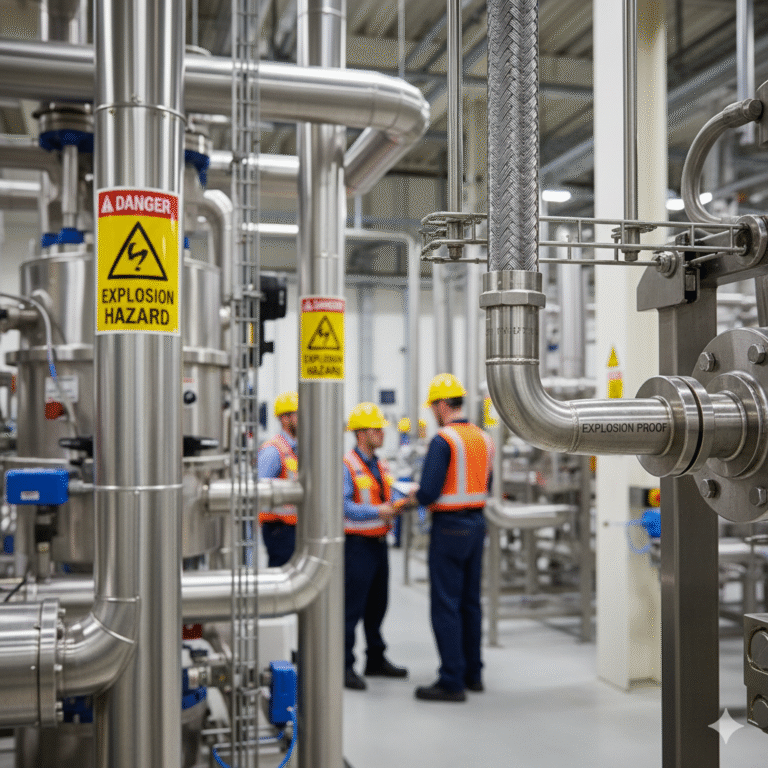
Even the best explosion protection equipment can fail without proper management.
Effective combustible dust safety requires continuous daily control.
Facilities should establish:
- Dust hazard inspection programs
- Clear safety responsibilities
- Regular cleaning procedures
- Dust collector inspection routines
- Employee safety training
- Hot work permit systems
- Emergency response drills
Compressed air should never be used casually for dust cleaning, as it can disperse combustible dust clouds into the atmosphere.
After fires or minor explosions, improper cleanup methods may also trigger secondary incidents.
Many accidents happen not because workers lack technical knowledge, but because:
- hazards are ignored,
- inspections are not enforced,
- maintenance is delayed,
- and safety systems are not continuously verified.
Dust explosion prevention is not about paperwork.
It is about disciplined daily execution.
Daily Inspection Checklist
Supervisors and safety personnel should routinely inspect:
- Dust accumulation on floors, beams, and cable trays
- Dust leakage from equipment
- Ventilation effectiveness
- Dust collector differential pressure
- Duct blockage or buildup
- Filter condition
- Dust discharge systems
- Unauthorized electrical equipment
- Grounding continuity
- Foreign object risks in grinders and crushers
- Hot work permit compliance
- Employee emergency awareness
If even one item cannot be clearly verified, risks may not be fully under control.

Final Thoughts
Dust explosion prevention is not simply about passing inspections.
It directly affects:
- worker safety,
- production continuity,
- equipment reliability,
- and long-term operational stability.
Many accidents begin with something small:
- a layer of dust,
- a loose grounding wire,
- an overheated bearing,
- or a poorly maintained dust collector.
Industrial safety is not built through slogans.
It is built through thousands of small actions done correctly every single day.