In industrial gas detection systems, four measurement units are commonly used:
%LEL (Lower Explosive Limit)
%VOL (Volume Percent)
ppm (parts per million)
mg/m³ (milligrams per cubic meter)
Although all of them describe gas concentration, they serve different safety purposes and engineering logic. Misunderstanding these units can lead to incorrect alarm settings, misjudged risk levels, and unsafe field decisions.
This guide explains their differences, conversions, and real industrial applications.
1. What Do These Units Mean?
1.1 %VOL — Volume Concentration
%VOL represents the volume percentage of a gas in air.
For example:
Oxygen in air ≈ 20.9% VOL
Methane in air can be expressed as volume percentage at higher concentrations
👉 It means:
“How much space the gas occupies in a given volume of air.”
Typical use:
Oxygen (O₂)
Carbon dioxide (CO₂)
High-concentration hydrocarbons
1.2 ppm — Parts Per Million
ppm stands for parts per million (10⁻⁶).
1 ppm means:
1 unit of gas per 1,000,000 units of air
Typical use:
Toxic gases: H₂S, CO, NH₃
Volatile organic compounds (VOCs)
👉 ppm is used for low concentration gas monitoring, especially for health-related exposure limits.
1.3 %LEL — Explosion Risk Indicator
LEL (Lower Explosive Limit) is the minimum concentration at which a gas can ignite.
%LEL represents:
Current concentration as a percentage of the explosive limit
For methane:
LEL = 5% VOL
UEL = 17% VOL
So:
100% LEL = fully reached explosion threshold
50% LEL = half of explosion risk limit
⚠️ Important: %LEL is not a concentration unit, but a safety risk indicator.
1.4 mg/m³ — Mass Concentration
mg/m³ represents:
milligrams of gas per cubic meter of air
It is widely used in:
Occupational health standards
Environmental monitoring
Regulatory exposure limits
For gases, mg/m³ can be converted from ppm using molecular weight.
2. Key Conversions You Must Know
2.1 %LEL ↔ %VOL ↔ ppm
If:
X = measured %LEL
LEL = gas lower explosive limit (%VOL)
Then:
%VOL:
ppm:
Example 1 — Methane (CH₄)
LEL = 5% VOL
25% LEL =
→ %VOL = 1.25% → ppm = 12,500 ppm
Example 2 — Hydrogen Sulfide (H₂S)
LEL ≈ 4% VOL
10% LEL =
→ %VOL = 0.4% → ppm ≈ 4,000 ppm
Key Insight:
Toxic gases often become dangerous long before reaching explosive levels.
2.2 ppm ↔ mg/m³ Conversion
At 25°C and 1 atm:
Example — H₂S (MW = 34.08):
10 mg/m³ ≈ 7.2 ppm
3. Typical Gas Reference Values (Industrial Data)
Gas
LEL (%VOL)
10% LEL
25% LEL
100% LEL
Methane (CH₄)
5.0
5,000 ppm
12,500 ppm
50,000 ppm
Hydrogen (H₂)
4.0
4,000 ppm
10,000 ppm
40,000 ppm
Propane (C₃H₈)
2.1
2,100 ppm
5,250 ppm
21,000 ppm
H₂S
4.0
4,000 ppm
10,000 ppm
40,000 ppm
CO
12.5
12,500 ppm
31,250 ppm
125,000 ppm
👉 Notice:
Highly toxic gases (H₂S, CO) are dangerous at very low ppm levels
Flammable risk and toxic risk are not the same thing
4. Industrial Safety Applications
4.1 Combustible Gas Detection (%LEL)
Typical alarm settings:
Low alarm: ≤ 25% LEL
High alarm: ≤ 50% LEL
Used in:
Oil & gas facilities
Chemical plants
Refineries
Storage tanks
4.2 Toxic Gas Monitoring (ppm / mg/m³)
Used for:
H₂S (hydrogen sulfide)
CO (carbon monoxide)
NH₃ (ammonia)
VOC gases
Alarm strategy:
Based on occupational exposure limits (OEL)
Often far below explosive thresholds
4.3 Oxygen Monitoring (%VOL)
Normal air oxygen:
20.9% VOL
Safety limits:
Low oxygen alarm: 19.5%
High oxygen alarm: 23.5%
Risks:
Oxygen deficiency → suffocation
Oxygen enrichment → fire acceleration
4.4 Confined Space Entry
Before entry, measure:
Oxygen (%VOL)
Toxic gases (ppm)
Flammable gases (%LEL)
Continuous monitoring is required during operation.
4.5 Hot Work (Welding / Cutting)
Gas must be below:
0.5% VOL (if LEL ≥ 4%)
0.2% VOL (if LEL < 4%)
Equivalent to approximately:
≤ 10% LEL for many gases
5. Common Misunderstandings in Gas Detection
❌ Mistake 1: “ppm and mg/m³ are interchangeable anytime”
They are not. Conversion depends on molecular weight and temperature.
❌ Mistake 2: “Low %LEL means safe”
Not true. Toxic gases can be deadly at ppm levels far below explosion limits.
❌ Mistake 3: “Alarm = safe limit”
Alarm means action required, not safe exposure.
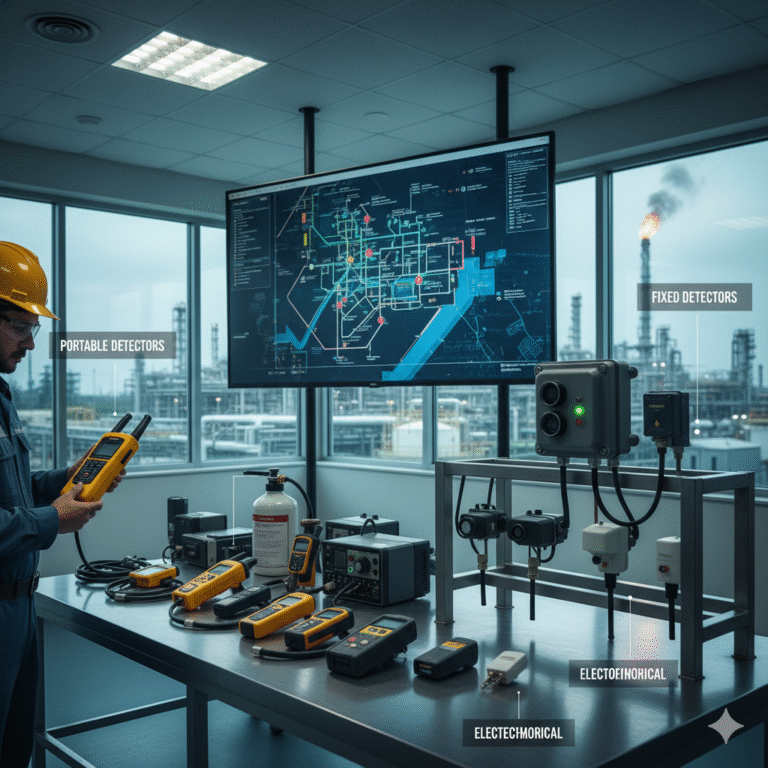
❌ Mistake 4: One detector fits all applications
Different sensing technologies matter:
Catalytic sensors → combustible gases
Electrochemical → toxic gases
IR sensors → hydrocarbons (not hydrogen)
❌ Mistake 5: Smell can replace detection
Many dangerous gases are odorless (e.g., CO), and odor fatigue is common (H₂S).
6. Engineering Summary
Each unit serves a different safety purpose:
%LEL → explosion risk
%VOL → volume concentration (O₂ / CO₂ / high gas levels)
ppm → low-level toxic gas monitoring
mg/m³ → regulatory mass concentration
In real industrial environments, gas safety must combine:
Gas type
Toxicity
Explosion limits
Oxygen level
Ventilation conditions
Proper instrumentation strategy
7. Industrial Gas Detection Solutions
At Zero Instrument, we provide industrial gas detection solutions for:
Combustible gas (%LEL) monitoring
Toxic gas (ppm) detection
Oxygen (%VOL) measurement
4–20mA / RS485 / Modbus output systems
Fixed and portable gas detection systems
👉 If you need a reliable gas detection solution for your project, feel free to contact us for technical support and quotation.