
Introduction
In industrial automation, instrument air quality is critical. Compressed air is not just “pressurized air”; it may carry moisture, oil mist, particles, and condensate. While these impurities may be acceptable for cleaning or pneumatic tools, they can cause malfunctions in instruments and control systems.
1. Factory Air vs. Instrument Air
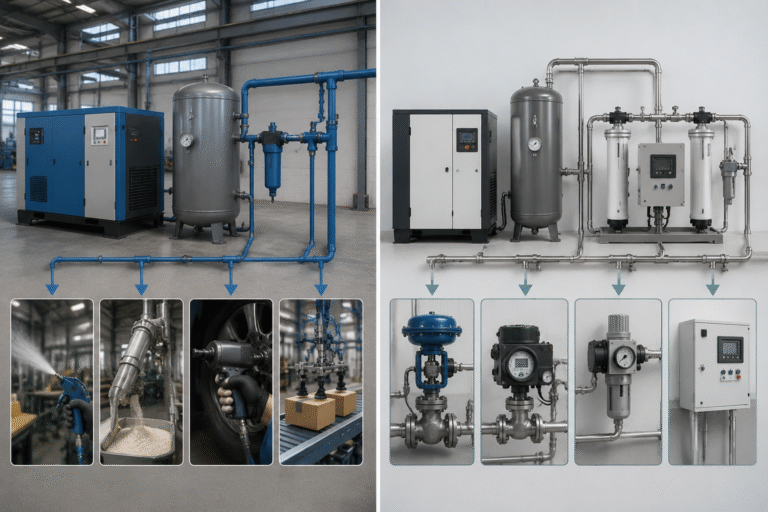
Factory air, also known as service air, is mainly used for cleaning, material conveying, pneumatic tools, and general process assistance. It undergoes basic treatment such as air tanks, filters, and drainage. Some systems include dryers, but the quality is generally lower.
Instrument air is used for pneumatic actuators, valve positioners, control valves, explosion-proof positive pressure cabinets, and other sensitive devices. Requirements include stability, cleanliness, dryness, low oil content, and minimal contaminants. Pressure dew point is crucial: condensation can cause corrosion, clogging, or freezing.
2. Refrigerated Air Dryers
Refrigerated air dryers (cold dryers) cool compressed air to condense water vapor, which is then drained. The process involves:
- Hot, humid air enters the heat exchanger.
- Air is cooled near freezing without icing.
- Water condenses and is drained automatically.
- Dry air is reheated and sent downstream.
Advantages:
- Simple structure
- Low investment
- Low maintenance
- Stable operation
Limitations:
- Typical pressure dew point: +2°C to +10°C
- Not suitable for extremely low temperatures or outdoor pipelines exposed below 0°C
3. Adsorption Air Dryers
For applications requiring lower dew points, such as outdoor pipelines, low temperatures, or critical control loops, adsorption dryers are used. They employ desiccants such as:
- Activated alumina
- Silica gel
- Molecular sieves
Dual-tower operation ensures continuous supply: while one tower dries air, the other regenerates.
Advantages:
- Very low dew points (commonly -40°C, some models -70°C)
- Provides safety margin for critical systems
Limitations:
- Higher investment
- More complex control systems
- Regular desiccant maintenance
- Higher energy consumption
4. Types of Adsorption Dryers
- No-heat regeneration: Uses part of dry compressed air to purge saturated desiccant. Simple and reliable, but consumes some product air.
- Heated regeneration: Uses electric or steam heating to regenerate desiccant, reducing air consumption but increasing complexity and energy use.
- Blower/zero air loss: Uses ambient air with blower to regenerate desiccant, minimizing product air consumption. Ideal for large flow, continuous operation, and energy-sensitive systems, but higher cost and complexity.

5. Field Selection Considerations
- Ambient low temperature of pipelines
- Required pressure dew point
- Airflow and load fluctuations
- Sensitivity of downstream equipment (valves, actuators, analyzers)
- Total lifecycle cost (investment vs. operational cost)
6. Comparison Table of Air Dryers
| Type | Typical Pressure Dew Point | Advantages | Limitations | Suitable Applications |
|---|---|---|---|---|
| Refrigerated Dryer | +2°C ~ +10°C | Low cost, low maintenance, stable | Cannot achieve ultra-low dew points, low-temperature pipelines | General industrial air, indoor networks |
| No-heat Adsorption | -40°C | Simple, reliable | Product air consumption | Small to medium instrument air flow |
| Heated Adsorption | -40°C or lower | Lower air consumption, suitable for larger flow | More complex, energy use | Medium to large flow, instrument air |
| Blower/Zero-loss Adsorption | -40°C or lower | Lowest long-term operating cost | High investment, complex | Large flow, continuous operation, energy-sensitive |
7. What is an Instrument Air Drying System?
An instrument air drying system, installed downstream of the compressed air system, removes moisture, lowers pressure dew point, and filters out particles and oil. Its purpose is to provide stable, clean, dry compressed air for pneumatic instruments, control valves, positioners, actuators, and explosion-proof positive pressure devices, ensuring reliable long-term automation control.

Conclusion
Choose the right dryer based on actual conditions: low temperature exposure, air point requirements, desired dew point, and contaminant limits. For general industrial use, refrigerated dryers suffice; for critical instrument air, low temperature, outdoor lines, or continuous control loops, adsorption dryers are recommended. Large-scale, long-term projects should consider lifecycle costs of no-heat, heated, and blower/zero-loss adsorption dryers.