
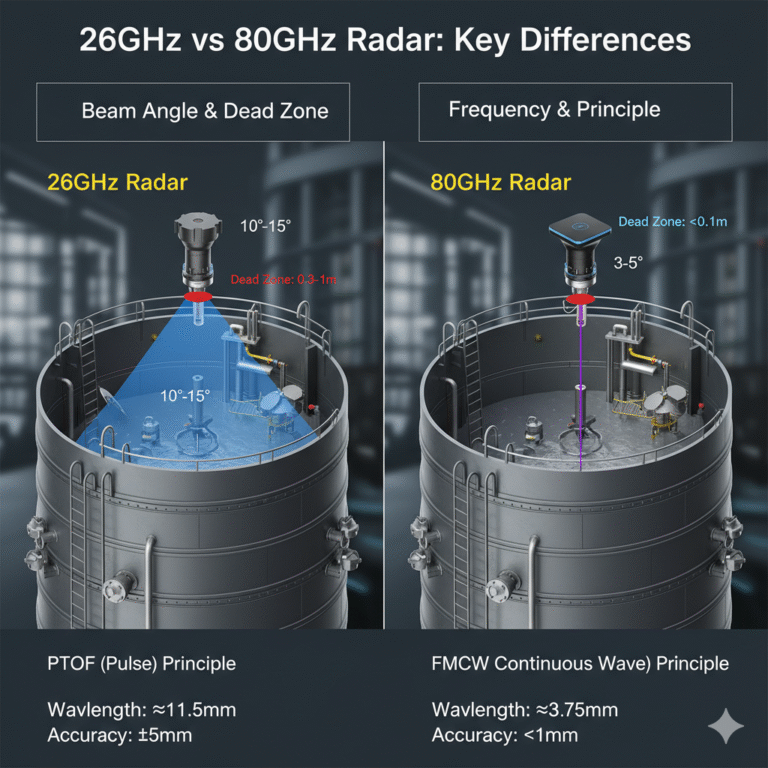
An 80 GHz radar level transmitter is widely used for non-contact liquid and solid level measurement in industrial applications. Its narrow beam angle, high measurement resolution, and ability to operate in relatively small installation spaces make it an attractive solution for modern process instrumentation.
But an interesting question frequently arises during instrument selection:
Can an 80 GHz radar level transmitter measure liquid level through a plastic tank wall without installing the sensor inside the tank?
The short answer is yes — under suitable conditions.
Radar waves can penetrate certain non-conductive materials, including some plastics and glass. This makes it possible to install a radar sensor outside a suitable plastic container and measure the liquid level inside without drilling the tank or opening the process connection.
However, this capability should not be confused with a universal feature of every 80 GHz radar transmitter.
The actual measurement performance depends on several factors, including the tank material, wall thickness, dielectric properties, surface condition, liquid characteristics, and installation geometry.
Let’s examine the engineering principles and practical limitations.
1. How Does Radar Measure Through a Plastic Tank Wall?
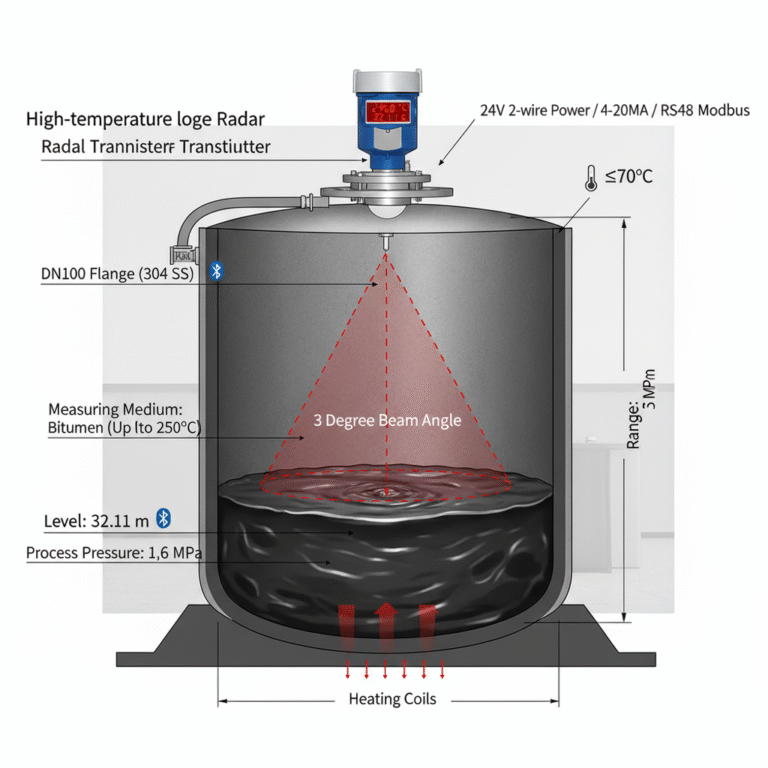
An 80 GHz radar level transmitter emits high-frequency electromagnetic waves toward the liquid surface.
Under normal installation conditions, the radar signal travels through the air inside the tank, reaches the liquid surface, and returns to the antenna after reflection.
The instrument calculates the distance based on the signal’s propagation time.
When measuring through a plastic tank wall, the signal follows a slightly different path:
- The radar signal travels through the air outside the tank.
- It reaches the outer surface of the plastic wall.
- Part of the signal is reflected by the wall, while the remaining energy penetrates the plastic.
- The transmitted signal travels through the tank wall and the space inside the container.
- It reaches the liquid surface and generates a reflected signal.
- The returning signal passes through the plastic wall again and is received by the radar antenna.
The instrument must distinguish the liquid surface echo from reflections generated by the tank wall and surrounding objects.
This is why through-wall measurement requires appropriate sensor characteristics and careful commissioning.
The principle is physically possible, but successful measurement depends on maintaining sufficient signal strength and separating the useful echo from unwanted reflections.
2. Which Tank Materials Can Be Penetrated?
The most important consideration is whether the tank wall is electrically non-conductive and sufficiently transparent to the radar signal.
Some commonly used materials include:
HDPE (High-Density Polyethylene)
HDPE tanks are widely used for water, chemicals, and industrial liquid storage. Suitable HDPE walls can allow radar signals to penetrate, making external measurement possible.
PP (Polypropylene)
PP is another common material used in chemical storage tanks and industrial containers. Its suitability depends on the specific material composition and wall thickness.
PVC (Polyvinyl Chloride)
Some PVC materials can transmit radar signals. However, additives, fillers, wall construction, and thickness may affect signal attenuation.
FRP (Fiberglass Reinforced Plastic)
FRP requires particular attention. Although the resin matrix is non-metallic, reinforcement materials and their arrangement may affect radar transmission. Actual testing is recommended.
Glass
Glass can also allow radar transmission under suitable conditions. However, thickness, coatings, surface moisture, and installation geometry must be considered.
Materials That Usually Cause Problems
Metal tanks are fundamentally different.
Stainless steel, carbon steel, and aluminum walls reflect electromagnetic waves and generally prevent external radar measurement through the tank wall.
The same caution applies to plastic tanks containing:
- Metallic reinforcement.
- Conductive coatings.
- Embedded metal mesh.
- Aluminum foil layers.
- Metallic protective films.
A tank may look like ordinary plastic from the outside while containing an internal conductive layer.
Therefore, identifying the actual wall construction is more important than simply knowing that the tank is made of plastic.
3. Why Does Wall Thickness Matter?
Even when a plastic material allows radar transmission, the signal does not pass through the wall without any energy loss.
Every material interface can generate reflections.
As the radar wave passes through the wall, some energy is reflected, while another portion is absorbed or scattered.
A thicker wall can increase attenuation and create additional reflection effects.
The practical result may include:
- Reduced signal amplitude.
- Stronger unwanted wall echoes.
- Difficulty identifying the actual liquid surface.
- Unstable readings under certain conditions.
- Increased difficulty measuring at low liquid levels.
There is no universal maximum wall thickness applicable to every 80 GHz radar transmitter.
A 5 mm HDPE wall and a 5 mm reinforced composite wall should not automatically be treated as equivalent.
The material’s dielectric properties and signal losses also matter.
For this reason, the manufacturer should evaluate the actual wall material and thickness before confirming suitability.
4. Does the Liquid’s Dielectric Constant Affect Measurement?
Yes. The dielectric constant of the measured medium is another important factor.
Radar level measurement relies on the reflection of electromagnetic waves from the liquid surface.
Generally, liquids with higher dielectric constants produce stronger radar reflections, while liquids with lower dielectric constants may produce weaker reflections.
Examples include:
| Liquid | Typical dielectric behavior |
|---|---|
| Water | High dielectric constant |
| Aqueous solutions | Generally high, depending on concentration |
| Alcohols | Medium to relatively high, depending on composition |
| Oils | Generally lower |
| Hydrocarbons | Often relatively low |
The exact dielectric constant varies with temperature, composition, frequency, and other physical properties.
When measuring through a plastic wall, the radar signal already experiences transmission losses before reaching the liquid.
If the liquid also produces a weak reflection, the returning signal may become insufficient for reliable measurement.
This is particularly important when measuring low-dielectric liquids such as certain hydrocarbons and oils.
A through-wall installation that works well with water should not automatically be assumed suitable for diesel, lubricating oil, or other low-dielectric liquids.
5. Installation Position: Why Does It Matter?
Even when the tank material is suitable, incorrect installation can cause measurement problems.
Several installation details deserve attention.
5.1 Keep the Sensor Away from Metallic Structures
Metallic objects near the radar beam may generate strong reflections.
Examples include:
- Metal support frames.
- Steel reinforcement structures.
- External pipelines.
- Brackets and mounting assemblies.
- Metallic tank accessories.
The sensor should be positioned so that its effective radar beam does not intersect unnecessary obstacles.
5.2 Prefer a Curved Tank Surface Where Appropriate
When installing above a curved plastic tank surface, some reflections from the tank wall may be directed away from the antenna.
This can help reduce unwanted echoes.
However, the installation geometry must be evaluated for the actual sensor and tank design.
A flat tank roof may require additional mounting or parameter adjustments.
5.3 Keep the Measurement Area Dry
Moisture on the external tank surface can interfere with radar transmission and create additional reflections.
Rainwater, condensation, snow, or standing water between the sensor and tank wall may cause unstable readings.
For outdoor applications, appropriate weather protection should be considered.
5.4 Avoid Internal Obstacles
Pipes, agitators, ladders, heating coils, and other internal structures can generate interference.
A suitable installation position should provide a clear measurement path toward the liquid surface.
5.5 Maintain the Correct Measurement Angle
The radar signal should reach the liquid surface as close to perpendicular as practical.
An unsuitable angle may reduce the strength of the reflected signal, particularly when the liquid surface is turbulent or uneven.
6. Can an 80 GHz Radar Measure Through the Side Wall or Only the Tank Top?
This is an important distinction.
Through-wall radar applications can involve different installation arrangements.
Top-down measurement through a plastic tank roof
The radar is installed above the tank and measures through a suitable non-metallic roof or lid.
This arrangement is often practical for IBC containers and plastic storage tanks.
It allows level monitoring without making an additional opening in the tank.
Side-mounted measurement through a plastic tank wall
The radar is installed outside the tank and directed horizontally toward the liquid surface.
This arrangement is more challenging.
The installation position must account for the changing liquid level, internal tank geometry, wall curvature, external obstacles, and the radar’s measurement characteristics.
Not every free-space radar transmitter is designed for this installation.
Furthermore, side-mounted measurement should not be confused with guided wave radar.
Guided wave radar uses a probe or cable to guide electromagnetic pulses along a defined path. External mounting through a plastic wall may be possible with certain specially designed guided wave systems, but their installation requirements are different.
Therefore, the manufacturer should confirm whether the proposed sensor supports top-down through-wall measurement, side-wall measurement, or both.
7. Typical Applications of Through-Wall Radar Measurement
When the application conditions are suitable, through-wall radar measurement can provide several practical advantages.
IBC Containers
External radar measurement can monitor liquid levels in intermediate bulk containers without opening the container.
This is useful in chemical storage, water distribution, and temporary liquid storage.
Chemical Storage Tanks
For certain corrosive liquids, external installation can eliminate direct contact between the sensor and the process medium.
This can simplify maintenance and reduce exposure to aggressive vapors.
Water Storage Tanks
Plastic water tanks used in industrial facilities, agriculture, and utility systems may be suitable for external radar measurement.
Closed Process Containers
In applications where drilling additional holes is undesirable, through-wall measurement may provide a non-invasive alternative.
However, suitability must always be confirmed for the actual tank and operating conditions.
8. Through-Wall Radar vs. Conventional Radar Installation
| Comparison | Through-wall installation | Conventional installation |
|---|---|---|
| Sensor position | Outside the tank | Above or inside the tank connection |
| Process penetration | Not required | Usually required |
| Signal path | Through tank wall | Through air or process atmosphere |
| Signal attenuation | Additional material losses | Generally lower |
| Wall reflection | Must be considered | Not normally applicable |
| Installation complexity | Application-dependent | Usually more straightforward |
| Maintenance access | Often easier | Depends on tank arrangement |
| Compatibility | Requires suitable non-metallic wall | Depends on process connection |
Through-wall radar is not necessarily better than conventional installation.
It is an alternative measurement arrangement that can be advantageous when tank access is limited or process penetration should be avoided.
9. What Information Should Be Provided Before Selecting an 80 GHz Radar?
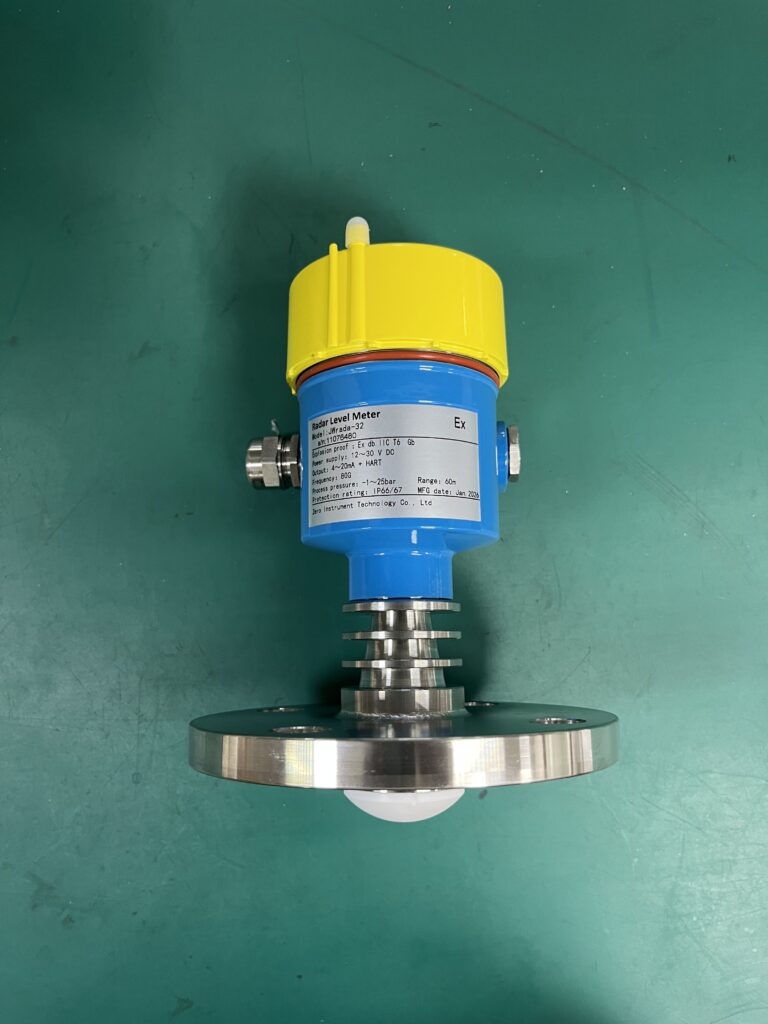
Before recommending a through-wall radar level transmitter, the following information should be collected.
| Parameter | Information Required |
|---|---|
| Tank material | HDPE, PP, PVC, FRP, glass, etc. |
| Wall construction | Single-layer or multilayer |
| Wall thickness | Actual thickness in mm |
| Dielectric properties | Material dielectric constant, if available |
| Measurement position | Through the top or side wall |
| Tank dimensions | Height, diameter, and geometry |
| Measuring range | Minimum and maximum liquid level |
| Liquid type | Water, oil, chemical, etc. |
| Liquid dielectric constant | If available |
| Operating temperature | Minimum and maximum |
| Surface condition | Calm, turbulent, foaming, etc. |
| Internal obstacles | Pipes, agitators, ladders, supports |
| Installation environment | Indoor or outdoor |
| Required output | 4–20 mA, HART, RS485, Modbus, etc. |
Providing this information allows the supplier to assess the feasibility of the application before selecting the instrument.
For critical applications, an actual sample test or on-site verification is preferable to relying solely on theoretical material properties.
10. Practical Recommendations: Do Not Assume Every 80 GHz Radar Can Measure Through Plastic
An 80 GHz operating frequency does not automatically guarantee through-wall measurement capability.
Different radar transmitters have different antenna designs, signal processing algorithms, mounting requirements, and application limitations.
Even if two instruments operate at the same frequency, their performance through a plastic tank wall may differ.
Before approving this installation method, consider the following recommendations:
- Confirm that the specific radar model supports measurement through non-metallic tank walls.
- Identify the exact tank material and wall construction.
- Verify the wall thickness and any reinforcement or coating.
- Confirm that the liquid provides sufficient radar reflection.
- Evaluate external moisture, internal obstacles, and installation geometry.
- Request manufacturer confirmation or conduct a practical test before placing a production order.
- Perform commissioning and echo evaluation under actual operating conditions.
For applications involving low-dielectric liquids, thick composite walls, multilayer tanks, or complicated internal structures, alternative measurement technologies may be more appropriate.
Conclusion
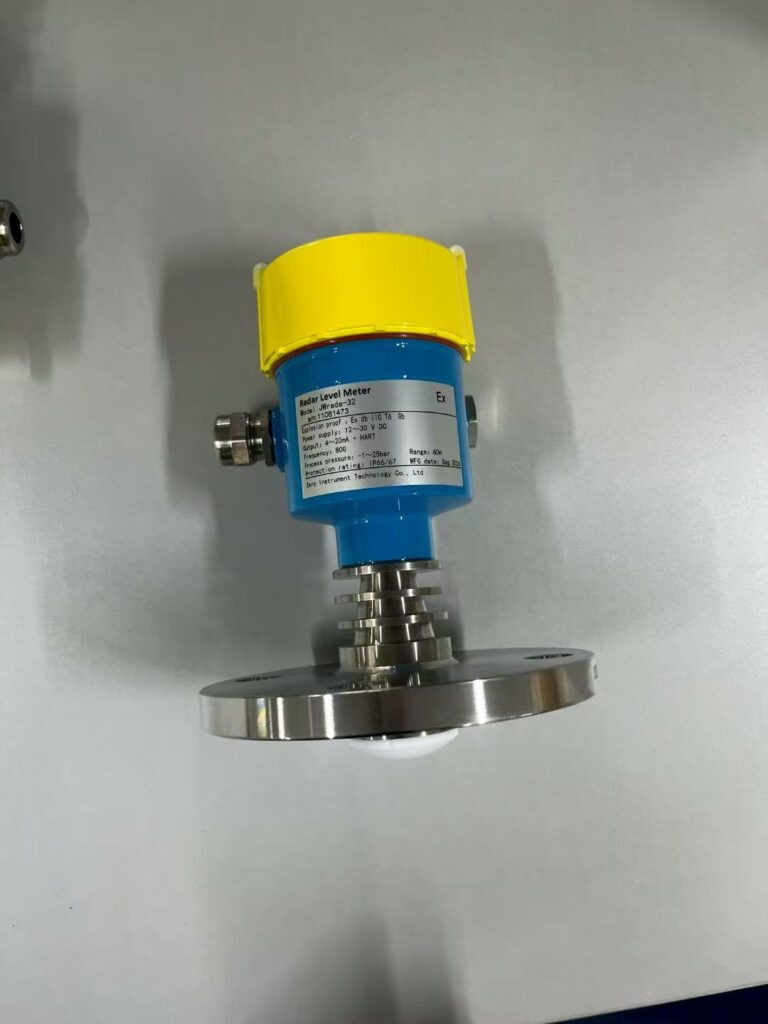
Can an 80 GHz radar level transmitter measure through a plastic tank wall?
Yes, it can — provided that the tank material, wall thickness, liquid characteristics, sensor design, and installation conditions are suitable.
The main advantage is that level measurement can be achieved without opening the tank or installing a conventional process connection.
However, the key to successful measurement is not simply choosing an 80 GHz instrument. It is understanding how the radar signal interacts with the tank wall and the measured medium.
A higher operating frequency does not automatically mean better penetration. A suitable material, an appropriate sensor, and correct installation are what make through-wall radar measurement reliable.
At Zero Instrument, we recommend evaluating the tank construction, liquid properties, and installation arrangement before selecting a radar level transmitter for through-wall applications.
If you are considering this solution, please provide your tank material, wall thickness, liquid type, measuring range, and installation photos. Our technical team can help evaluate the application and recommend a suitable measurement solution.