
Ball valves, globe valves, gate valves, and butterfly valves are four of the most commonly used valve types in industrial piping systems. Their basic structures are easy to recognize, but selecting the right one for a real application is not always as simple as it seems.
A common rule of thumb is:
- Butterfly valves for water
- Globe valves for steam
- Ball valves for gas
- Gate valves for large pipelines
These rules may help with a quick preliminary judgment, but they are not reliable enough for actual valve selection.
The first question should not be:
“What fluid is flowing through the pipe?”
It should be:
“What is this valve expected to do?”
Is it used for shutoff, isolation, throttling, or flow regulation?
Consider three pipelines carrying exactly the same cooling water.
A valve on the main circulating-water header may remain fully open for months and close only during maintenance. A valve at an equipment inlet may operate several times a day. Another valve on a bypass line may need to regulate flow continuously.
The medium is the same, but the operating duties are completely different.
That is why valve selection should begin with function, followed by the medium, design pressure, design temperature, pipe size, pressure-drop requirements, operating frequency, materials, sealing design, and actuation method.
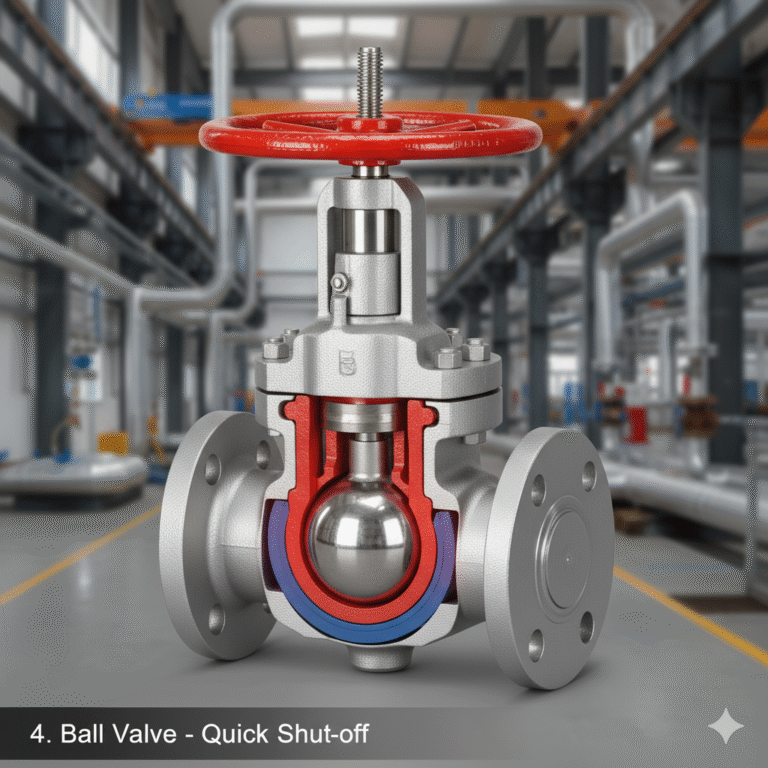
1. Ball Valve: Fast and Reliable Shutoff
A ball valve uses a rotating ball with a bore through its center.
When the bore aligns with the pipeline, the valve is open. Rotate the ball 90 degrees, and the valve closes.
This simple quarter-turn operation gives ball valves one of their most important advantages:
fast shutoff.
Ball valves are widely used in natural gas, fuel gas, oil, compressed air, water, and many industrial process lines where reliable isolation and frequent operation are required.
Why Are Ball Valves Good for Isolation?
A full-port ball valve provides a flow passage close to the internal diameter of the connected pipe.
When fully open, the fluid therefore passes through the valve with relatively little obstruction. This generally results in a low pressure drop compared with more restrictive valve designs.
This can become important in long piping systems containing many valves.
Even a relatively small pressure loss across one valve can become significant when dozens of valves, fittings, strainers, and other components are installed in the same system.
Can a Ball Valve Be Used for Flow Control?
A standard on/off ball valve is normally best operated either fully open or fully closed.
Keeping a conventional ball valve partially open for long periods can expose the ball and valve seats to concentrated high-velocity flow. Depending on the service conditions, this may accelerate erosion and damage the sealing surfaces.
If a process requires throttling or modulating control, specialized designs such as:
- V-port ball valves
- Segmented ball valves
- Control ball valves
may be more appropriate.
Therefore, a useful way to remember a standard ball valve is:
Fast operation, tight shutoff, and low resistance when fully open.
2. Globe Valve: Better Suited to Throttling
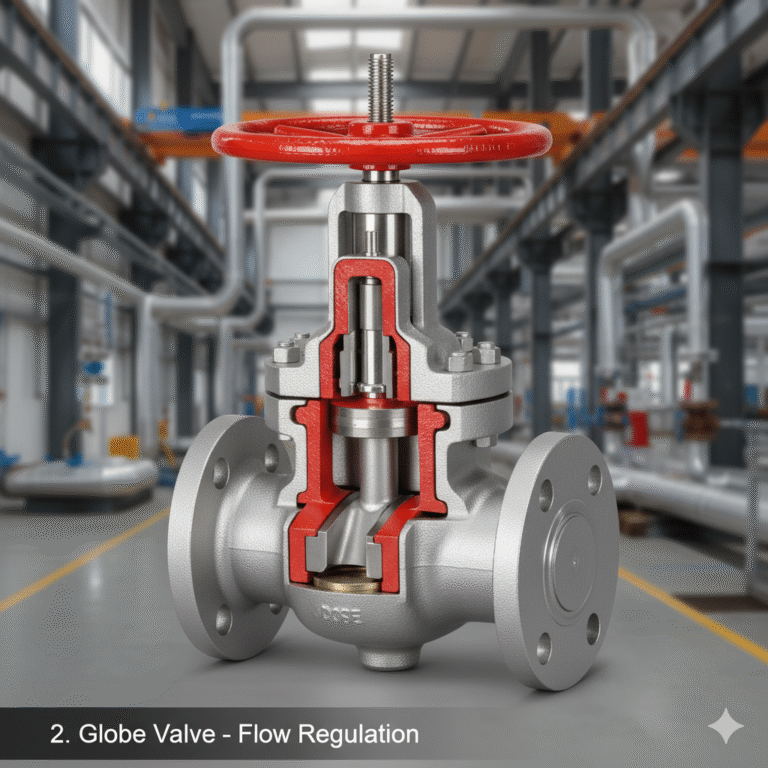
A globe valve works differently from a ball valve.
Instead of rotating a closure element by 90 degrees, the valve stem moves the disc toward or away from the valve seat.
As the disc position changes, the available flow area also changes.
This makes the globe valve inherently more suitable for throttling than conventional gate valves and standard on/off ball valves.
Globe valves are commonly found in steam, thermal oil, utility, and various process piping systems.
Why Are Globe Valves Used for Throttling?
Imagine manually adjusting a valve to reduce or increase flow.
With a globe valve, the movement of the stem and disc progressively changes the flow passage. This provides much better throttling capability than partially opening a conventional gate valve.
However, this does not mean that every process-control application should use a standard manual globe valve.
For continuous automatic control of flow, pressure, temperature, or level, a properly sized control valve with the required flow characteristic and actuator is normally preferred.
The key distinction is:
A globe valve is generally suitable for throttling, but precise process control requires proper control-valve selection and sizing.
The Trade-Off: Higher Pressure Drop
The internal flow path of a globe valve is more tortuous than that of a full-port ball valve or a fully open gate valve.
The fluid changes direction as it passes through the valve body.
As a result, globe valves generally create a higher pressure drop.
For a large-flow pipeline where the valve remains fully open most of the time and minimizing energy loss is important, a globe valve may therefore not be the first choice.
Pay Attention to Flow Direction
Globe valves may have a specified preferred or required flow direction depending on their design and service conditions.
Always check:
- The flow arrow on the valve body
- Manufacturer instructions
- Valve construction
- Pressure and temperature conditions
This is particularly important in steam and higher-pressure applications.
3. Gate Valve: Designed for Pipeline Isolation
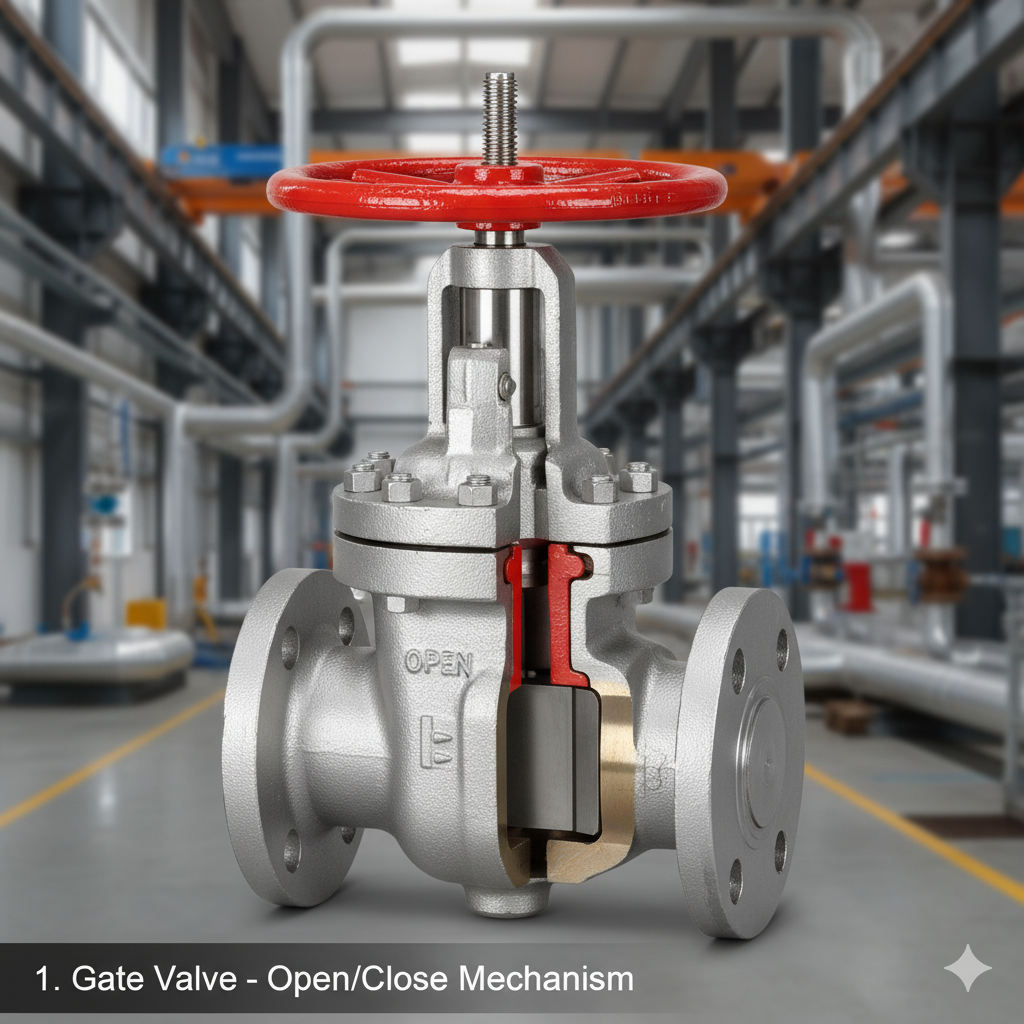
A gate valve can be thought of primarily as an isolation valve.
The gate moves vertically into or out of the flow path.
When the gate is fully raised, the pipeline is open. When it is lowered onto the seating surfaces, the valve is closed.
Its ideal operating condition is therefore straightforward:
fully open during normal operation and fully closed when isolation is required.
Gate valves are widely used in:
- Water supply systems
- Oil and gas pipelines
- Petrochemical plants
- Utility systems
- Large process pipelines
One major advantage is the relatively unobstructed flow path when the valve is fully open.
This makes gate valves attractive for pipelines where low pressure loss is important.
Why Shouldn’t a Gate Valve Be Used for Throttling?
A common field mistake is to partially close a gate valve to control flow.
It may appear to work initially—the flow rate changes as the gate moves into the flow path.
But that does not make it a good long-term throttling solution.
With the gate partially open, high-velocity fluid can be concentrated around the gate and seating surfaces. Flow-induced vibration and erosion may damage the sealing surfaces.
The result can be particularly frustrating:
The valve appears to regulate flow successfully for months, but when it is finally required to provide tight isolation, the damaged seating surfaces may no longer seal properly.
For most applications, a conventional gate valve should therefore be considered a two-position device:
Fully open or fully closed.
Gate Valve vs Ball Valve
Both can provide pipeline isolation, but their operating characteristics are different.
Choose a ball valve when:
- Fast operation is important
- Frequent opening and closing are expected
- Tight shutoff is a major requirement
- Quarter-turn actuation is preferred
Consider a gate valve when:
- The valve remains fully open for long periods
- Isolation is mainly required for shutdown or maintenance
- Low pressure loss is important
- The pipeline diameter makes the design practical
4. Butterfly Valve: A Major Advantage in Large Pipelines
The advantages of a butterfly valve may not look particularly dramatic at small pipe sizes.
Move to DN300, DN500, DN800, or larger, however, and the difference becomes much more obvious.
At large diameters, valve selection is no longer only about sealing performance and pressure drop.
Engineers also have to consider:
- Valve weight
- Face-to-face dimensions
- Actuator size
- Pipe-support requirements
- Installation space
- Maintenance access
- Total installed cost
This is where butterfly valves become extremely attractive.
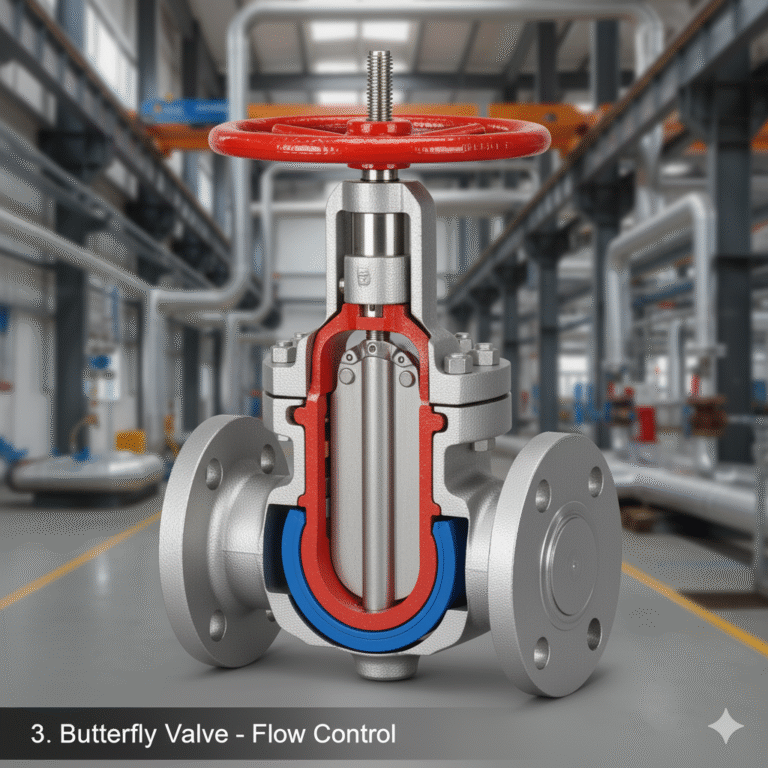
Their basic structure—a disc rotating around a shaft—allows the valve body to remain relatively compact.
Butterfly valves therefore typically offer:
shorter installation length, lower weight, compact actuation, and better cost efficiency at large diameters.
This explains their widespread use in:
- Cooling-water systems
- Circulating-water systems
- HVAC systems
- Water treatment
- Fire-water systems
- Municipal water supply
- Large-diameter utility pipelines
Does a Butterfly Valve Have Low Pressure Loss?
A butterfly valve has an important structural difference from a full-port ball valve or fully open gate valve:
the disc remains inside the flow path even when the valve is fully open.
Therefore, the valve still creates flow resistance.
For high-flow systems—particularly pump discharge lines and large circulating-water systems—the valve’s resistance coefficient should be included in hydraulic calculations.
Not All Butterfly Valves Are the Same
“Butterfly valve” describes a broad valve category rather than one universal design.
Common configurations include:
- Concentric butterfly valves
- Resilient-seated butterfly valves
- Double-offset butterfly valves
- Triple-offset butterfly valves
- Metal-seated butterfly valves
Their capabilities regarding pressure, temperature, shutoff performance, cycling frequency, and media compatibility can differ substantially.
Therefore, simply specifying “butterfly valve” is not enough for an industrial application.
5. Ball Valve vs Globe Valve vs Gate Valve vs Butterfly Valve
The following comparison provides a practical starting point:
| Feature | Ball Valve | Globe Valve | Gate Valve | Butterfly Valve |
|---|---|---|---|---|
| Primary function | Shutoff / isolation | Throttling / shutoff | Isolation | Isolation / throttling* |
| Operating motion | Quarter-turn | Linear | Linear | Quarter-turn |
| Shutoff speed | Fast | Moderate | Slow | Fast |
| Pressure drop when open | Low | Relatively high | Very low | Low to moderate |
| Throttling capability | Limited for standard designs | Good | Poor | Good depending on design |
| Frequent operation | Very suitable | Suitable | Less suitable | Very suitable |
| Large-diameter suitability | Possible | Less attractive | Good | Excellent |
| Installation space | Compact | Moderate | Requires stem clearance | Very compact |
| Typical applications | Gas, oil, air, process lines | Steam, thermal oil, throttling service | Main pipelines, utility isolation | Water, HVAC, cooling systems |
*Actual performance depends heavily on valve design, trim, actuator, operating conditions, and required control accuracy.
This table should be treated as a selection guide rather than an absolute rule.
6. Can These Four Valve Types Replace Each Other?
Sometimes—but not automatically.
Several valve types may technically perform the same basic function while offering very different performance, cost, maintenance, and operating characteristics.
Ball Valve vs Gate Valve
Both are widely used for isolation.
A ball valve is usually more attractive when fast and frequent operation is required.
A gate valve can be a strong choice for a main pipeline that remains fully open during normal operation and only closes during maintenance or shutdown.
Gate Valve vs Globe Valve
Their external appearance can sometimes be similar, but their intended duties are very different.
A gate valve is primarily designed for isolation.
A globe valve is much better suited to throttling.
Using a gate valve as a long-term throttling device can damage the gate and seating surfaces.
Ball Valve vs Butterfly Valve
Both are quarter-turn valves and can provide rapid isolation.
For smaller and medium pipe sizes where tight shutoff and a relatively unrestricted flow path are priorities, ball valves are often attractive.
As pipe diameter increases, however, butterfly valves become increasingly competitive because of their lower weight, shorter face-to-face dimensions, compact structure, and generally lower installed cost.
Globe Valve vs Butterfly Valve
Both may be used for throttling in suitable applications, but they should not be considered interchangeable.
The final selection depends on:
- Required flow coefficient (Cv/Kv)
- Pressure drop
- Control range
- Valve characteristic
- Pipe diameter
- Fluid properties
- Pressure and temperature
- Actuator requirements
- Required shutoff class
For critical process control, proper valve sizing is essential.
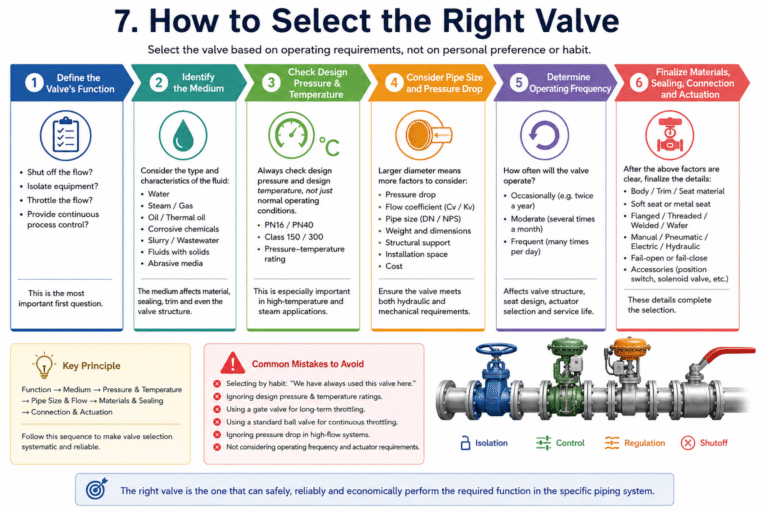
7. How to Select the Right Valve
When selecting a valve for a new pipeline, avoid starting with the valve type.
Start with the operating requirements.
Step 1: Define the Valve’s Function
What must the valve actually do?
- Shut off the flow?
- Isolate equipment?
- Throttle the flow?
- Provide continuous process control?
This is the most important first question.
Step 2: Identify the Medium
Water is relatively straightforward.
The situation changes when the medium becomes:
- Steam
- Natural gas
- Thermal oil
- Corrosive chemicals
- Slurry
- Wastewater
- Fluids containing solids
- Abrasive media
The medium directly affects body material, seat material, sealing design, trim, and sometimes the valve structure itself.
Step 3: Check Design Pressure and Design Temperature
Do not select a valve based only on normal operating pressure and temperature.
Check the design pressure and design temperature.
A valve marked PN16, PN40, Class 150, or Class 300 does not necessarily have the same allowable working pressure at every temperature.
Pressure-temperature ratings depend on factors including valve material and applicable design standards.
This is especially important in high-temperature steam and process applications.
Step 4: Consider Pipe Size and Pressure Drop
A DN50 valve and a DN1000 valve may perform the same basic isolation function, but the engineering considerations are very different.
At large diameters, factors such as:
- Weight
- Installation dimensions
- Structural support
- Actuator torque
- Maintenance access
- Pressure loss
- Cost
become increasingly important.
Step 5: Determine Operating Frequency
Will the valve operate twice a year or 30 times a day?
The answer affects:
- Valve structure
- Seat design
- Actuator selection
- Expected service life
- Maintenance requirements
A valve suitable for occasional emergency isolation may not be the best choice for frequent cycling.
Step 6: Finalize Materials, Sealing, Connection, and Actuation
Only after the operating requirements are clear should you finalize details such as:
- Body material
- Trim material
- Seat material
- Soft seat or metal seat
- Flanged, threaded, welded, or wafer connection
- Manual, pneumatic, electric, or hydraulic actuation
- Fail-open or fail-close requirement
- Position switches and other accessories
This sequence makes valve selection much more systematic.
8. Avoid Selecting Valves by Habit
One of the most dangerous sentences in valve selection is:
“We have always used this valve here.”
Previous operating experience is valuable, but it should be treated as a reference—not as a substitute for engineering verification.
Even when the medium remains unchanged, the operating conditions may be completely different.
Consider water systems.
A circulating-water main, pump discharge line, heat-exchanger branch, and flow-control line may all carry water, yet their valve requirements can be very different.
The same applies to steam.
Changing pressure and temperature conditions can affect:
- Pressure rating
- Body material
- Seat and packing selection
- Valve construction
- Actuation requirements
The correct selection sequence should therefore be:
Function → Medium → Pressure & Temperature → Pipe Size & Flow → Materials & Sealing → Connection & Actuation
Following this sequence eliminates many common selection mistakes.
Conclusion
Ball valves, globe valves, gate valves, and butterfly valves should not be ranked simply as “better” or “worse.”
They are designed around different operating requirements.
Ball valves are excellent for fast, reliable shutoff.
Globe valves are better suited to throttling and manual flow adjustment.
Gate valves are well suited to pipelines that remain fully open during normal operation and require isolation during maintenance or shutdown.
Butterfly valves become particularly attractive in large-diameter systems where weight, installation space, actuation, and cost become major considerations.
When evaluating a pipeline, do not immediately ask:
“Should I install a ball valve or a butterfly valve here?”
First collect the basic process information:
- Medium
- Required valve function
- Design pressure
- Design temperature
- Pipe size
- Flow rate
- Allowable pressure drop
- Operating frequency
Once these conditions are clearly defined, selecting the appropriate valve becomes much easier.
Valve selection is not about memorizing which valve belongs to which fluid. It is about understanding what the valve is actually expected to do in the piping system.