
1. Introduction: Two Flowmeters Designed for Difficult Conditions
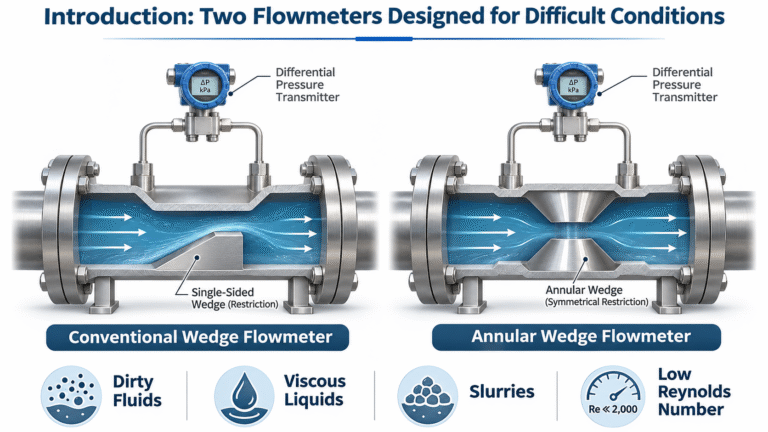
When measuring dirty fluids, viscous liquids, slurries, or fluids operating at relatively low Reynolds numbers, conventional differential pressure flowmeters may encounter challenges such as clogging, erosion, unstable pressure signals, and increased maintenance requirements.
This is one reason why wedge flowmeters are widely considered for demanding industrial applications.
However, there is another design worth understanding: the annular wedge flowmeter.
Both annular wedge and conventional wedge flowmeters use a restriction element to generate a differential pressure across the measuring section. Both can be applied to challenging process conditions.
So, what makes them different?
The answer is not simply that one is newer or better than the other. Their structural differences can influence flow distribution, potential wear patterns, pressure tapping arrangements, and long-term maintenance requirements.
Let’s examine the differences from an engineering perspective.
2. How Does a Conventional Wedge Flowmeter Work?
A conventional wedge flowmeter is a differential pressure flowmeter that uses a wedge-shaped restriction installed inside the measuring pipe.
As the fluid passes through the restricted section, its velocity changes and a differential pressure is generated between the upstream and downstream pressure tapping points.
The differential pressure is then measured by a differential pressure transmitter and used to calculate the flow rate.
One of its main advantages is its ability to handle fluids that may be difficult for conventional orifice plate flowmeters, including:
- High-viscosity liquids
- Wastewater containing suspended solids
- Slurries and certain abrasive fluids
- Fluids with relatively low Reynolds numbers
- Process streams containing contaminants
The wedge-shaped opening can provide a relatively large passage for solids compared with some other restriction-based designs.
However, the actual resistance to clogging depends on the wedge geometry, opening size, particle characteristics, and process conditions.
There is another issue that deserves attention: erosion.
In some conventional wedge designs, the flow accelerates around the restricted area, potentially creating localized high-velocity regions. Depending on the flow direction, particle concentration, and internal geometry, certain areas may experience concentrated wear over time.
This is particularly important when handling abrasive fluids.
3. What Is an Annular Wedge Flowmeter?
An annular wedge flowmeter uses a different restriction geometry.
Instead of relying on a conventional single-sided wedge arrangement, it employs an annular, symmetrical wedge-shaped restriction around the flow passage.
This geometry changes how the fluid approaches and passes through the restriction.
The symmetrical arrangement is intended to distribute the restriction around the pipe circumference rather than concentrating the entire restriction on one side.
Depending on the specific design, this can offer several potential engineering advantages:
- More symmetrical flow restriction
- Different distribution of local flow velocities
- Potentially reduced concentration of wear in a single localized area
- Greater flexibility in pressure tapping arrangements
However, an important point should be emphasized: not all annular wedge flowmeters have identical internal geometries.
Actual flow distribution and erosion performance must be evaluated using the manufacturer’s design, operating conditions, and, where available, test data.
4. Five Key Differences Between Annular and Conventional Wedge Flowmeters
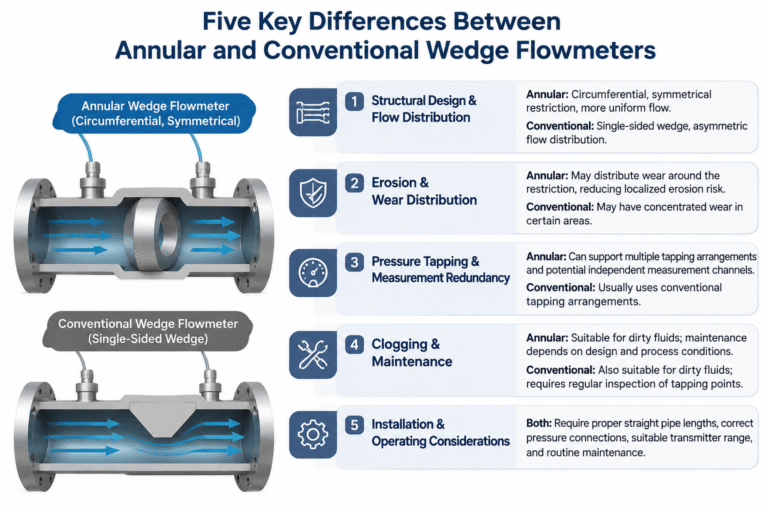
4.1 Structural Design and Flow Distribution
This is the most fundamental difference.
A conventional wedge flowmeter generally uses a wedge-shaped obstruction arranged on one side of the pipe.
An annular wedge flowmeter uses a circumferentially symmetrical restriction.
The difference in geometry influences how the fluid is accelerated and redistributed as it passes through the measuring section.
For applications involving suspended solids or non-uniform flow conditions, this difference may be worth considering during instrument selection.
However, symmetrical geometry alone does not guarantee better measurement accuracy. The overall performance also depends on the flowmeter calibration, installation conditions, and differential pressure measurement system.
4.2 Erosion and Wear Distribution
This is one of the most important considerations in abrasive applications.
When fluids contain sand, mineral particles, or other solid contaminants, repeated particle impacts can gradually wear internal flowmeter surfaces.
In certain conventional wedge configurations, erosion may become concentrated around specific areas of the wedge and downstream flow region.
An annular wedge design can help distribute the restriction around the circumference, potentially reducing the concentration of wear at a single location.
This may be beneficial in applications such as:
- Mining slurry transportation
- Wastewater containing abrasive solids
- Oil and gas production fluids
- Chemical process streams containing suspended particles
- Industrial liquids with high solid content
However, annular geometry does not eliminate erosion.
The actual service life still depends on several factors:
- Fluid velocity and operating flow range.
- Particle size, hardness, and concentration.
- Material selection for wetted components.
- Operating pressure and temperature.
- Internal geometry and flow characteristics.
For highly abrasive applications, material selection and erosion evaluation are just as important as the flowmeter’s structural design.
4.3 Pressure Tapping and Measurement Redundancy
Another potential advantage of certain annular wedge designs is their flexibility in pressure tapping arrangements.
Some designs can incorporate multiple independent pressure tapping connections.
When properly configured, these connections may support separate differential pressure measurement channels.
For example, if one measurement channel becomes blocked or develops a fault, another independently designed channel may remain available.
This can be particularly valuable in continuous industrial processes where measurement interruption may affect production or process control.
Potential applications include:
- Continuous chemical processing
- Oil and gas production facilities
- Critical process monitoring
- Applications requiring additional measurement availability
However, it is important to distinguish between multiple pressure tapping ports and genuine measurement redundancy.
For a system to provide meaningful independent redundancy, the design should consider:
- Independent high- and low-pressure impulse connections.
- Separate differential pressure transmitters, where required.
- Independent isolation and maintenance arrangements.
- Common-mode failure risks, including shared process connections.
- The overall control and safety system architecture.
Multiple pressure tapping points do not automatically make a flowmeter SIL-certified or suitable for SIS applications.
Any safety-related application must be assessed according to the relevant functional safety requirements and the certification of the complete measurement loop.
4.4 Clogging and Maintenance
Both annular wedge and conventional wedge flowmeters are commonly considered for fluids that may cause problems for traditional differential pressure devices.
Their restriction geometries can provide advantages in handling certain dirty or viscous fluids.
Nevertheless, neither design is completely immune to blockage.
Potential problems include:
- Solids accumulating around pressure tapping points.
- Sediment settling during low-flow operation.
- Fibrous materials collecting around internal structures.
- Impulse lines becoming blocked.
- Deposits gradually changing the effective flow passage.
Maintenance requirements should therefore be evaluated based on the actual fluid composition and operating conditions.
For particularly dirty services, the pressure tapping arrangement, isolation valves, flushing connections, and access for maintenance should be considered before installation.
4.5 Installation and Operating Considerations
Both types require proper installation to obtain reliable measurements.
Important factors include:
- Upstream and downstream straight pipe requirements.
- Correct flow direction.
- Proper pressure tapping connections.
- Appropriate differential pressure transmitter range.
- Impulse line routing and drainage.
- Adequate support against pipeline vibration.
The required straight pipe lengths should always follow the manufacturer’s installation instructions.
It is also important to consider the available differential pressure at minimum, normal, and maximum flow rates.
A flowmeter that performs well at normal operating conditions may not provide sufficient measurement stability at very low flow rates.
5. Quick Comparison: Which Design Offers What?
| Comparison | Annular Wedge Flowmeter | Conventional Wedge Flowmeter |
|---|---|---|
| Restriction geometry | Annular and symmetrical | Conventional wedge-shaped restriction |
| Flow distribution | Designed for circumferential symmetry | Depends on single-sided wedge geometry |
| Potential erosion pattern | May distribute wear around the restriction | May experience localized wear in certain regions |
| Pressure tapping | May support multiple tapping arrangements | Usually uses conventional tapping arrangements |
| Measurement redundancy | Possible with independent channels | Possible with additional system engineering |
| Dirty fluid applications | Suitable for selected applications | Suitable for selected applications |
| Maintenance | Depends on geometry and process conditions | Depends on geometry and process conditions |
Neither design is universally superior. The right choice depends on the process conditions and the specific manufacturer’s construction.
6. Which Flowmeter Should You Choose?

The selection should begin with the actual operating conditions rather than the instrument name.
Choose a Conventional Wedge Flowmeter When:
- The process involves viscous or dirty fluids.
- The application requires a relatively simple differential pressure measurement solution.
- The expected erosion level is manageable.
- Standard pressure tapping arrangements are sufficient.
- Initial investment and maintenance accessibility are important considerations.
Consider an Annular Wedge Flowmeter When:
- The process involves abrasive particles and localized wear is a concern.
- The application may benefit from a circumferentially symmetrical restriction.
- Multiple independent differential pressure measurement channels are required.
- The process is critical and measurement availability is particularly important.
- The specific design has demonstrated advantages under similar operating conditions.
Before making a final selection, engineers should collect the following information:
- Fluid name and composition.
- Minimum, normal, and maximum flow rates.
- Operating pressure and temperature.
- Fluid density and viscosity.
- Solid content and particle size, if applicable.
- Pipeline diameter and material.
- Required measurement accuracy.
- Available differential pressure range.
- Required output signals and control system interface.
- Material and corrosion resistance requirements.
These details help determine whether a conventional or annular wedge design is more appropriate.
7. Installation and Maintenance: Details That Should Not Be Ignored
Regardless of the selected design, several practical issues should not be overlooked.
First, pay attention to pressure tapping points.
Pressure connections are often more vulnerable to blockage than the main measuring passage. Their arrangement should be suitable for the fluid and solids characteristics.
Second, select the correct transmitter range.
An excessively large differential pressure range may reduce measurement resolution at low flow rates. The transmitter should be selected according to the actual operating range.
Third, consider material compatibility.
For abrasive services, material hardness and erosion resistance should be evaluated. For corrosive fluids, wetted material compatibility is equally important.
Fourth, establish a maintenance plan.
Regular inspection of pressure connections, impulse lines, isolation valves, and transmitter zero stability can help identify problems before they affect process operation.
For critical applications, maintenance procedures should also address the availability of alternative measurement channels, if the system has been designed with genuine redundancy.
8. Final Takeaway
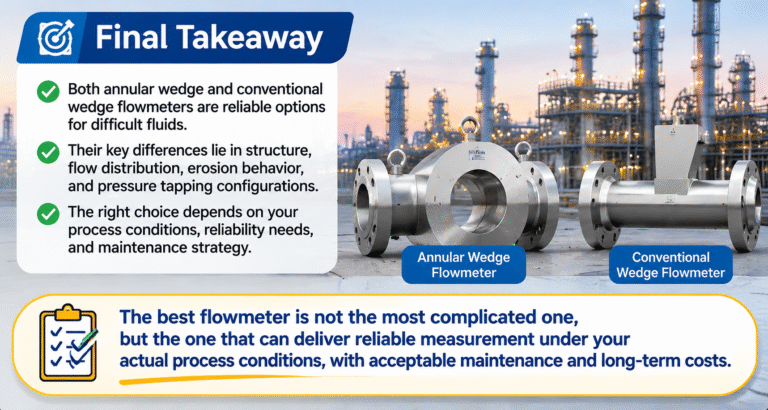
Annular wedge and conventional wedge flowmeters share the same basic differential pressure measurement principle, but their internal geometries can lead to different operating characteristics.
A conventional wedge flowmeter remains a practical choice for many dirty-fluid and high-viscosity applications.
An annular wedge flowmeter may offer additional advantages in applications where circumferentially symmetrical restriction, potential wear distribution, or multiple independent pressure measurement channels are important.
However, no structural design can compensate for incorrect sizing, unsuitable materials, poor installation, or inadequate maintenance.
The best flowmeter is not necessarily the one with the most complicated structure. It is the one that can deliver reliable measurements under the actual process conditions, with acceptable maintenance requirements and long-term operating costs.
Choosing the right instrument means looking beyond the measuring principle and understanding what happens inside the pipeline over years of operation.