
Introduction
When engineers start working with industrial communication, they often encounter many similar terms:
- Ethernet
- TCP/IP
- Socket
- Modbus TCP
- EtherNet/IP
- PROFINET
- EtherCAT
These concepts are frequently mixed together because they are all related to industrial networking.
For example, when someone asks:
“Does this device support Ethernet communication?”
The answer might be:
- Yes, it supports Modbus TCP.
- Yes, it supports PROFINET.
- Yes, it supports EtherNet/IP.
Technically, these answers are not exactly the same because they refer to different communication layers.
A simple way to understand the relationship is:
Ethernet is the road.
TCP/IP defines the traffic rules.
Socket is the software interface.
Modbus TCP, EtherNet/IP, PROFINET, and EtherCAT are the industrial languages used by devices to communicate.
Understanding this structure makes industrial communication much easier.
1. Ethernet: The Foundation of Industrial Networking
Ethernet is the basic network technology that defines how devices physically connect and exchange data on a local network.
Originally developed for computer networks, Ethernet is now widely used in industrial automation systems, including:
- PLCs
- HMIs
- Remote I/O modules
- Industrial robots
- Variable frequency drives
- Vision systems
- Industrial instruments
From a field application perspective, Ethernet mainly defines:
- Cable types and connectors
- Network switches
- Data frames
- MAC address identification
- Physical communication methods
However, Ethernet itself is not an industrial communication protocol.
It only provides the communication infrastructure.
Just like a highway, Ethernet provides the road, but the transportation rules and cargo depend on higher-level protocols.

2. TCP/IP: The Basic Communication Framework
TCP/IP is the foundation of modern network communication.
Whenever industrial devices use:
- IP address
- Subnet mask
- Gateway
- Port number
they are usually working with TCP/IP communication.
Typical industrial network settings include:
IP Address
Example:
192.168.1.100
Used to identify a device on the network.
Subnet Mask
Example:
255.255.255.0
Defines the network range.
Gateway
Used for communication between different networks.
Port Number
Defines the communication service.
Example:
Modbus TCP normally uses:
Port 502
Difference Between IP and TCP
A simple explanation:
IP answers: “Where is the device?”
TCP answers: “How do we transfer data reliably?”
TCP provides:
- Connection establishment
- Data confirmation
- Error checking
- Retransmission
UDP provides:
- Faster transmission
- Lower delay
- No guaranteed delivery
In industrial automation, communication is not only about “connecting successfully”.
Engineers also care about:
- Data stability
- Timing accuracy
- Real-time response
- Diagnostics
This is why different industrial protocols were developed.
3. Socket: The Software Communication Interface
Socket is often misunderstood.
Socket is not an industrial protocol.
It is a programming interface that allows software applications to communicate through a network.
For example:
- A PC software reads data from a PLC.
- A test program communicates with an instrument.
- A custom application connects to a sensor.
Typical applications:
- TCP Socket communication
- UDP Socket communication
- Custom device protocols
- Testing and debugging tools
A socket only provides the communication channel:
“Send these bytes.”
“Receive these bytes.”
It does not define what the data means.
The actual data format must be defined by the communication protocol.
Therefore:
Socket is a communication interface, not a communication standard.
4. Modbus TCP: Simple and Widely Used Industrial Protocol
Modbus TCP is one of the most common industrial Ethernet protocols.
Its popularity comes from:
- Simple structure
- Open standard
- Easy troubleshooting
- Large number of supported devices
Modbus TCP normally runs on:
- Ethernet
- TCP/IP
- Port 502
The communication model is simple:
Client sends request → Server returns data
Typical Applications
Modbus TCP is widely used for:
- PLC reading flow meter data
- SCADA systems collecting instrument information
- Energy meter monitoring
- Temperature controller communication
- Remote I/O systems
- Gateway communication from Modbus RTU
The main concept of Modbus TCP is the register system:
- Coil
- Discrete Input
- Input Register
- Holding Register
For example, an electromagnetic flow meter may provide:
- Flow rate
- Totalizer value
- Alarm status
- Device parameters
through Modbus registers.
Advantages and Limitations
Advantages:
✔ Simple
✔ Low cost
✔ Easy configuration
✔ Easy troubleshooting
Limitations:
- Limited device description capability
- Less advanced diagnostics
- Not designed for highly synchronized control
For many monitoring and measurement applications, Modbus TCP remains an excellent choice.

5. EtherNet/IP: Industrial Ethernet for Rockwell Automation
EtherNet/IP is often misunderstood because of its name.
The “IP” here means:
Industrial Protocol
not Internet Protocol.
EtherNet/IP was developed by ODVA and is widely used in:
- Rockwell Automation systems
- Allen-Bradley PLCs
- Industrial robots
- Drives
- Sensors
- Remote I/O
EtherNet/IP is based on:
CIP (Common Industrial Protocol)
Compared with Modbus TCP, EtherNet/IP provides a more complete object-based communication model.
It supports:
- Real-time I/O communication
- Parameter configuration
- Device diagnostics
- Device management
A simple comparison:
Modbus TCP = Reading and writing registers
EtherNet/IP = Communicating with intelligent device objects
6. PROFINET: Industrial Ethernet for Siemens Automation
PROFINET is the industrial Ethernet protocol developed by:
PROFIBUS & PROFINET International (PI)
It is especially common in:
- Siemens PLC systems
- TIA Portal projects
- Factory automation
- Remote I/O systems
- Drives
- Robots
PROFINET focuses on engineering integration.
Important features include:
- Device name management
- IP configuration
- GSDML device files
- Real-time communication
- Diagnostics
- Network topology recognition
PROFINET communication levels include:
PROFINET RT
Real-Time communication
Used for:
- PLC control
- Remote I/O
- Standard automation
PROFINET IRT
Isochronous Real-Time communication
Used for:
- Motion control
- High precision synchronization
The biggest advantage of PROFINET is its strong integration with Siemens engineering tools.
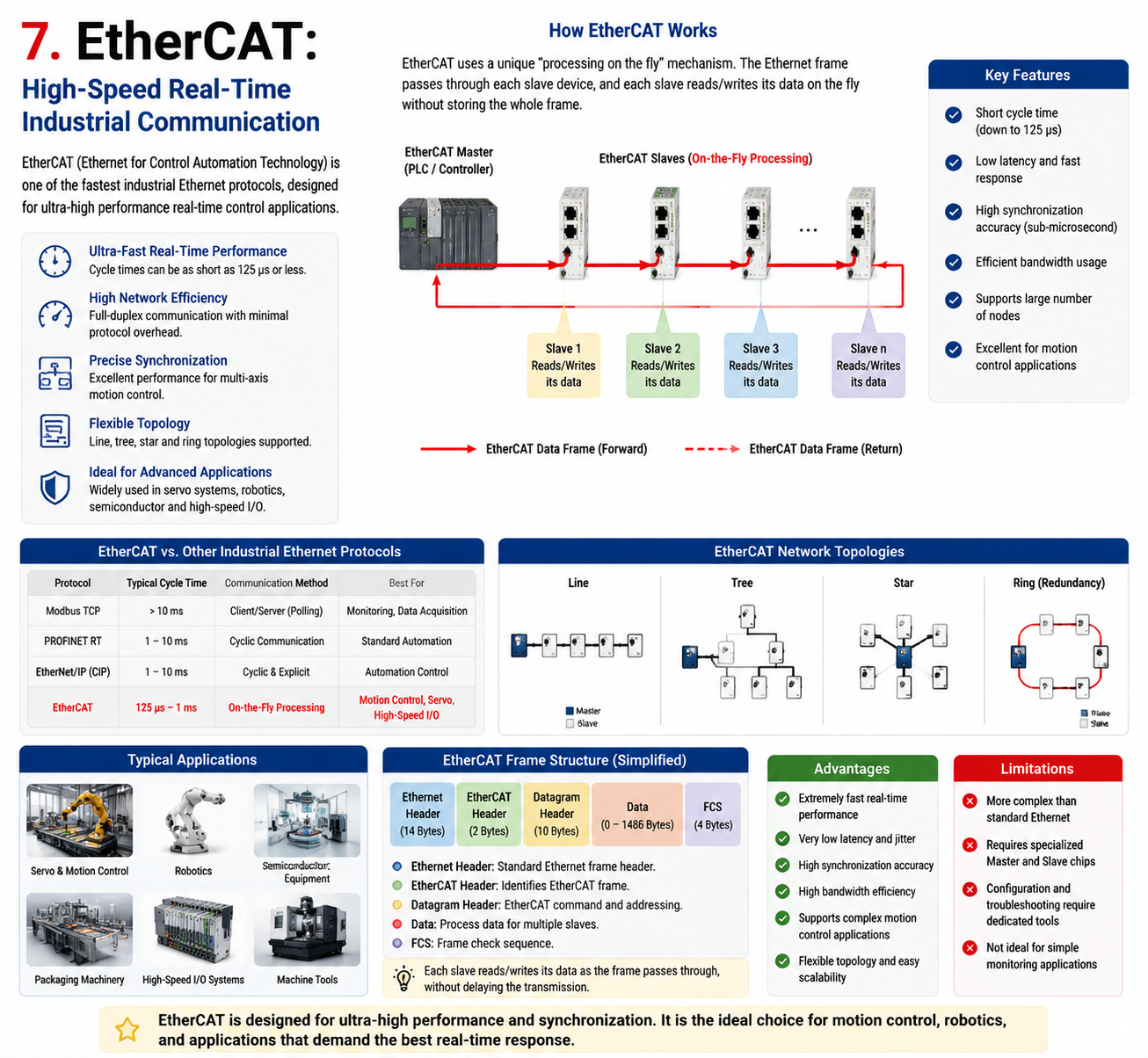
7. EtherCAT: High-Speed Real-Time Industrial Communication
EtherCAT is one of the fastest industrial Ethernet-based communication technologies.
It is commonly used in:
- Servo systems
- Motion control
- Robotics
- Semiconductor equipment
- High-speed I/O systems
Unlike traditional Ethernet communication, EtherCAT uses a special processing method:
The data frame passes through each slave device.
Each device reads or writes its own data while the frame continues moving.
This greatly reduces communication delay.
EtherCAT Advantages
- Extremely short communication cycle time
- Excellent multi-axis synchronization
- High network efficiency
- Suitable for demanding motion applications
A simple comparison:
Modbus TCP → Data monitoring
PROFINET / EtherNet/IP → Industrial control
EtherCAT → High-speed synchronized control
8. Industrial Communication Protocol Comparison
| Protocol | Main Application | Typical Users | Main Advantage |
|---|---|---|---|
| Ethernet | Network foundation | All systems | Universal connection |
| TCP/IP | Communication framework | All devices | Standard networking |
| Socket | Software communication | Developers | Flexible programming |
| Modbus TCP | Instrument monitoring | SCADA, PLC | Simple and open |
| EtherNet/IP | Automation control | Rockwell systems | Object-based communication |
| PROFINET | Automation control | Siemens systems | Excellent engineering integration |
| EtherCAT | Motion control | Robotics, Servo | Ultra-fast synchronization |
9. How to Select the Right Communication Protocol for Industrial Instruments?
For industrial instruments such as:
- Flow meters
- Level transmitters
- Pressure transmitters
- Temperature transmitters
the correct protocol depends on the control system.
For simple measurement and monitoring:
Recommended:
- Modbus RTU
- Modbus TCP
- 4-20mA
- Pulse output
Applications:
- Water treatment
- Energy monitoring
- Utility systems
For Siemens automation systems:
Recommended:
- PROFINET
For Rockwell Automation systems:
Recommended:
- EtherNet/IP
For high-speed machinery:
Recommended:
- EtherCAT
The best protocol is not always the fastest one.
The right choice depends on:
- PLC compatibility
- System architecture
- Engineering tools
- Maintenance capability
- Required response time
- Network complexity

Conclusion
Industrial communication protocols are not the same thing.
They belong to different layers:
- Ethernet provides the network foundation.
- TCP/IP defines basic communication rules.
- Socket provides software access.
- Modbus TCP, EtherNet/IP, PROFINET, and EtherCAT define how industrial devices exchange meaningful information.
Understanding these layers helps engineers troubleshoot communication problems faster.
A communication failure may come from:
- Cable connection
- Switch configuration
- IP address
- Port settings
- Device name assignment
- PLC program
- Communication cycle settings
Industrial communication is not simply about:
“Can the devices connect?”
The real question is:
“Are all communication layers correctly matched?”