
Introduction
A level switch is one of the most commonly used instruments in industrial process control systems. It is mainly used for detecting whether the liquid or solid material level reaches a preset position and then sending a switching signal to control pumps, valves, alarms, or other equipment.
Compared with continuous level measurement instruments such as radar level transmitters and ultrasonic level meters, level switches provide a simple, reliable, and cost-effective solution for high-level, low-level, and safety limit detection.
Different applications require different technologies. Factors such as medium characteristics, temperature, pressure, viscosity, corrosion, installation conditions, and explosion protection requirements should be considered before selecting the correct level switch.
This article introduces the main types of industrial level switches, including float, tuning fork, capacitance, RF admittance, external mounted, rotary paddle, optical, electronic, and ultrasonic level switches.
1. Float Level Switch
Working Principle
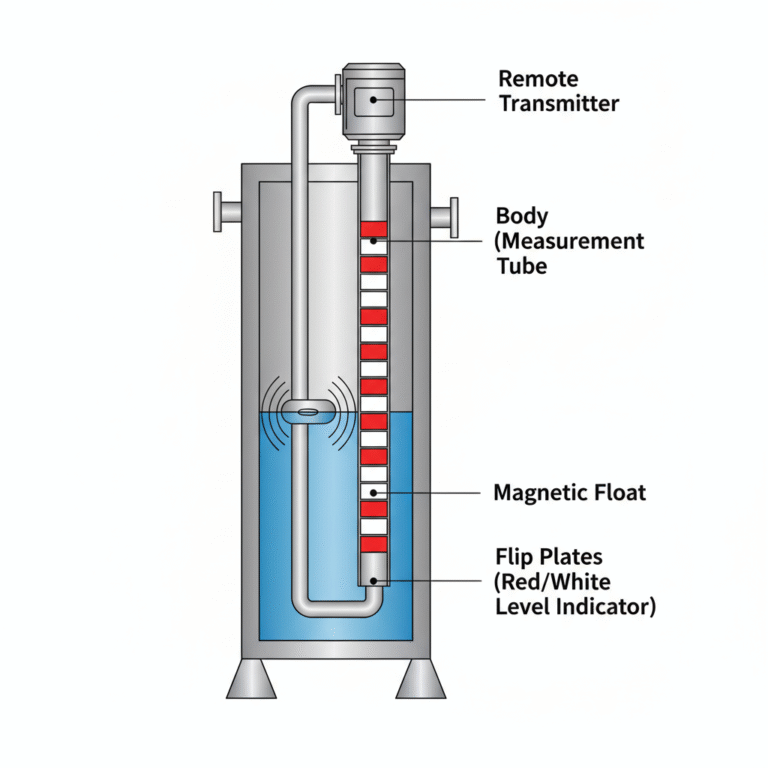
A float level switch uses the buoyancy force of a floating element to detect liquid level changes.
When the liquid level rises or falls, the float moves accordingly and activates an internal magnetic switch to generate an electrical signal.
Float switches are widely used in water tanks, wastewater systems, chemical storage tanks, and industrial equipment.
Advantages
- Simple structure and easy installation
- Low cost and high reliability
- No complicated electronic components
- Fast switching response
- Strong resistance to electrical load impact
- Suitable for multi-point level control
- Easy maintenance
Limitations
- Moving parts may wear over long-term operation
- Not suitable for highly viscous liquids or liquids containing excessive solids
- Measurement accuracy is lower compared with electronic level instruments
- Installation usually requires tank opening and process interruption
Typical Technical Specifications
- Maximum cable length: up to 30 m
- Operating temperature:
- Standard type: 0~80°C
- High-temperature type: up to 120°C
- Ambient temperature: -40~70°C
- Pressure: Atmospheric pressure
- Medium density: ≥0.6 g/cm³
- Contact capacity: 220VAC 10A
- Protection rating: IP65
- Wetted material: Stainless steel
2. Tuning Fork Level Switch
Working Principle
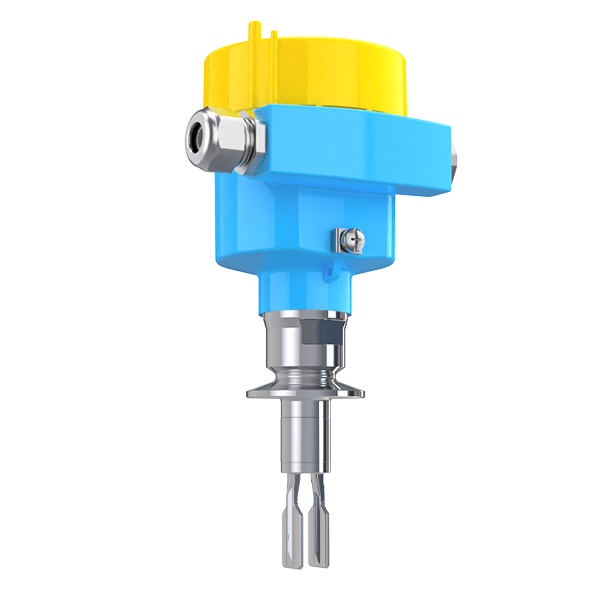
A tuning fork level switch uses a vibrating fork sensor. When the liquid contacts the fork, the vibration frequency changes, and the electronic circuit detects this change to produce a switching signal.
It is one of the most popular point-level measurement technologies in modern industries.
Advantages
- No moving mechanical parts
- Maintenance-free operation
- No calibration required in most applications
- Not affected by flow, bubbles, turbulence, or foam
- High reliability and self-diagnostic function
- Suitable for a wide range of liquids
Limitations
- Not recommended for extremely viscous media
- Material buildup between the forks may affect detection
- Very dense coating materials may require special designs
Typical Technical Specifications
- Power supply:
- DC12~24V
- AC220V
- Sensor material: 316 stainless steel
- Protection rating: IP68
- Maximum pressure: 1 MPa
- Liquid density: ≥0.8 g/cm³
- Powder density: ≥0.2 g/cm³
- Operating temperature: -10~85°C
3. Capacitance Level Switch
Working Principle
A capacitance level switch detects level changes by measuring the variation of capacitance between the sensing probe and the tank wall.
When the material contacts the probe, the dielectric constant changes, causing the output signal to switch.
Advantages
- Suitable for liquids and solids
- Good corrosion resistance with proper probe materials
- Can be installed on non-metallic tanks
- Suitable for chemical, plastic, and powder applications
Limitations
- Requires correct calibration
- Performance depends on dielectric constant
- Material buildup may affect measurement
- Installation usually requires tank modification
Applications
- Chemical storage tanks
- Plastic materials
- Powder and granule silos
- Food and pharmaceutical industries
4. External Mounted Level Switch
Working Principle
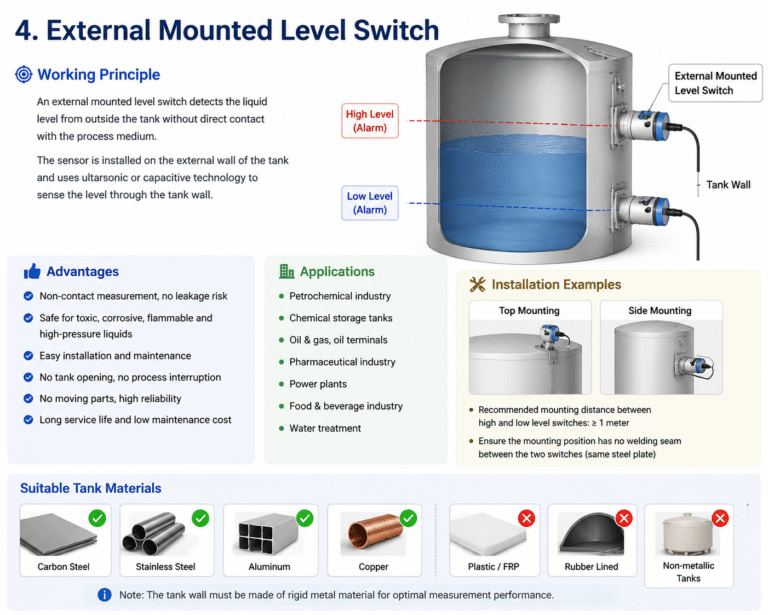
External level switches measure the level from outside the tank without contacting the process medium.
The sensor is installed on the external surface of the tank and detects the liquid level through the tank wall.
Advantages
1. Safe Non-Contact Measurement
Because the sensor does not contact the process medium:
- No leakage risk
- No corrosion damage
- No contamination
- Suitable for toxic, corrosive, flammable, and high-pressure liquids
2. Easy Installation and Maintenance
- No tank opening required
- No draining or cleaning
- No production shutdown
- No hot work installation
3. Excellent Reliability
- No moving parts
- Fully sealed structure
- Long service life
Applications
Widely used in:
- Petrochemical plants
- Chemical storage
- Oil terminals
- Pharmaceutical industries
- Power plants
Limitations
- Tank wall must be rigid material
- Installation position requirements must be considered
- Proper mounting distance is required
5. RF Admittance Level Switch
Working Principle
RF admittance technology is an improved capacitance measurement method.
It separates the sensing signal from the coating effect, allowing reliable detection even when material buildup exists on the probe.
Advantages
- Suitable for liquids and solids
- Excellent anti-coating performance
- No moving parts
- Maintenance-free operation
- Strong resistance to foam, steam, and agitation
- Stable performance in harsh environments
Applications
Commonly used in:
- Chemical industry
- Oil and gas
- Water treatment
- Paper industry
- Cement plants
- Food processing
6. Rotary Paddle Level Switch
Working Principle
A rotary paddle level switch is mainly designed for solid materials.
A small motor rotates the paddle continuously. When material covers the paddle and stops rotation, the switch output changes.
Advantages
- Designed for powder and granular materials
- Reliable mechanical structure
- Adjustable torque
- Dust-proof sealing design
- Easy maintenance
- Suitable for silo level detection
Typical Applications
- Cement powder
- Coal powder
- Grain
- Plastic pellets
- Chemical powder
Technical Specifications
- Material particle size: ≤20 mm
- Material density: ≥0.5 g/cm³
- Material temperature: ≤185°C
- Power supply: 220VAC 50Hz
- Output contact: 250VAC 5A
- Protection rating: IP65
7. Electronic Level Switch
Advantages
Electronic level switches provide:
- Strong vibration resistance
- Good impact resistance
- Resistance to salt spray and corrosion
- No influence from magnetic fields
- No influence from external light
- No moving parts
Applications
Suitable for:
- Clean water
- Wastewater
- Seawater
- Chemical liquids
- Industrial water treatment
- Marine applications

8. Optical Level Switch
Working Principle
An optical level switch uses infrared light reflection changes caused by liquid contact to detect the presence of liquid.
Advantages
- No mechanical moving parts
- Compact design
- High repeatability
- Fast response
- Cost-effective
Limitations
Not recommended for:
- Crystallizing liquids
- Frozen liquids
- Heavy coating applications
9. Ultrasonic Level Switch
Working Principle
An ultrasonic level switch uses high-frequency sound waves to detect liquid level changes without direct contact.
The sensor calculates the level based on the time required for ultrasonic waves to travel between the sensor and liquid surface.
Advantages
- Non-contact measurement
- Suitable for corrosive liquids
- No contamination risk
- Suitable for difficult-to-access tanks
- Temperature compensation available
Limitations
- Performance affected by heavy foam
- Influenced by vapor and turbulence
- High viscosity materials may reduce measurement stability
Level Switch Selection Guide
| Application Condition | Recommended Level Switch |
|---|---|
| Water tank | Float / Tuning Fork |
| Chemical liquid | Tuning Fork / External Mounted |
| Corrosive liquid | External Mounted |
| High viscosity liquid | RF Admittance |
| Powder material | Rotary Paddle |
| Food industry | Tuning Fork |
| Wastewater | Electronic / Ultrasonic |
| High pressure tank | External Mounted / Special Tuning Fork |

Conclusion
Choosing the correct level switch depends on the actual process conditions rather than the instrument type alone.
For simple water applications, float switches provide a low-cost and reliable solution. For modern industrial processes requiring high reliability and low maintenance, tuning fork and RF admittance technologies are widely preferred. For dangerous or corrosive media, external mounted level switches provide maximum safety because there is no direct contact with the process material.
Understanding the advantages and limitations of each technology helps engineers select the most reliable and economical level detection solution.