
Does More Maintenance Always Mean Better Equipment Reliability?
Does increasing maintenance frequency always make equipment more reliable?
Does installing vibration and temperature sensors automatically reduce equipment failures?
The answer is not always.
During discussions with industrial plants about equipment reliability, one question appears repeatedly:
Should we use Preventive Maintenance (PM) or Predictive Maintenance (PdM)?
Many companies schedule extensive annual maintenance activities. Equipment is stopped regularly for inspection and overhaul, yet unexpected failures still occur and production efficiency is affected.
Other companies invest heavily in online monitoring systems, installing sensors everywhere, but maintenance teams end up collecting large amounts of data without knowing what actions should actually be taken.
After working with many industrial projects, it becomes clear that the real problem is often not choosing between PM and PdM.
The fundamental question is:
Why does the equipment fail in the first place?
A reliable maintenance strategy should always start from understanding equipment failure mechanisms.
1. Increasing Maintenance Frequency Does Not Always Prevent Failures
Many people believe:
“More frequent maintenance means more reliable equipment.”
However, actual industrial conditions are often more complicated.
For example, one manufacturing plant performed regular maintenance:
- Gearbox oil replacement every six months
- Motor insulation testing every year
- Complete maintenance records were maintained
However, bearing failures continued to happen repeatedly.
After detailed inspection, engineers found that the real problem was not lubrication.
The coupling had been misaligned for a long time, causing the bearing to operate under continuous uneven loading.
The maintenance activities were performed correctly, but they were not addressing the actual failure cause.
This situation is common in industry.
Shortening maintenance intervals without understanding failure mechanisms often increases maintenance workload rather than improving equipment reliability.
The purpose of maintenance is not simply to do more work.
The purpose is to perform the right maintenance at the right time.
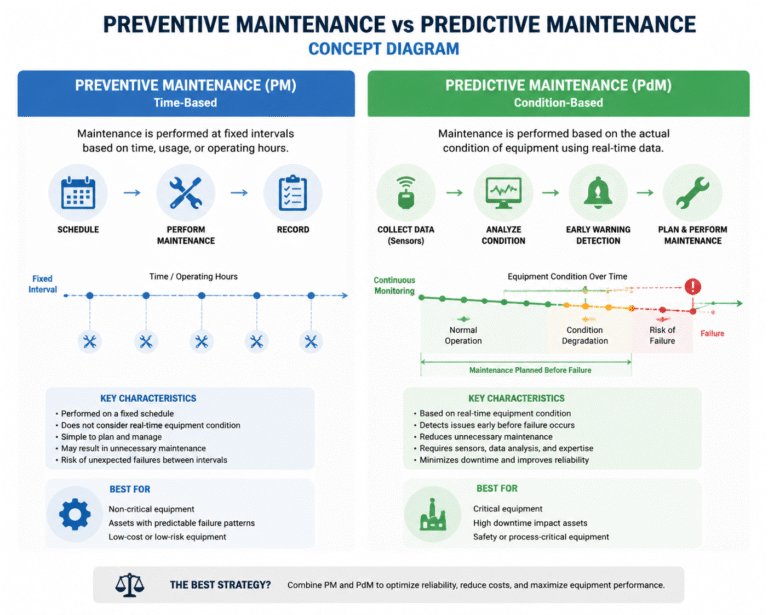
2. What Is Preventive Maintenance (PM)?
Preventive Maintenance (PM) is a maintenance strategy based on predetermined schedules.
Maintenance activities are planned according to:
- Operating hours
- Calendar time
- Production cycles
- Running distance
- Manufacturer recommendations
Typical PM activities include:
- Lubrication
- Cleaning
- Inspection
- Adjustment
- Tightening
- Replacement of wear parts
The basic idea behind PM is simple:
Replace or maintain components before they reach the expected failure point.
Many components have predictable aging characteristics:
- Lubricating oil deteriorates over time
- Seals become aged
- Filters become blocked
- Belts wear gradually
For these components, scheduled maintenance is effective and practical.
This is why PM remains widely used in factories today.
It is not because companies lack advanced technology.
PM continues to exist because it is:
- Simple
- Reliable
- Easy to manage
However, PM has one important limitation:
It works best when equipment failure follows a predictable life cycle.
In reality, many failures do not follow a fixed schedule.
Some components may still be in excellent condition when replaced.
Others may fail shortly after scheduled maintenance.
3. What Is Predictive Maintenance (PdM)?
Predictive Maintenance (PdM) is a maintenance strategy based on the actual health condition of equipment.
Instead of asking:
“When should we perform maintenance?”
PdM asks:
“What is happening inside the equipment right now?”
PdM uses condition monitoring technologies such as:
- Vibration monitoring
- Temperature measurement
- Motor current analysis
- Oil analysis
- Pressure monitoring
- Acoustic monitoring
The collected data is analyzed through:
- Trend analysis
- Statistical methods
- Diagnostic models
- Machine learning technologies
The goal is to detect abnormal changes before equipment failure occurs.
4. PdM Focuses on Equipment Changes, Not Just Failures
Many companies misunderstand Predictive Maintenance.
They think PdM means:
“Predict exactly when a machine will fail.”
In reality, PdM focuses on detecting equipment condition changes.
A machine rarely fails instantly.
Usually, there is a degradation process before failure:
- Bearing wear causes vibration changes
- Motor insulation aging increases temperature
- Poor lubrication affects noise and current
- Misalignment changes vibration patterns
PdM identifies these early warning signs.
For example:
A motor bearing may gradually deteriorate.
The process may look like this:
Normal operation →
Small vibration increase →
Abnormal vibration trend →
Bearing damage →
Equipment failure
If vibration changes are detected early, maintenance can be scheduled during planned downtime instead of causing an emergency shutdown.
The biggest value of PdM is not reducing maintenance work.
It is giving maintenance teams more time to make better decisions.

5. PM vs PdM: Key Differences
| Item | Preventive Maintenance (PM) | Predictive Maintenance (PdM) |
|---|---|---|
| Maintenance basis | Time or operating schedule | Actual equipment condition |
| Main purpose | Prevent expected failures | Detect developing problems |
| Data required | Maintenance plan | Sensor and monitoring data |
| Typical methods | Inspection, lubrication, replacement | Vibration, temperature, oil analysis |
| Advantage | Simple and easy to implement | Avoid unnecessary maintenance and unexpected downtime |
| Limitation | May replace healthy components | Requires monitoring system and data analysis |
| Best application | General equipment | Critical equipment with high downtime impact |
6. Not All Equipment Requires the Same Maintenance Strategy
A common mistake in many factories is applying the same maintenance method to every machine.
For example:
A plant may have hundreds of pieces of equipment, but only a small number of machines actually determine production continuity.
These critical assets may include:
- Main production motors
- Large pumps
- Compressors
- Turbines
- Key process equipment
For these machines, adding condition monitoring systems can provide significant value.
For less important equipment:
- Routine inspection
- Basic PM
- Corrective maintenance after failure
may be more economical.
A mature maintenance strategy should consider:
- Equipment importance
- Production impact
- Safety risk
- Failure consequences
- Repair difficulty
- Spare parts availability
Maintenance resources should be allocated according to risk, not equally distributed across all equipment.

7. How Predictive Maintenance Is Used in Industrial Instrumentation
Modern industrial instruments also benefit from predictive maintenance concepts.
Flow Meters
Condition monitoring can help identify:
- Unstable output signals
- Empty pipe conditions
- Electrode problems
- Abnormal measurement trends
For electromagnetic flow meters, monitoring signal stability and diagnostic information can help detect potential problems before measurement failure occurs.
Pressure Transmitters
Typical monitoring items include:
- Zero drift
- Output instability
- Abnormal pressure trends
- Impulse line blockage
Radar Level Transmitters
Condition monitoring can analyze:
- Echo signal strength
- False echo changes
- Signal loss frequency
- Abnormal level fluctuations
These diagnostic functions help maintenance teams understand whether a problem comes from the instrument itself or the process condition.
8. PM and PdM Are Not Competitors
The question is not:
“Should we choose PM or PdM?”
A better approach is:
How can we combine both methods effectively?
PM provides:
- Routine inspection
- Lubrication
- Cleaning
- Basic equipment care
PdM provides:
- Equipment condition information
- Early warning signals
- Data-based maintenance decisions
A reliable maintenance system usually combines both:
- Use PM for general equipment
- Apply PdM to critical assets
- Use corrective maintenance where failure consequences are acceptable
The goal is not to perform more maintenance.
The goal is to perform maintenance more intelligently.

Conclusion
For many years, industries have discussed whether Preventive Maintenance will be replaced by Predictive Maintenance.
However, the real change is not replacing one method with another.
It is moving from:
“Maintain equipment because the schedule says so”
to:
“Maintain equipment because data shows it needs attention.”
Whether using PM or PdM, equipment reliability ultimately depends on one thing:
Are maintenance decisions based on real failure mechanisms and actual operating conditions?
The most effective maintenance strategy is not the one with the most technology.
It is the one that puts the right resources on the equipment that matters most.