
Practical Anti-Vibration Solutions for Instrumentation Panels and High-Vibration Environments
Applicable for: M3 / M4 / M5 screw terminals
Typical environments: DCS cabinets, PLC panels, MCC cabinets, vibration-prone industrial installations
Introduction
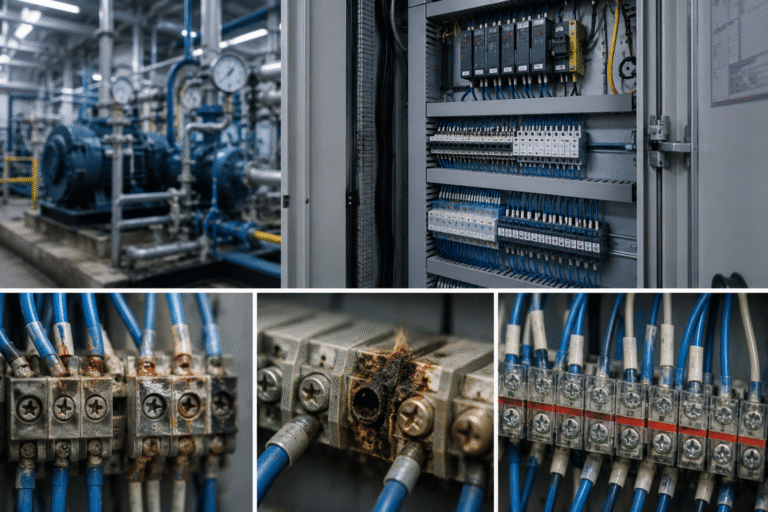
In many industrial plants — especially chemical, power generation, steel, mining, and water treatment facilities — DCS control cabinets are often installed close to:
- Pumps
- Blowers
- Compressors
- Cooling fans
- Rotating machinery
Continuous vibration can gradually loosen terminal screws and reduce contact pressure inside terminal blocks.
This issue is far more common than many engineers realize.
In actual field applications, loose terminals can lead to:
- Unstable 4–20mA signals
- Intermittent communication failures
- Unexpected interlock trips
- PLC I/O fluctuations
- False alarms
- Heat buildup and terminal burning
In many cases, engineers spend hours checking instruments, transmitters, grounding systems, and PLC modules — only to discover that the real problem is simply a loose terminal connection.
This article provides a complete practical guide for preventing terminal loosening in DCS and instrumentation cabinets, from low-cost quick fixes to long-term maintenance-free solutions.
The solutions are organized into four levels:
- Low-cost immediate improvements
- Mid-level reinforcement for strong vibration
- High-end maintenance-free upgrades
- Wiring workmanship and installation practices
All recommendations are suitable for real industrial field conditions and can be directly used by maintenance teams and purchasing departments.
1. Low-Cost Solutions — Washers, Locknuts, and Threadlocker
These methods require minimal modification and can usually be implemented immediately using standard hardware.
Suitable for:
- Standard DCS I/O cabinets
- Instrument signal terminals
- Moderate vibration environments
1.1 Flat Washer + Spring Washer Combination
Typical Configuration
Screw → Flat Washer → Spring Washer → Terminal → Tightening
Advantages
- Lowest cost
- Easy to implement
- Widely available
Suitable For
- Standard indoor control cabinets
- Low to moderate vibration areas
Recommended Sizes
- M3
- M4
- M5
Material Recommendation
- Zinc-plated steel
- Stainless steel
1.1 Flat Washer + Spring Washer Combination
Typical Configuration
Screw → Flat Washer → Spring Washer → Terminal → Tightening
Advantages
- Lowest cost
- Easy to implement
- Widely available
Suitable For
- Standard indoor control cabinets
- Low to moderate vibration areas
Recommended Sizes
- M3
- M4
- M5
Material Recommendation
- Zinc-plated steel
- Stainless steel
1.2 Toothed Lock Washers (Internal or External Tooth)
Compared with ordinary spring washers, toothed lock washers provide significantly better anti-vibration performance.
The teeth bite into the contact surface and reduce rotational loosening under vibration.
Advantages
- Better vibration resistance
- Higher friction locking
- More reliable than standard spring washers
Recommended Brands
- Bossard
- MISUMI
Suitable For
- Medium vibration environments
- Instrument cabinets near rotating equipment
1.3 Belleville Spring Washers
Belleville washers provide stable preload force even under long-term vibration and thermal cycling.
They are widely used in:
- ESD systems
- SIS systems
- Critical pressure and flow measurement points
Advantages
- Excellent fatigue resistance
- Stable preload force
- High vibration reliability
Recommended Applications
- Critical interlock circuits
- Safety shutdown systems
- High-reliability cabinets

Why Traditional Spring Washers Often Fail
Many engineers still rely heavily on standard spring washers.
However, under continuous industrial vibration:
- Spring washers can fatigue over time
- Contact surfaces wear down
- Preload force gradually decreases
- Loosening eventually returns
This is why many modern industrial standards increasingly prefer:
- Wedge-lock washers
- Belleville washers
- Spring clamp terminals
- Torque-controlled installation
- Spiralock systems
instead of ordinary spring washers alone.
2. Locknuts and Anti-Loosening Fasteners
2.1 Nylon Insert Locknuts
Nylon insert locknuts use a nylon ring to grip the screw thread and resist loosening.
Advantages
- Reusable
- Low cost
- Effective for moderate vibration
Temperature Range
-50°C to +120°C
Recommended Applications
- Standard instrument cabinets
- Indoor electrical panels
Purchasing Keywords
- M3 nylon insert locknut
- M4 locknut nickel plated
2.2 All-Metal Locknuts (Spiralock / Hard-Lock)
For stronger vibration or higher temperatures, all-metal locknuts are significantly more reliable.
Advantages
- High-temperature resistance
- Excellent vibration resistance
- Reusable
- Long service life
Recommended Brands
- Spiralock
- Hard-Lock
Suitable For
- Cabinets near pumps or compressors
- Outdoor industrial installations
- High-temperature environments
Unlike nylon locknuts, all-metal locknuts are not affected by heat aging.
2.3 Flange Lock Screws
Flange lock screws integrate locking teeth directly into the screw head.
Advantages
- Faster installation
- Reduced component count
- Improved anti-loosening performance
Recommended Brands
- Phoenix Contact
- Weidmüller

3. Threadlocker — Essential in High-Vibration Areas
For cabinets exposed to continuous vibration, threadlocker is highly recommended.
Recommended Type
Medium-Strength Removable Threadlocker
Recommended Models
- Loctite 243
- 3M Scotch-Weld
Benefits
- Prevents loosening
- Reduces oxidation
- Allows future maintenance and removal
Important Warning
Do NOT use high-strength threadlocker such as Loctite 272.
Once cured, it becomes extremely difficult to remove and may damage the terminal during maintenance.
4. Mid-Level Reinforcement — Spring Clamp Terminal Blocks
When vibration becomes severe, improving the terminal structure itself is often more effective than continuously upgrading screws and washers.
This is the most recommended solution for industrial vibration environments.
4.1 Spring Clamp Terminals (Strongly Recommended)
Spring clamp terminals eliminate screw loosening entirely.
Instead of screw pressure, conductors are continuously held by spring force.
Advantages
- No screw loosening
- Extremely high vibration resistance
- Maintenance-free operation
- Stable long-term contact pressure
Typical Performance
Many spring terminals can withstand vibration levels up to 30g.
Compared with screw terminals, loosening incidents can be reduced by over 90%.
Recommended Brands
- Phoenix Contact ST Series
- Weidmüller A Series
- SUPU
Suitable Cable Sizes
- 0.5–2.5mm² instrumentation cable
- 2.5mm² and 4mm² terminal types
Typical Lifetime
More than 10 years maintenance-free.
Screw Terminals vs Spring Clamp Terminals
| Item | Screw Terminal | Spring Clamp Terminal |
|---|---|---|
| Vibration Resistance | Moderate | Excellent |
| Periodic Retightening | Required | Not Required |
| Long-Term Stability | Medium | Very High |
| Maintenance Cost | High | Very Low |
| Recommended for Strong Vibration | No | Yes |
4.2 Terminal Retainers and Locking Accessories
Even with spring terminals, additional accessories improve reliability.
Recommended Accessories
- End clamps
- Terminal retainers
- Partition plates
- Locking bars
- Bridge locking pins
Benefits
- Prevent terminal movement
- Reduce vibration transmission
- Improve mechanical stability

5. High-End Maintenance-Free System Solution
For critical applications where loosening cannot be tolerated, a complete system-level solution is recommended.
Typical applications:
- ESD systems
- SIS systems
- Critical flow measurements
- Pressure protection loops
- Safety shutdown circuits
Recommended Full Solution
Terminal Structure
- Spring clamp terminals
- Redundant dual-channel wiring if necessary
Mechanical Locking
- Belleville washers
- All-metal locknuts
- Medium-strength threadlocker
Environmental Adaptation
High-Temperature Cabinets
Use all-metal locking hardware only.
Avoid nylon locknuts.
Corrosive Environments
Use:
- Stainless steel hardware
- Corrosion-resistant terminals
Extremely High Vibration
Install:
- Cabinet shock absorbers
- Anti-vibration mounting feet
6. Wiring Practices — The Foundation of Anti-Loosening
Even the best locking hardware cannot compensate for poor wiring workmanship.
6.1 Crimped Ferrules Are Mandatory
Bare stranded wire should never be inserted directly into terminals.
Without ferrules:
- Copper strands deform over time
- Contact pressure decreases
- Resistance increases
- Loosening becomes inevitable
Recommended Types
- Pin ferrules
- OT terminals
- UT terminals
Recommended Material
Tin-plated copper
Recommended Tool
Ratchet crimping tool with preset pressure control.
6.2 Proper Cable Slack and Torque Control
Wires should never be stretched tightly.
Instead, leave a natural cable loop or gentle bend to absorb vibration movement.
Recommended Tightening Torque
| Screw Size | Recommended Torque |
| M3 | 0.5–0.8 Nm |
| M4 | 1.2–1.5 Nm |
| M5 | 2.0–2.5 Nm |
Important Recommendation
Always use a preset torque screwdriver.
Never rely on “hand feeling”.
6.3 Cabinet Cable Vibration Isolation
Recommended Practices
- Use flexible cable clamps
- Avoid rigid fixing directly onto metal ducts
- Add intermediate cable fixing points every ≤300mm
- Use flexible cable duct installation methods
These measures significantly reduce vibration transmission into terminal connections.
7. Recommended Solutions by Vibration Level
| Vibration Level | Recommended Solution |
| Normal Vibration | Flat washer + toothed washer + torque control |
| Medium Vibration | Locknut + Loctite 243 + ferrules |
| Strong Vibration | Spring clamp terminals + anti-vibration accessories |
| Critical Safety Systems | Full maintenance-free system solution |

Final Recommendations
Based on practical industrial experience, the following approach is strongly recommended:
For Standard DCS Cabinets
Usually sufficient:
- Toothed lock washers
- Ferrules
- Proper torque control
For High-Vibration Areas
Instead of continuously improving screw locking methods:
Upgrade directly to spring clamp terminals.
This often reduces long-term maintenance costs dramatically.
For ESD / SIS Systems
Do not rely only on tightening screws.
Use:
- Spring terminals
- Torque verification
- Redundant wiring
- Scheduled inspection procedures
Safety systems should never depend on “manual retightening”.
Conclusion
Terminal block loosening is not simply a “washer problem”.
It is a complete engineering reliability issue involving:
- Terminal selection
- Mechanical locking
- Wiring workmanship
- Installation methods
- Vibration management
- Maintenance strategy
The most effective long-term principle is simple:
Whenever possible, eliminate screw loosening risks entirely by using spring clamp terminals.
For applications where screw terminals must still be used:
Proper washers, threadlocker, ferrules, and torque control are all essential.
In industrial control systems, small loose connections can eventually become major shutdown events.
Reliable wiring is not a detail — it is part of system safety.