
In industrial automation projects, one question comes up again and again:
Should the system use only an HMI, or should it be designed with a SCADA system from the beginning?
At first, the difference may not seem important. During commissioning, both solutions can appear to work fine. Operators can start and stop equipment, view process values, and acknowledge alarms.
But as the project grows, the difference becomes obvious.
Some projects start with only a few touch panels to save cost and simplify deployment. Initially everything works well. Later, however, more equipment is added, more tags appear, management requests production reports, and maintenance teams need historical records. Suddenly the system becomes difficult to manage:
- Alarm information is scattered
- Data is isolated
- Historical trends are missing
- Troubleshooting becomes inefficient
In many cases, the plant eventually has to add a SCADA system afterward.
The opposite situation also exists. Some projects are relatively small, involving only a single machine or a simple local process, yet a full SCADA platform is installed unnecessarily. The result is higher cost, greater system complexity, and operators who find the system harder to use.
So the real question is not whether HMI or SCADA is “better.”
The real question is:
What level does the project actually need?
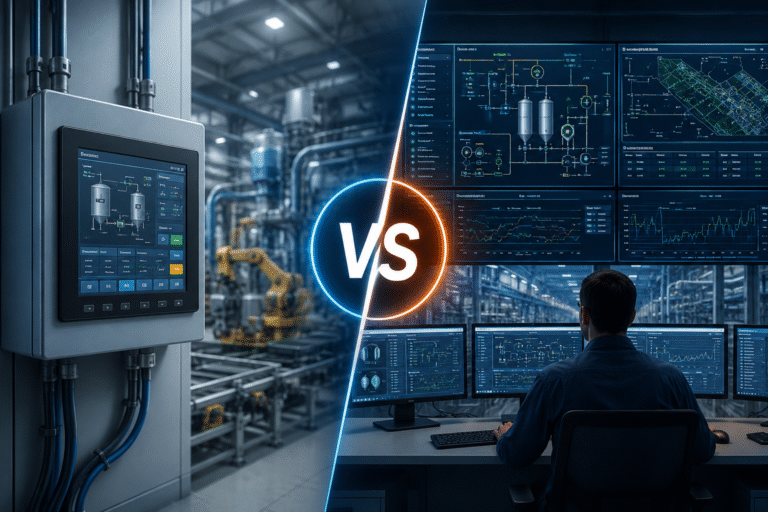
First: Don’t Choose the Software Before Understanding the Application
In real engineering projects, system architecture should never be determined by screen size, software brand, or what looks more advanced.
It should be determined by operational requirements.
If the application involves:
- A single machine
- A dosing skid
- A pump station
- An air compressor
- A packaging line
- A local conveyor section
and operators mainly work beside the equipment, then an HMI is usually enough.
An HMI is directly connected to the PLC through protocols such as:
- Profinet
- Modbus TCP
- Modbus RTU
- EtherNet/IP
Operators can:
- Monitor equipment status
- Modify parameters
- Acknowledge alarms
- Switch between Auto and Manual modes
For these applications, a lightweight and simple architecture is often the best solution.
However, large systems are completely different.
For projects such as:
- Water treatment plants
- Wastewater facilities
- Power stations
- Utility tunnels
- Substations
- District heating systems
- Full production lines
- Multiple remote stations
the focus is no longer local operation.
The focus becomes overall system visibility and centralized management.
Engineers need to know:
- Which station is offline
- Which pump is tripping frequently
- Which valve feedback is abnormal
- Which process values are drifting
Managing this through isolated HMIs quickly becomes difficult.
As the Number of Tags Increases, HMI Starts Reaching Its Limits
Many engineers select systems based only on the number of devices.
In reality, the more important factor is:
The number of I/O points and tags.
With dozens of tags, HMI works very well.
With several hundred tags, it can still work, but alarm handling, trends, and variable organization already require careful planning.
Once the system reaches thousands of tags, relying only on HMIs usually becomes inefficient.
Typical problems begin to appear:
- Variables scattered across different screens
- Inconsistent naming conventions
- Non-centralized alarm records
- Difficult maintenance and modification
Even changing one process parameter may require editing multiple screens separately.
This is where SCADA systems become much more suitable.
A SCADA platform can centrally integrate data from:
- PLCs
- RTUs
- Intelligent instruments
- VFDs
- Protection relays
using protocols such as:
- OPC UA
- Modbus TCP
- IEC 60870-5-104
- DNP3
The data can then be unified into:
- Alarm systems
- Historical trends
- Reports
- User management
- Remote monitoring
At this stage, the issue is no longer “how many functions” the system has.
It becomes a question of maintainability.

Different People Expect Different Things from the System
One reason system selection becomes difficult is that different people care about different things.
Operators Care About Simplicity
Operators mainly focus on usability:
- Are the buttons clear?
- Are alarm messages understandable?
- Is Auto/Manual switching safe?
- Can faults be handled quickly?
For operators, a simple and stable HMI is often more valuable than a complicated feature-rich system.
Engineers Care About Architecture
Control engineers usually focus on deeper technical details:
- PLC address planning
- Tag naming standards
- Sampling intervals
- Network redundancy
- VLAN segmentation
- Server redundancy
- Alarm priority classification
- SOE (Sequence of Events) recording
If these issues are ignored during the design phase, they almost always become maintenance problems later.
Management Cares About Data
Management teams typically focus on:
- Equipment utilization
- Downtime statistics
- Energy consumption
- Alarm response time
- Daily and monthly reports
- Production analysis
At this level, a standalone HMI is no longer enough.
A SCADA platform combined with Historian or database systems becomes essential.

Why SCADA Becomes Important in Large Systems
In small systems, alarms are simple.
An alarm appears, the operator acknowledges it, and operation continues.
Large systems are very different.
Alarm management may require:
- Alarm priority levels
- Acknowledgment records
- Alarm filtering
- High-frequency alarm analysis
- Event traceability
- SOE recording
This is especially critical in:
- Power systems
- Municipal infrastructure
- Water treatment plants
- Process industries
Historical data is equally important.
During commissioning, many teams believe real-time values are enough.
Months later, problems begin to appear:
- Pumps trip repeatedly
- Tank levels fluctuate unexpectedly
- Flow rates gradually decrease
- Valve response times become slower
Without historical trends, troubleshooting becomes guesswork.
With SCADA and Historian systems, engineers can analyze:
- Long-term trends
- Alarm history
- Performance degradation
- Process behavior patterns
This dramatically improves diagnostics and maintenance efficiency.
So, How Should You Choose?
The decision is actually quite straightforward.
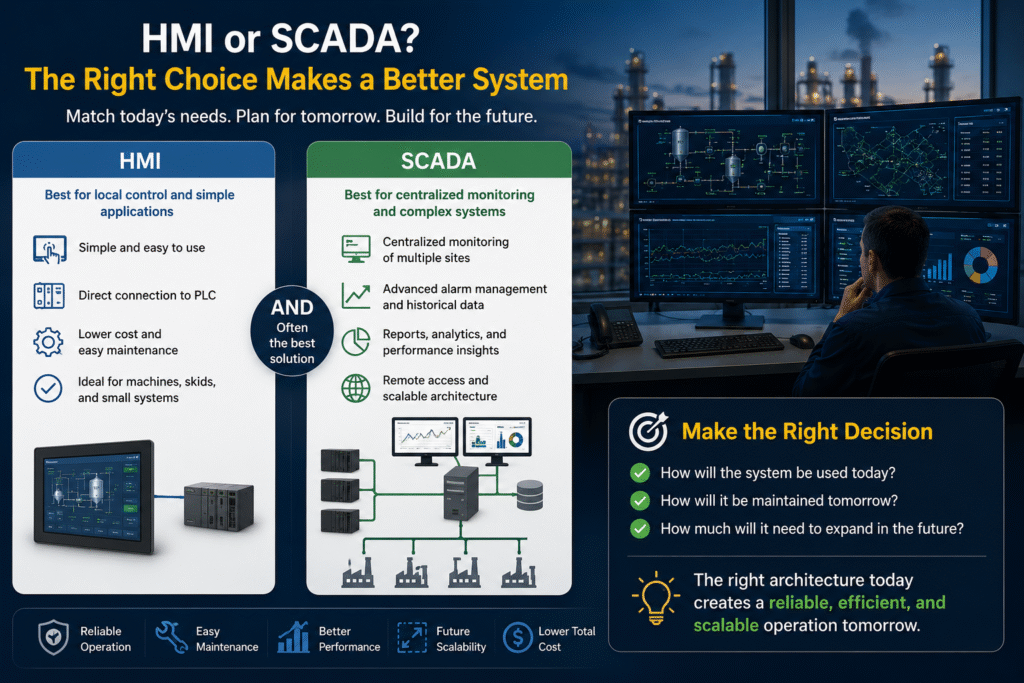
HMI Is Usually Enough When:
- The system is small
- Local operation is the priority
- Tag count is limited
- Historical storage is unnecessary
- Long-term analytics are not required
In these cases, HMI provides:
- Lower cost
- Simpler maintenance
- Faster deployment
- Easier operation
SCADA Is Necessary When:
- Multiple PLCs or stations are involved
- Large numbers of tags exist
- Centralized monitoring is required
- Historical trends are important
- Alarm management becomes critical
- Remote monitoring is needed
- Reporting and analytics are required
At this point, the project should be designed using a proper SCADA architecture from the beginning.
In Reality, Most Industrial Projects Use Both
In many modern automation systems, HMI and SCADA are not competitors.
They work together.
For example:
- The local HMI is used for equipment operation, maintenance, and parameter adjustment
- The SCADA system is used for centralized monitoring, alarms, historical data, reporting, and remote supervision
This hybrid architecture is extremely common in industrial projects.
Final Thoughts
A good automation architecture is not the most complicated one.
It is the one that:
- Matches current operational needs
- Remains easy to maintain
- Leaves reasonable room for future expansion
Choosing HMI or SCADA is ultimately about answering three practical questions:
- How will the system be used today?
- How will it be maintained tomorrow?
- How much will it need to expand in the future?
Once these questions are clear, the right solution usually becomes obvious.