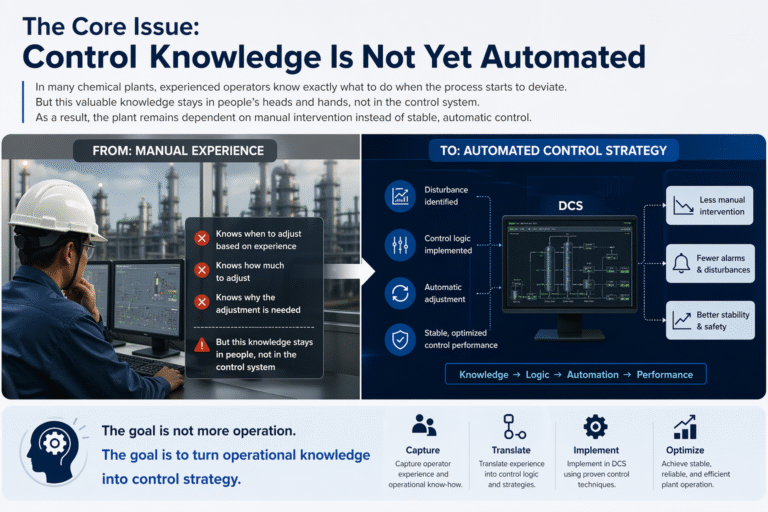
From Manual Operation to True Automation: Why Most Plants Don’t Need APC First / Instrumentation Introduction: A Common but Overlooked ProblemIn many chemical plants, operators are still heavily involved in daily control:Frequent manual valve adjustmentsRepeated interventions to stabilize process variablesPersistent alarms and fluctuationsAt first glance, the solution seems obvious:“We need APC (Advanced Process Control)”But in reality, that is often not the real answer. The Core Issue: Control Knowledge Is Not Yet AutomatedThe fundamental problem in most plants is not the lack of advanced systems.It is this:Operational knowledge has not been translated into control strategy.Experienced operators often know:When to adjustHow much to adjustWhy the adjustment is neededBut this knowledge stays in human actions — not in the DCS. The Reality: 70% of Problems Can Be Solved Within DCSBased on real industrial experience, more than 70% of control issues can be solved using existing DCS functions:Proper PID tuningCascade controlFeedforward compensationBasic logic optimizationNo APC required. A Typical Example (Real Engineering Logic)A temperature control loop required frequent manual intervention — over 10 times per shift.After analysis:Main disturbance: feed flow fluctuationOriginal design: single-loop PIDOptimization:Added feedforward compensationRe-tuned PID parametersResult:Temperature fluctuation reduced by ~60%Manual intervention nearly eliminated👉 No APC. Just proper control engineering. Why APC Projects Often FailMany APC or optimization projects fail not because of algorithms, but because:Basic control loops are not stable.Applying APC on unstable loops is like:Building a tower on sand. Operator Upgrade: From “Controller” to “Control Engineer”Digital transformation should not make operators busier.It should change their role:From:Manual adjustment executorTo:Knowledge contributorOperators should:Record when and why adjustments are madeIdentify recurring disturbancesCollaborate with engineers to convert experience into logic Management Insight: More Operation ≠ More SafetyFrequent operator intervention does NOT mean better control.In fact, it often indicates:Poor disturbance rejectionWeak automation capabilityTrue safety comes from:Stable automatic controlReduced dependency on manual actions A Practical Approach to Control OptimizationInstead of jumping into high-cost solutions:Start from unstable loopsAnalyze disturbance sourcesImprove basic control strategyThen consider advanced control if necessary Conclusion: Start from One LoopYou don’t need a massive digital transformation project.Start small:One unstable loopOne frequent alarmOne manual interventionTurn it into an automatic, stable control loop.That’s how real automation begins. Need Help Evaluating Your System?If your plant is experiencing:Frequent manual operationsUnstable process variablesIneffective control loopsFeel free to share:Fluid / process typeFlow / temperature / pressure rangeExisting control setupWe can help evaluate whether optimization can be achieved directly within your current DCS — before investing in expensive APC systems. Share This Story, Choose Your Platform! Contact Us Please prove you are human by selecting the tree. Request a Quote