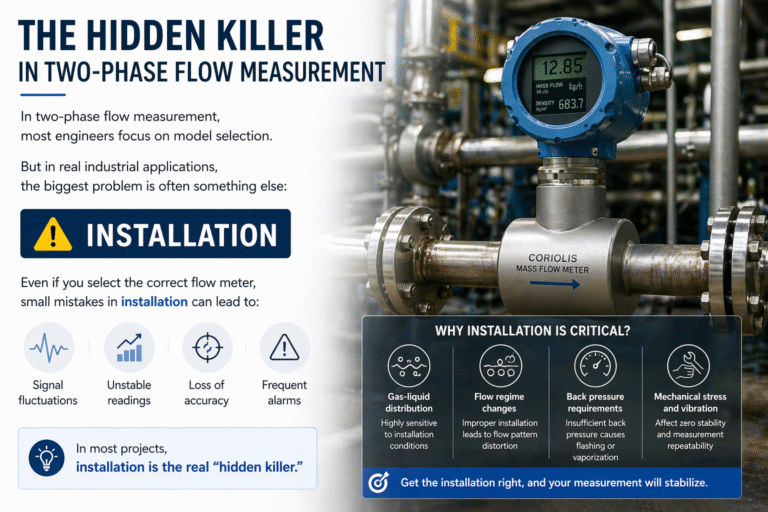
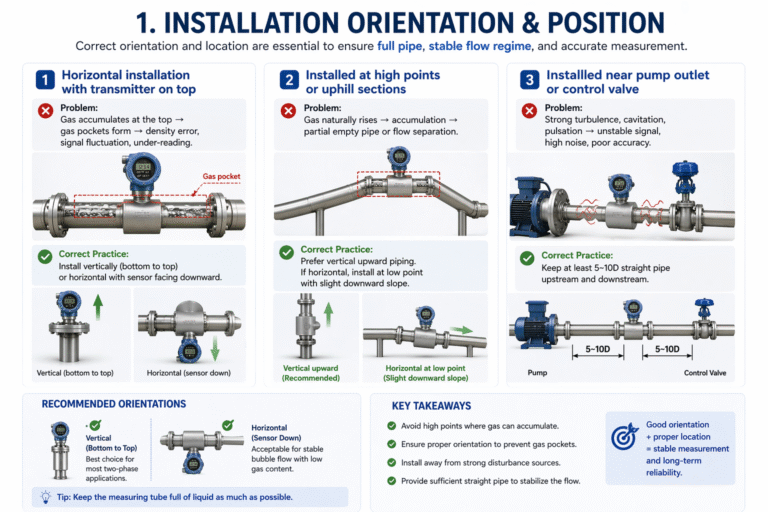
Why Your Two-Phase Flow Meter Is Unstable (90% of Problems Come from These 9 Installation Mistakes) / Flow meter Introduction: The Hidden Killer in Two-Phase Flow MeasurementIn two-phase flow measurement, most engineers focus on model selection.But in real industrial applications, the biggest problem is often something else:Installation.Even if you select the correct flow meter, small mistakes in:Installation positionBack pressurePipe stressFlow regimecan lead to:Signal fluctuationsUnstable readingsLoss of accuracy👉 In fact, in most projects, installation is the real “hidden killer.”This article summarizes 9 common installation mistakes based on real project experience — and how to fix them. 1. Installation Orientation & PositionMistake 1: Horizontal installation with transmitter on topProblem:Gas accumulates at the top → gas pockets form → density error and unstable signalCorrect Practice:Install vertically (bottom to top)Or horizontal with sensor facing downward Mistake 2: Installed at high points or uphill sectionsProblem:Gas naturally rises → accumulation → partial empty pipe or flow separationCorrect Practice:Prefer vertical upward pipingIf horizontal → install at low point with slight downward slope Mistake 3: Installed near pump outlet or control valveProblem:Strong turbulence, cavitation, pulsation → unstable signalCorrect Practice:Keep 5–10D straight pipe upstreamAvoid strong disturbance zones 2. Full Pipe & Back Pressure (Critical for Two-Phase Flow)Mistake 4: No back pressure or insufficient back pressureProblem:Flashing / vaporization occurs → unstable gas-liquid ratio → measurement failureCorrect Practice:Ensure outlet pressure > vapor pressureInstall control valve downstream, not upstreamAlways verify back pressure for volatile fluids Mistake 5: No venting or draining systemProblem:Residual gas remains → zero drift, unstable readingsCorrect Practice:Install vent valve at high pointsInstall drain valve at low pointsFully purge before operation 3. Pipe Stress & Alignment (Often Ignored)Mistake 6: Pipe misalignment / forced installationProblem:Mechanical stress changes sensor behavior → zero drift, poor repeatabilityCorrect Practice:Ensure perfect flange alignmentNo forced pullingAdd independent support for large meters Mistake 7: Installed near vibration sourcesProblem:External vibration interferes with sensor → unstable signal or alarmCorrect Practice:Keep distance ≥ 4× meter lengthUse rigid supports or vibration isolation 4. Upstream Flow Pattern (Directly Affects Accuracy)Mistake 8: Disturbance too close (elbows, reducers, tees)Problem:Uneven phase distribution → flow regime distortion → large errors (10–50%+)Correct Practice:Maintain 5–10D straight pipeUse flow conditioner or mixer if needed Mistake 9: Ignoring gas-liquid ratio & flow regimeProblem:Different flow regimes behave very differently:Bubble flow → relatively stableSlug / annular flow → highly unstableCorrect Practice:If gas content >5% → vertical upward installation is strongly recommendedHorizontal installation only for stable low gas conditions 5. Other Common IssuesNo isolation valves → difficult maintenance and zeroingIncorrect pipe sizing → too low velocity (phase separation) or too high (cavitation)Improper heating/insulation → local vaporization or condensationElectrical interference → unstable signal (poor shielding/grounding) 💡 Practical Advice (From Real Projects)In most industrial applications involving:Flow metersLevel transmittersPressure transmitters👉 The most reliable solution for two-phase flow is often:Coriolis mass flow meter + proper installation designBecause:It directly measures mass flow and densityLess sensitive to flow profile compared to other technologiesHowever:Even the best meter will fail if installed incorrectly. ✅ Quick Checklist: Good vs Bad InstallationA “good” two-phase installation should ensure:Vertical upward installation (preferred)Full pipe conditionSufficient back pressureMinimal disturbanceProper mechanical supportEffective venting 🚀 ConclusionTwo-phase flow measurement is not only about selecting the right meter.👉 It is about creating the right physical environment.Most unstable readings are not caused by the instrument itself,but by incorrect installation.If you fix the installation, the measurement will stabilize. If you are facing unstable flow measurement in your project,feel free to share your application details.👉 We can help you check whether the issue is installation or meter selection,and recommend the most suitable solution. Share This Story, Choose Your Platform! Contact Us Please prove you are human by selecting the truck. Request a Quote