
In industrial process plants, one of the most frequently overlooked yet critical decisions in control valve selection is the fail action setting.
For the same pneumatic control valve, some engineers prefer FC (Fail Close), others insist on FO (Fail Open), while some believe FL (Fail Locked) is the safest option.
When asked why, the most common answer is:
“This is how we always did it in previous projects.”
At first glance, this seems reasonable.
Until one day, the instrument air supply fails.
What appears to be a simple configuration choice can directly determine whether the process is protected or escalated into an incident.
1. What Do FC, FO, and FL Mean?
Pneumatic control valves use compressed air as the driving force for actuator movement.
When air supply is lost, the valve must automatically move to a predefined safe position to prevent process upset, equipment damage, or safety hazards.
This predefined behavior is known as Fail Action.
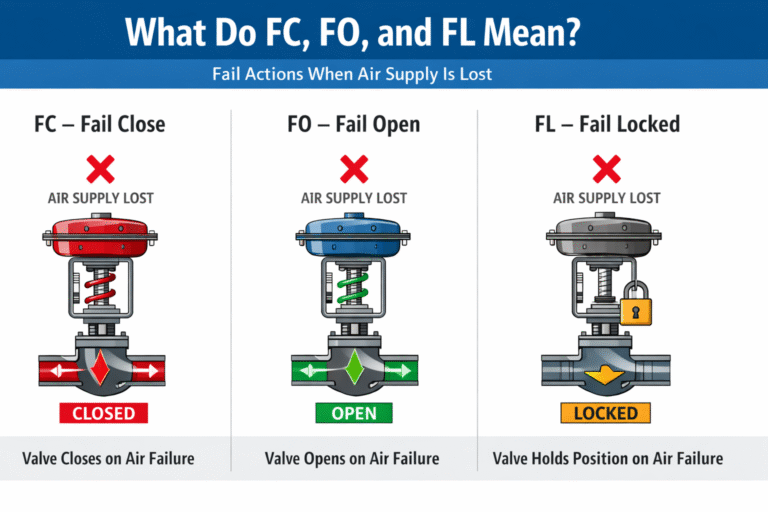
The three most common fail actions are:
- FC (Fail Close) – Valve closes when air supply fails
- FO (Fail Open) – Valve opens when air supply fails
- FL (Fail Locked) – Valve remains at the last position, usually through air lock or mechanical retention
Although the definitions are simple, the real challenge is:
Which fail action is truly safe for the process?
This is not purely a valve issue.
It is fundamentally a risk management decision.
2. FC Is Not Always the Safest Choice
Many engineers instinctively assume:
“If anything fails, the valve should close.”
However, this is not always correct.
FC is generally suitable for applications where immediate isolation is required, such as:
- Natural gas pipelines
- Petroleum transfer lines
- Toxic or corrosive media
- Reverse flow prevention systems
In these cases, shutting off the medium helps minimize leakage and isolate hazards.
However, if the process safety depends on continuous venting, cooling, or circulation, selecting FC may actually increase risk.
3. When FO Should Be Used Instead of FC
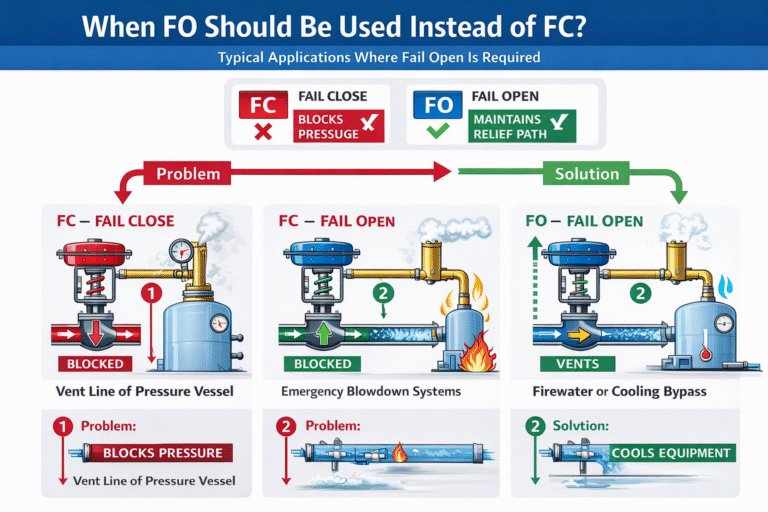
A common engineering mistake is using FC in applications where the system must continue releasing pressure during failure.
FO (Fail Open) is typically selected for:
- Pressure vessel vent lines
- Reactor relief paths
- Emergency blowdown systems
- Firewater supply systems
- Cooling water bypass lines
In these cases, choosing FC may block the relief path, leading to:
- abnormal pressure rise
- equipment overpressure
- possible vessel damage
This is especially critical in systems protected by American Petroleum Institute safety philosophies such as PSV and SIS.
Fail action must always be evaluated as part of the overall protection layer design.
4. FL Seems Stable, but Requires Careful Evaluation
Some engineers believe:
“The safest valve is the one that does not move.”
This leads to the selection of FL (Fail Locked).
FL is often used in:
- fine chemical dosing systems
- pharmaceutical batching processes
- highly sensitive thermal control loops
- continuous process units requiring temporary stability
However, whether the valve can truly hold position depends on actuator design, such as:
- air lock valve
- volume tank
- mechanical holding mechanism
Without proper design support, FL may result in:
- loss of control capability
- inability to respond to process deviations
- prolonged unsafe operating conditions
Therefore, FL should be selected only after detailed process risk assessment.
5. A Practical Way to Decide
When unsure whether to choose FC, FO, or FL, ask one key question:
What is the worst consequence if the air supply fails?
Then work backward.
| Main Risk | Recommended Fail Action |
|---|---|
| Leakage / hazardous release | FC |
| Overpressure / blockage | FO |
| Process disturbance / quality instability | FL |
Fail action is not a default setting.
It is a consequence-based engineering decision.
6. Why Experience Alone Is Not Enough
According to International Electrotechnical Commission standards such as IEC 61508 / IEC 61511, fail-safe positions must be determined through formal risk assessment methods, including:
- HAZOP
- LOPA
- SIL review
- process safety analysis
In actual projects, many hidden risks come from simply copying previous designs without reviewing the real process conditions.
This is one of the most common causes of valve selection errors.

Conclusion
Choosing between FC, FO, and FL is never a matter of habit.
It is a process safety decision.
Each choice leads to different consequences:
- FC helps isolate hazardous media
- FO helps release pressure safely
- FL helps maintain temporary process stability
The key is not which one is “more safe”.
The key is:
Which one best matches the risk control logic of the current process?
Before finalizing your valve specification, ask yourself:
Is this fail action based on risk analysis, or simply inherited from the last project?