
In industrial automation and electrical control systems, the emergency stop button (E-stop) is one of the most critical safety components. Its main purpose is to immediately stop machinery or disconnect power during dangerous situations.
A common question from engineers and maintenance personnel is:
Why are emergency stop buttons always designed with normally closed (NC) contacts instead of normally open (NO) contacts?
The answer lies in one essential safety principle:
Fail-safe design.
This article explains the logic, working principle, and practical engineering reasons behind the use of NC contacts in emergency stop circuits.
1. Understanding NC and NO Contacts
In industrial electrical systems, push buttons and switches usually have two types of contacts:
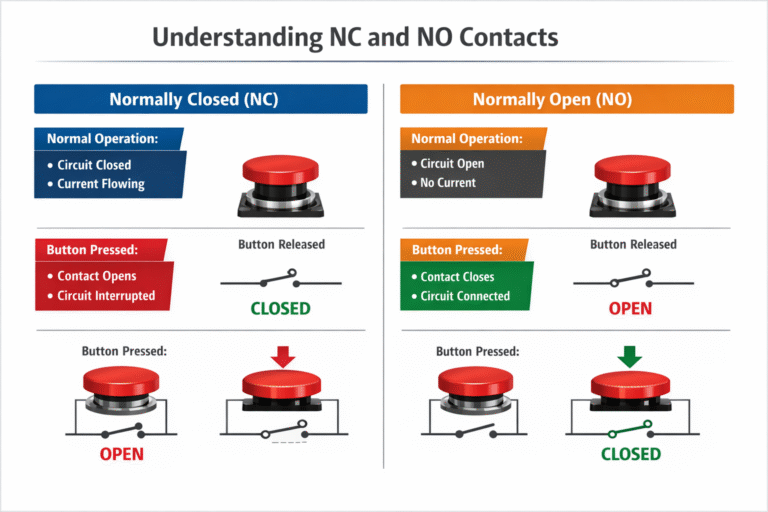
Normally Closed (NC)
The circuit remains closed during normal operation, allowing current to flow.
When the button is pressed, the contact opens and interrupts the circuit.
Normally Open (NO)
The circuit remains open during normal operation.
When the button is pressed, the contact closes.
For emergency stop applications, NC contacts are the industry standard.
2. The Core Reason: Fail-Safe Safety Logic
The main reason emergency stop buttons use NC contacts is to ensure fail-safe protection.
Immediate Shutdown When Pressed
Under normal conditions, the NC contact keeps the control circuit energized.
Once the E-stop button is pressed, the contact opens immediately, cutting off the control signal or power supply to the equipment.
This ensures instant machine shutdown.
3. Protection Against Wiring Failures
This is the most important engineering advantage.
In industrial environments, wiring faults may occur due to:
- cable vibration
- loose terminals
- broken wires
- connector damage
- corrosion
With an NC safety circuit, any wire break or loose connection automatically opens the circuit.
This means:
fault = machine stop
This is exactly what a safe system should do.
Even if the emergency stop button itself is not pressed, the machine will still stop when the wiring fails.
This is why engineers call it a fail-safe circuit.
4. What If NO Contacts Were Used?
If a normally open contact were used instead, a broken wire would still keep the circuit open in its normal state.
The control system may not detect the fault.
As a result, the machine might continue operating without proper emergency protection.
This creates a serious safety risk.
That is why NO contacts are generally used only for signal indication, alarm feedback, or PLC status monitoring—not as the main emergency stop control contact.
5. Typical Emergency Stop Working Principle
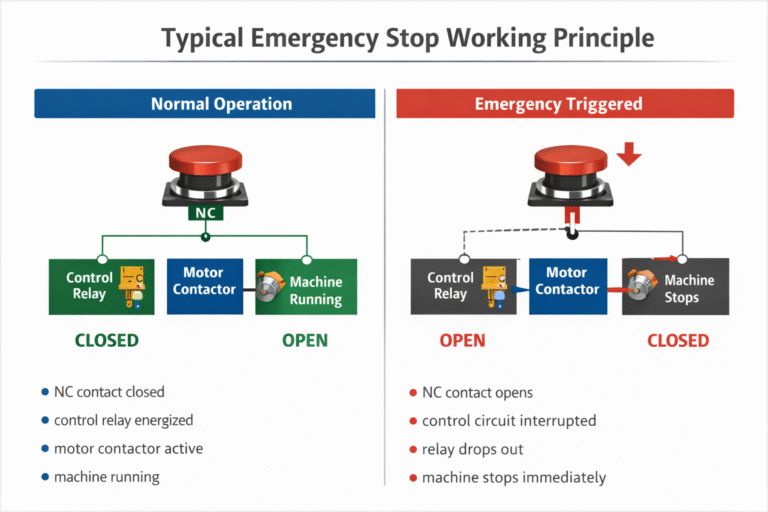
Normal Operation
- NC contact closed
- control relay energized
- motor contactor active
- machine running
Emergency Triggered
- button pressed
- NC contact opens
- control circuit interrupted
- relay drops out
- machine stops immediately
This response is extremely fast and reliable.
6. Mechanical Self-Locking Design
Most emergency stop buttons use a mechanical latching structure.
After being pressed, the button remains locked in the stop position.
The operator must manually reset it by:
- twisting
- pulling
- key release
This prevents accidental restart after an emergency shutdown.
This design is widely required by industrial safety standards.
7. International Safety Standards
Emergency stop circuits using NC contacts comply with major international standards, including:
- International Organization for Standardization ISO 13850
- International Electrotechnical Commission IEC 60204-1
- EN 418
These standards require emergency stop systems to follow the fail-safe principle.
This is why NC contacts are the global standard solution.
8. Multiple Emergency Stops in Series
In industrial plants, multiple E-stop buttons are often installed at different locations.
These buttons are typically wired in series.
This ensures that pressing any single emergency stop button will stop the entire system.
Typical applications include:
- conveyor systems
- pump stations
- packaging lines
- filling systems
- process plants
9. Regular Maintenance and Testing
Regular inspection is essential.
Recommended checks include:
- NC contact continuity test
- wire connection inspection
- mechanical reset function
- relay response test
Routine testing ensures long-term safety reliability.

10. Conclusion
Emergency stop buttons use normally closed (NC) contacts because NC circuits provide the highest level of operational safety.
Their key advantage is:
any fault automatically forces the system into a safe stop condition
This fail-safe logic is the foundation of industrial electrical safety design.